It seems like most school districts follow the same plan for high school science: Biology, then Chemistry, and then Physics. The sciences move from the least to most math-intensive as students progress through the parallel path of Algebra-Geometry-Algebra-Pre-Calc-Calculus. I had Biology in ninth grade, so that is what we’ll do, too!
Sunshinegirl has ALWAYS been fascinated by animals, so she has the zoology portion of biology down. I can ask her anything about any animal on earth, and either she knows for sure or has a good idea. As we’ve touched on other realms of “Biology” over time — evolution (yes, we believe in it), cellular processes, and DNA — she has been intrigued. (She watches PBS Nature episodes on demand FOR FUN!) Knowing her nature, I suspect (and am hoping) that this year of Science is a success.
A textbook!?
I know of all science years I wanted this on to be not only “solid” but full of true laboratory experiences (minus the dissection — she is VERY against that). I looked into a few options, but I kept coming back to the “textbook” model. If you’ve read any of my other posts, you know that we have been textbook-adverse for years, leaning heavily instead on “living books”. Can’t you do both?
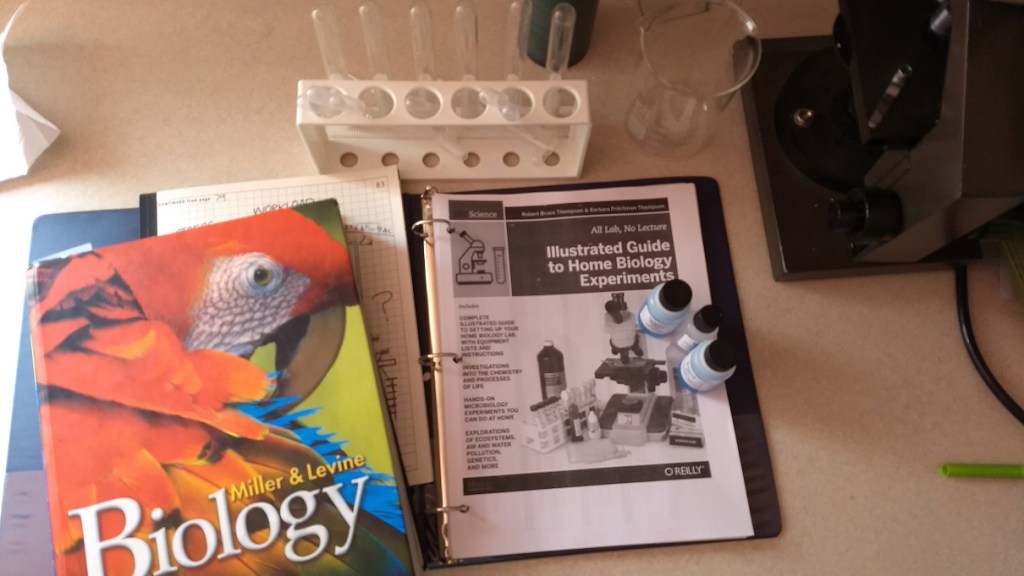
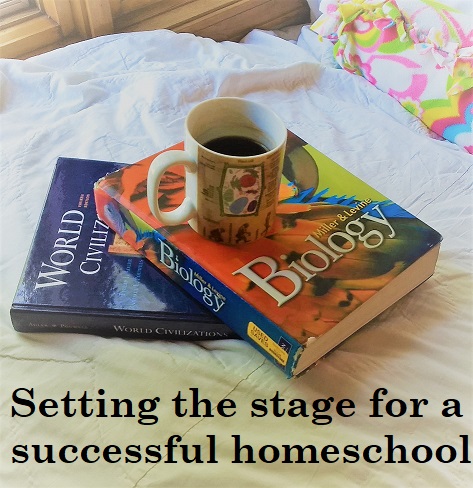
I narrowed it down to using the online Biology textbook from CK-12 or Miller-Levine Biology. Both seemed to be highly recommended and a complete Biology course. Both were supported with a schedule for the labs that I was planning on using (see below for details on that). Two things eventually made us sway towards using CK-12: 1) the multi-media aspects of CK-12 (in-text links to supporting videos and activities) and 2) that it was the recommended book to use with the Build Your Library plan I had already purchased. I did go ahead and buy a used copy of Miller-Levine Biology (for under $10 on Amazon for a slightly older edition) to have as a resource (or to use when the Internet is down!).
Updateafter week 1: After a week of using CK-12, we realized that Sunshinegirl reading from a screen wasn’t working out. We switched to Miller-Levine Biology, and we are working through it together (it has more detail/information, so we decided to work through the text together).
Labs
Up to this point our “labs” have been somewhat underwhelming and relying on items that are readily available at the grocery store. I didn’t want that for this “big” science year; I wanted this to be more in line with good public school Biology. I wanted real experiments with real chemicals and supplies. Luckily there are many resources for that!
I found the Illustrated Guide to Home Biology online for free — you can download the PDF (or order it from Amazon for a cost). What is brillant is that you can order pre-made “kits” that support the experiments and labs found in the manual — saves me having to hunt down chemicals and supplies. The Home Scientist offers various varieties of the kits from basic to super-extra. I luckily have a lot of the labware (test tubes, slides, etc.) already (one of my most amazing garage sale finds EVER), so I ended up purchasing the “refill” kit. I am hoping that kit gets us by most of the experiments.
Another EXTREMELY helpful touch from the Home Scientist is correlation guides for the major homeschool biology curriculum. Each guide specifies which experiment(s) to do with each correlating chapter in the text. (Note: While the Home Scientist also recommends CK-12 or Miller-Levine, it also has guides for BJU and Apologia.
Living Books
I gave in and decided to use a textbook this year, but we intend to use it more as our “spine”. It will be our jumping-off point for the different topics to ensure that we cover all of the Michigan “standards” for Biology. But along with the labs/experiments, the “Living Books” will be where the real learning happens.
There are so many great books out there that cover biological topics written by experts in their fields that are truly accessible reading for a high schooler. Books that have real stories and experiences of the author that make science more than just facts on paper.
Some of the books are from the Build Your Library Level 10 booklist (with the associated reading schedule in the guide we purchased), and others are pulled from other Charlotte Mason or Classical booklist. What do we hope to read this year?
And more (some from BYL and others related to the above)
THIS will be the most exciting portion of Biology class this year!
Expectations
I have high expectations for Biology, so I’m hoping that I don’t get those hopes up. I think Sunshinegirl could really get into Biology (minus the dissection, of course — the animal lover she is!), so I want to make this a true learning experience.
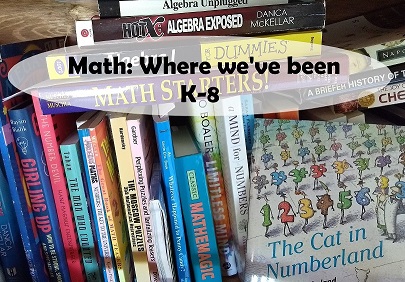
If you’ve read my post on Where We’ve Been with Math, you know that it took a long time to figure out what works best for my creative-soul daughter. I’m going to discuss our eighth grade year here first, since many students don’t attack Algebra 1 until high school. It also sets the stage for what we plan for Geometry.
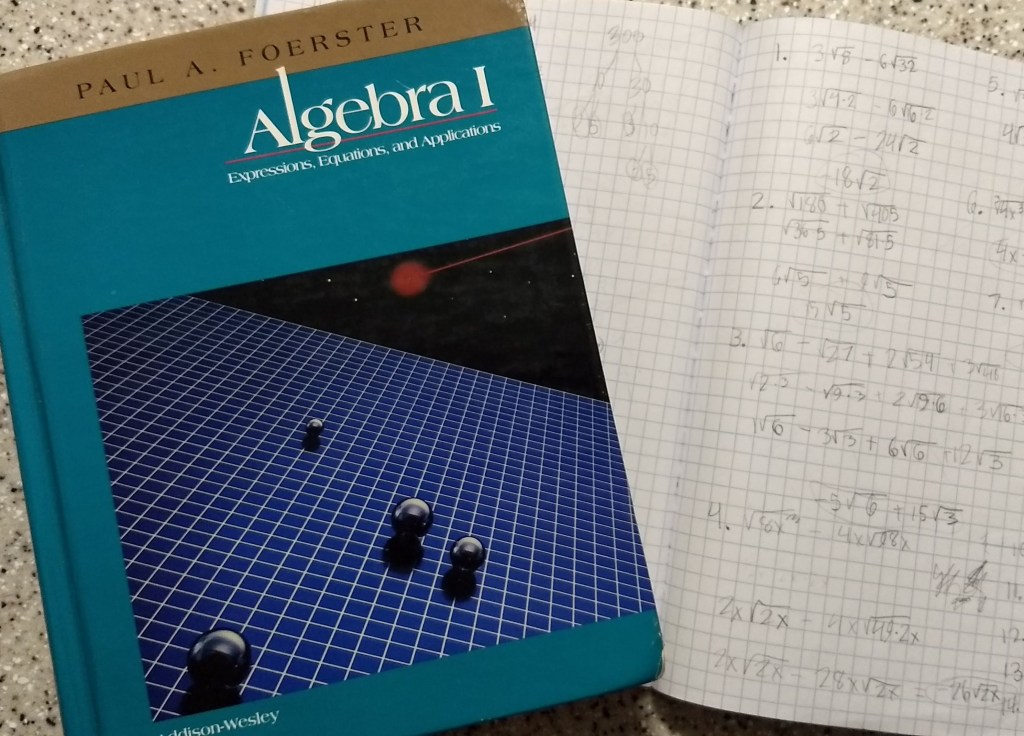
I spent time reading reviews of each on various forums and websites, and both texts sounded impressive. Foerster’s Algebra sounded a little more complete (covered more topics), and it promised more real-world problems to solve (partially due to learning the Quadratic function halfway through the book instead of the traditional end-of-the-year). I didn’t research any other books — I decided to go with Foerster’s.
About halfway through the year all was going wonderfully, and then we started to hit a wall. All of the sudden the topics seemed more difficult for Sunshinegirl to grasp, no matter how I tried to explain or teach it. By February or early March it was getting to be a struggle, but we continued on. It wasn’t until the first of April when my college-aged son looked at what we were doing and said “hey, we just covered that last week in my Linear Algebra class — none of us ever remembered learning that in high school”. Hmm. That prompted me to look in other texts for the same concept to see if I could find other ways of approaching it, and I happened to pull out an Algebra 2 textbook (did I mention I LOVE PILES OF BOOKS). I found that concept … over halfway through Algebra 2! So I realized then that the text we were using WAS very rigorous and a challenge, which really wasn’t ideal for us. Many homeschoolers are very far ahead and need challenges, and for those students the book would be ideal. Not for us.
We spent the last few months shifted over, filling in the gaps, using the CK-12 Algebra 1 online textbook (free). Each lesson had good explanations AND videos to go with them! The problem sets at the end were manageable, and the answer key for all problems was easily accessible. A huge weight was lifted.
Before we switched, I sat Sunshinegirl down and explained the situation. I told her that she was doing what was typically Algebra 2 work, so she should not feel inadequate for not “getting it”. She was REALLY down on herself, so this talk was necessary. I gave her the option to switch or continue on, and together we made the decision to switch. Lesson learned: Be frank with your student and work through issues together.
Geometry – Learn from mistakes
Towards the end of the Algebra 1 debacle, I started looking into what would work for Geometry, knowing better what works and what doesn’t. I started down the path looking at Harold Jacob’s Geometry (his Algebra 1 was the option I did not choose, though it might have been the better choice in retrospect!). I read the reviews and previewed the samples, and I thought I had found the book for us. It had great cartoons at the beginning of each chapter, so it sounded so much better.
About the same time I found Michael Serra’s Patty Paper Geometry that would supplement the text. I already know that Sunshinegirl likes hands-on geometry — drawing constructions with straight-edge and compass was something she enjoyed in her local school district’s homeschool math enrichment class. I ordered the book and a box of patty paper (those square waxed paper like sheets that separate meat patties).
But wait, there is more. After purchasing that book, I started seeing reviews for Michael Serra’s full Geometry text. How did I miss that!? And it is a Cathy Duffy Top pick!? The text is Discovering Geometry, and when reading through the reviews I thought “THIS is how my daughter needs to learn!”. Not only are there a lot of hands-on activities, but there is an entire Chapter 0 (before Chapter 1) on Art and Geometry. PERFECT for the girl that can’t do arts and crafts enough!
I ordered the text (you can purchase most texts used on Amazon for less than $10) as well as the solutions manual, and I can’t wait for Geometry to begin this year! This will be the year that math shines. This will be a year without math tears or having to have math “right after lunch because that is when I’m in the best mood for the worst subject” (says Sunshinegirl)!
I love science (now). In high school and college, not so much. I did just fine in my high school and college science classes, but I was that kid that could learn anything and took tests well. I just wasn’t “into science”.
My public-schooled son, Rockman, is a science-nerd; he’s majoring and minoring in various science and math fields right now. He was the one that helped bring science to our household, and it spilled over into my daughter’s homeschool education. Science, like math, isn’t a subject to be memorized and regurgitated, but a subject to explore and play with. Science has a history, which is fascinating in itself.
Does Sunshinegirl like science? She will profess that it “isn’t her thing”, but what she means by that is “I love to explore and experiment with science, but I hate memorizing terms”. I need to keep that love for exploration alive in high school, but first I want to tell you where we have been.
As mentioned in other posts, we followed AmblesideOnline for K-8th grade, and science is somewhat built into those years’ curricula. Many living books are on the schedule to address the various science disciplines. For example:
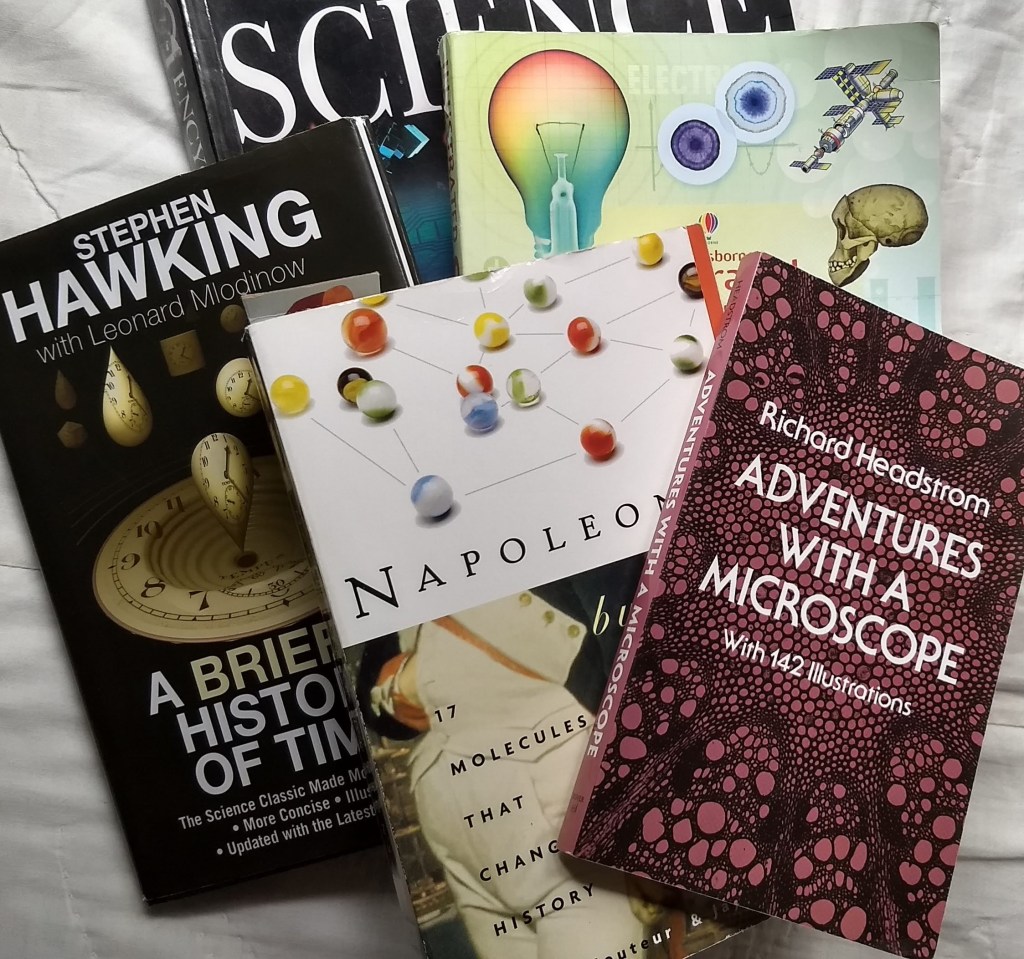
The Handbook of Nature Studyby Anna Botsford Comstock The Mystery of the Periodic Table by Benjamin Wiker and Jeanne Bendick The Sea Around Us by Rachel Carson It Couldn’t Just Happen by Lawrence Richards The Elements: A Visual Exploration of Every Known Atom in the Universeby Theodore Gray – selected elements Albert Einstein and the Theory of Relativityby Robert Cwiklik Ordinary Genius by Stephanie McPherson Archimedes and the Door of Scienceby Jeanne Bendick Galileo and the Magic Numbers by Sidney Rosen Eric Sloane’s Weather Book by Eric Sloane The Life of the Spider by Jean Henri Fabre The Wonder Book of Chemistry by Jean Henri Fabre First Studies of Plant Lifeby George Francis Atkinson Adventures with a Microscope by Richard Headstrom Signs and Seasons: Understanding the Elements of Classical Astronomy by Jay Ryan Great Astronomers by R.S. Ball Napoleon’s Buttons: 17 Molecules That Changed History by Penny Le Couteur and Jay Burreson The Chemical History of a Candle by Michael Faraday Johannes Kepler: Giant of Faith and Science by John Hudson Tiner Phineas Gage: A Gruesome but True Story About Brain Science by John Fleischman A Briefer History of Timeby Stephen Hawking William Harvey and the Discovery of the Circulation of the Blood by Thomas Henry Huxley
The above is the list of books for Years 6-8 as defined in the AO curriculum, and the boldfaced ones are the books we used at least partially. These are great examples of living books on science topics (Napoleon’s Buttons, Phineas Gage, The Elements and Life of a Spider being our favorites!).
Since we have a very “sciency” household, I wanted something more structured for science in addition to these resources, so we used various “curricula” over the years in addition to the AO suggestions.
Note: we did drop some of the AO options — some because we were covering the topics with other resources, and others because they were more Christian in worldview.
Sixth grade – Bite-sized Physics
In sixth grade we started out with Life of Fred pre-algebra with Physics, but we quickly found that as much as I wanted to like LOF, it wasn’t for us. I did some research, and I ended up finding Bite-Size Physics by Science Jim. They were a series of short books on various Physics topics, and at the time they seemed to be about what we needed. While I the link above is to a site that sells the books, previously I had bought them (I thought) from Science Jim’s site, but he no longer makes any reference to them.
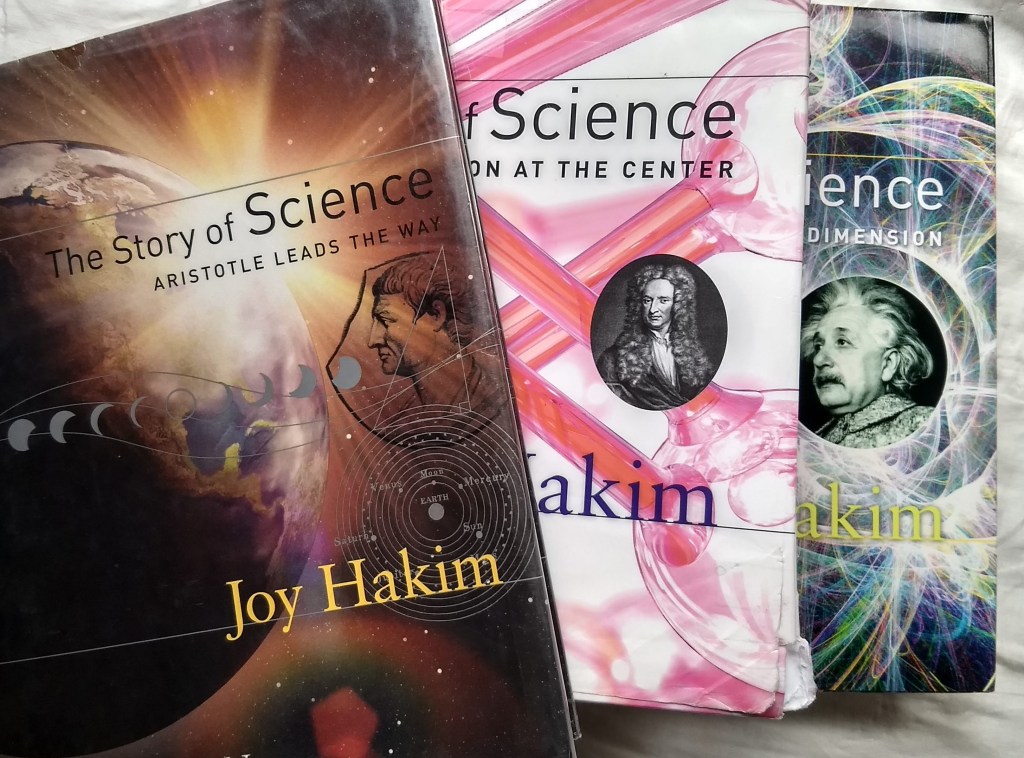
In addition to the AO readings and Bite-sized Physics, I had Joy Hakim’s three book series on the Story of Science, so we started this year with The Story of Science: Aristotle Leads the Way. This book series was designed in a “textbook” format but covers the history of science over thousands of years. Knowing the history behind the science and the scientists themselves brings to life the concepts of science. We greatly enjoyed reading through these books. (Note: We did purchase the “guide” that went with this book but ended up not using it. Sunshinegirl would write a written narration of the chapter after we read it, but more often we spent time discussing what we read — which is far more important than “worksheets”.)
Seventh grade – AO + BHP + 25 Rocks + CK-12
Seventh grade was a little more eclectic, with the main resource being the Big History Project. This was more of the history of the world from a scientific standpoint. I had found this resource the previous summer and loved it — the best part is that it was FREE. It is all online, is multimedia, and it encourages students to take in the information, process it, and question. BHP can be used in middle or high school as a full curriculum (there are forums dedicated to using it in the classroom) or accessed by adults interested in the topics. You can follow it from start to finish or you can pick and choose the sections you want to cover; there is a Science scope and sequence that we followed since our focus was more on the science. Sunshinegirl loved doing this, and I regret that we didn’t finish it all (though it is the pre-historic history that really interests her, and we did get through all of that).
In addition, we wanted this year to be about Earth history AND Earth science somewhat, so we supplemented with the book 25 Rocks by David Prothero. Rocks are a big deal in our household (Rockman is majoring in geophysics), so this was the perfect book. Written at the adult level, some went over Sunshinegirl’s head, but she was engaged and a few years later still recalls bits of it when we see something related on PBS or elsewhere.
To round out the “Earth Science” year, we spent the last six weeks working through the CK-12 Earth Science for Middle School text online (again FREE). This was to cover the basic topics and vocabulary.
I should also note that we continued with the Joy Hakim Story of Science series this year on the side. This year, we did not read this book together — this book was something Sunshinegirl read on her own and wrote a narration on, but it was important to me to keep working through the series. She read The Story of Science: Newton at the Center — each chapter is a quick read and includes numerous photos, diagrams, and sidebar histories. Highly recommended for fifth thru seventh-ish grade classes.
Eighth grade – Chemistry
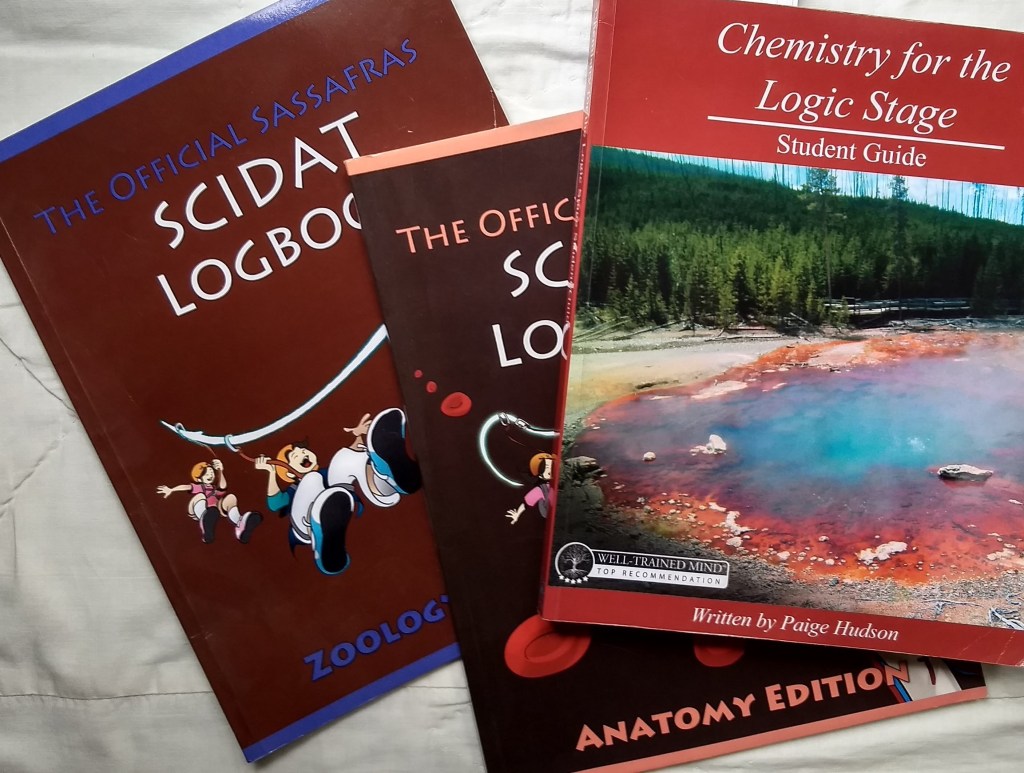
After spending two years piecing together science, I wanted to go back to using a full “curriculum” that included lab work. In the elementary years we used resources from Elemental Science (as well as the Charlotte Mason-friendly Sassafras series), so I thought we’d go back to this. We chose to use Chemistry for the Logic stage, a Classical science curriculum for the middle school years. We purchased the Student workbook and the teacher guide, as well as two of the recommended reference books.
The experiments and activities each week were easy to follow, using mostly household or easy to purchase supplies, and guided the student through writing the lab report. Each week there was a recommended reading or two from the reference books (which required written narration), periodic table memorization, a diagram to work through, and the experiment. It was easy to use and did not require much “mom-time”, and I think all in all Sunshinegirl was fine with it.
The structure of the course and the labs were good, but we sometimes struggled with the readings. One of the resource books is reviewed online as “useful for AP Chemistry” preparation, so some of the concepts were a bit over her head, so we just acknowledged that and moved on.
To round out the year to ensure basic concepts were understood at an eight grade level, we switched to CK-12 Physical Science for middle school (the Chemistry chapters). She read through the chapters and wrote narrations in her science notebook, and she seemed to find this easy to understand. This was a preview for high school since we were looking to use CK-12 for Biology, and I am glad we tried it. It seemed thorough, and it was easy for me to create a “class” and daily “assignments”. She would just need to log in, go to her assignments for that day, and do the readings. (We also used CK-12 for Algebra 1 for the last two months of the year.)
Eclectic
So as you can tell, we didn’t stay consistent with Science, but used what made sense at the time and what was best for the time. We adapted to her learning, and I think it went well. Do I like switching mid-year? Not really. But if it makes sense and increases understanding, I will do anything. And that is what homeschool should be able — meandering and finding what “works” for each student. In all, she had a well rounded science experience — the highlights being the Big History Project, Napoleon’s Buttons, Chemical History of a Candle, and 25 Rocks.
Yes, I wrote that on purpose. I read early on that language learning happens best at a young age when native language acquisition is still taking place. So why not start a language in Kindergarten? Sounds great!
I studied French for four years in high school and two more semesters in college before giving up — my language “acquisition” did not begin until my high school years, and I felt I just wasn’t getting it. My original intent was to double major in math AND French, with the idea that I would teach high school, so dropping French wasn’t taken lightly. Thanks to a wonderful teacher in high school (thank you, Madame Butler!), I did have a better than average grasp on the language even after all of these years, so I figured French would be our first choice.
Well….Sunshinegirl had a friend whose mother (a good friend of mine) is German and spoke only German to him (while his father spoke only English). Sunshinegirl wanted to be like him, so she asked if we could learn German! She very thoughtfully asked — it wasn’t just a kindergartener’s whim. Knowing that my family has a lot of German in it (which was part of her reason, as well), I agreed, though I knew ZERO German. We could learn together — I already knew one language, how hard could it be?
Charlotte Mason advocates multiple modern languages (plus Latin) to be learned at a young age, so I thought — why not try both! I gathered some basic materials for both German and French, and we started out the year. Quickly we realized that was too much, and after much discussion (which did include Sunshinegirl — I try to include her in education decisions, even at a young age), we decided to go with German. We spent the elementary years trying to learn German — it is MUCH harder to learn than French, for what it’s worth!
In fifth grade I cried “uncle”. Even though I spent MUCH more time trying to learn the language (much of it using audio lessons — Audio Tutor, which was renamed Audiotrainer/Deutschtrainer, now 50 languages — was a HUGE help, Sunshinegirl was grasping the language faster than I could keep up. We used Rosetta Stone for a year, and we read a lot of stories and watched a lot of movies in German.
I convinced her to switch to French in sixth grade, explaining that I couldn’t adequately teach her German anymore, but I could teach French. I told her that if she tried French for middle school, she could decide what she wanted for high school (since I could find high school level German programs if needed).
What did we use?
French texts used for middle school
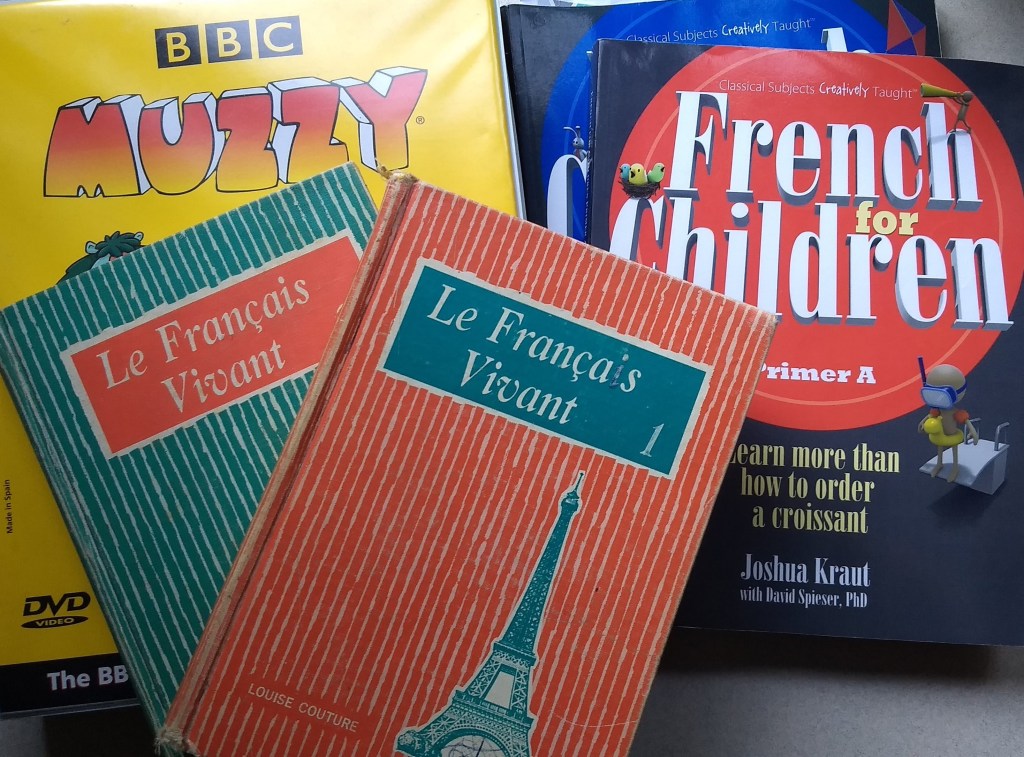
In sixth grade we used Classical Academic Press’s French for Children series (Primer A and B) (having used the Latin for Children for two years and was happy with it). It was a gentle introduction created for grades 4-7. She learned basic French from it, but after Primer A and B (which is a full year course together), there was not a “next-step”.
In seventh grade we jumped in with a French 1 textbook (ask any Charlotte Mason advocate — textbooks are evil! They are far from “living books”.) I know, crazy, but I wanted some structure to our days. We’d still watch movies and listen to audio lessons (we used 50 Languages French as well, though she finds them boring), but a textbook would provide the grammar structure. After looking through multiple textbook “scope and sequence” and the few comparisons and reviews that I could find online, I chose the Bien Dit series. French teachers seemed to comment that it had more content “sooner” than the other alternatives (Bon Voyage and Allez viens). The great thing is that you can get used, older editions for less than $10 on Amazon, so this was an inexpensive way to try it out. It did provide structure, but I felt we weren’t speaking “enough”. Part of that is on me — I needed to go deeper than the textbook — but hindsight is 20-20.
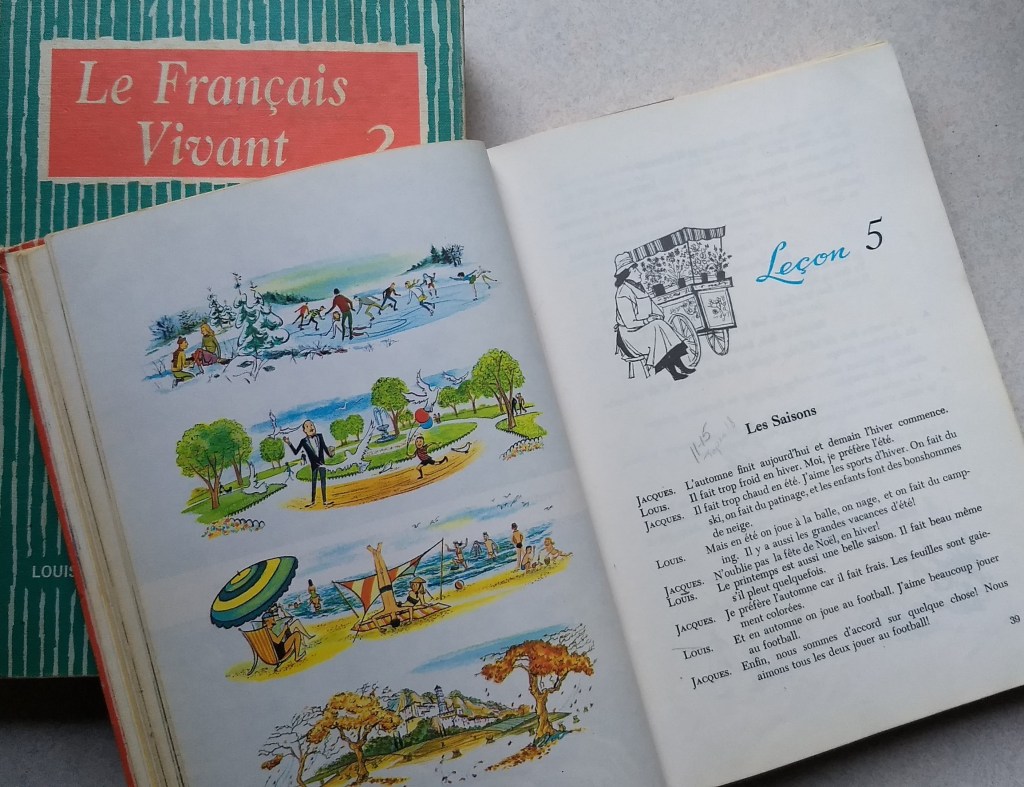
In eighth grade I knew we needed to spend more time on natural “speaking”, and I didn’t want to jump into a French 2 textbook (I wanted to call eighth grade year “French 1”), so I spent time trying to find the perfect curriculum that would guide us. I stumbled on two books at a thrift store — Le Français Vivant 1 and Le Français Vivant 2 by Louise Couture, both textbooks from 1965 (complete with wonderful 1960’s style illustrations and charm), so we decided to try book one for French 1. The focus on the text was to read, hear, and repeat out loud lessons in order to practice speaking. It wasn’t flashy, but it had simple stories with lots of repetitive lessons that really gave real-life practice. Sunshinegirl didn’t like the fact that it was so repetitive, but the goal was to speak common sentences and constructs over and over to make them come naturally in natural language, and I think this is what we needed. I realized towards the end of the year when it dove into the Conditional and Subjunctive tenses, though, that this was probably a college-level text. She took it in stride and practiced those tenses, even knowing that a normal French 1 course barely gets through le présent, le passé composé and possibly le futur tenses.
Le Francais Vivant 1 & 2 by Louise Couture
You can’t learn a language through a book, and you can’t even learn one from listening to audio. The only way to truly learn is to experience the language the way natives do. I find that I, personally, seem to “learn” the most when I read a French novel (nothing too difficult — I’m barely Intermediate Mid in level) or speak the language. We often would go shopping or for coffee on Friday afternoons and declare it German or French speaking time. She loved the fact that we could speak to each other in a public place and confuse others. Hey, whatever motivates you, I suppose.
So I am one of those weird people that actually loved math in school. I graduated with a BS in Math from the University of Michigan, which sounds like torture itself. Why did I choose math? Because it “makes sense” and is just a series of puzzles that are longing to be solved. I’m not talking arithmetic or plugging in numbers to the quadratic equation, but proofs and long problems that require creative thought. THAT is mathematics.
Full disclosure: I couldn’t do “calculus” today to save my life, even with a degree in Math. I ended up in Information Technology, but what my degree did for me is teach me how to think logically. Math isn’t always about what you remember, but the process to get to the end result.
So when I decided to homeschool I realized that “math should be the easiest subject for me to teach”. HA! Was I wrong for so many reasons:
Reason 1: Math is exploration
I was taught traditional math through high school, and since I’m a “good test taker”, I would be taught a concept, would quickly understand the steps I needed to use, and could easily reproduce those steps in homework and on tests. But math is SO much more! In teaching (i.e., “re-learning”) elementary and middle school math, I realized there are so many ways to look at the same problem. There are different ways to solve, model, and play with simple problems, and I am pretty sure I never was encouraged to look at those alternate “visions”.
“Here is the step by step process, now do it that way every time”.
Most math teachers in the world
Reason 2: Textbooks are dry and don’t tell the entire story
For my daughter, who is very hands on and visual, learning a cookbook method for solving problems doesn’t work. The method that works for her is more often not the method that works for me. (I’m very left brained, and she is very right brained.) Early on we found out about the concept of “living math”, which encourages exploration with manipulatives and reading “real” math stories and texts. (A great resource for this has been the Living Math website and forums.).
While working through problem sets has always been a struggle (boring!), reading a good math reader book or story has been a very memorable part of our math lessons. In elementary school we read through many of the Sir Cumference picture books, but one of our favorites was The Cat in Numberland That book is more of a short chapter book that delves into the concept of infinity, which normally isn’t a topic explored until high school. Even in early elementary school, though, it intrigued Sunshinegirl, and we read it often. A perfect example how mathematics isn’t just formulas but can be creative thought experiments.
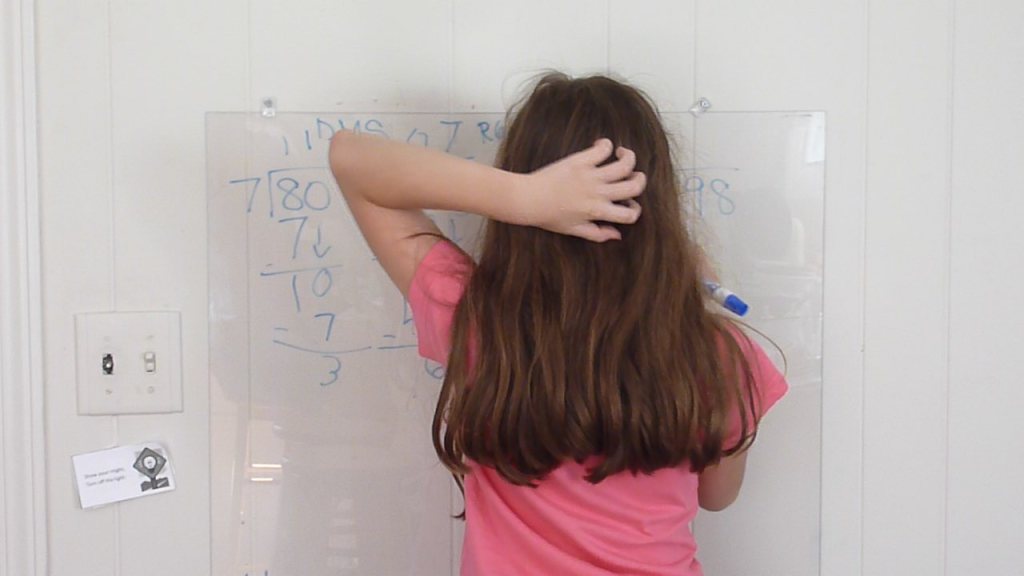
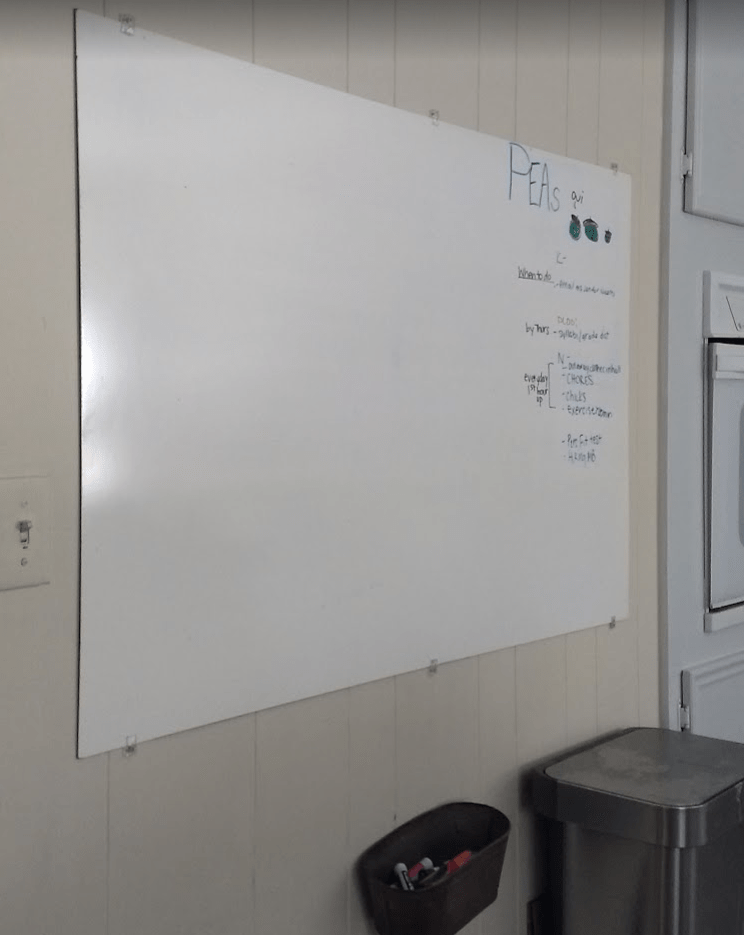
Did I mention white boards are amazing for working math problems? Clear Plexiglas blends into the kitchen!
Reason 3: My daughter isn’t me
This is the biggest reason, and it has been the underlying source of tears and struggles throughout her math career. She KNOWS I have a degree in math, so early on she wasn’t sure if she could “live up” to my level of math knowledge. This stressed her out, long before I realized it. Yes, I’m a bad homeschool mom for not realizing this early on.
As I mentioned before, I am a very logical thinker, and I can see how things “work” fairly quickly in mathematics, so I’ve never struggled in math (well, other than Math 512 Abstract Algebra!). My daughter is a creative, free soul, which I absolutely love about her, but this makes logical, organized thinking much harder. If I knew then what I know now, we would have done elementary math SO much different: MUCH more hands on, more exploration.
Curriculum and resources used
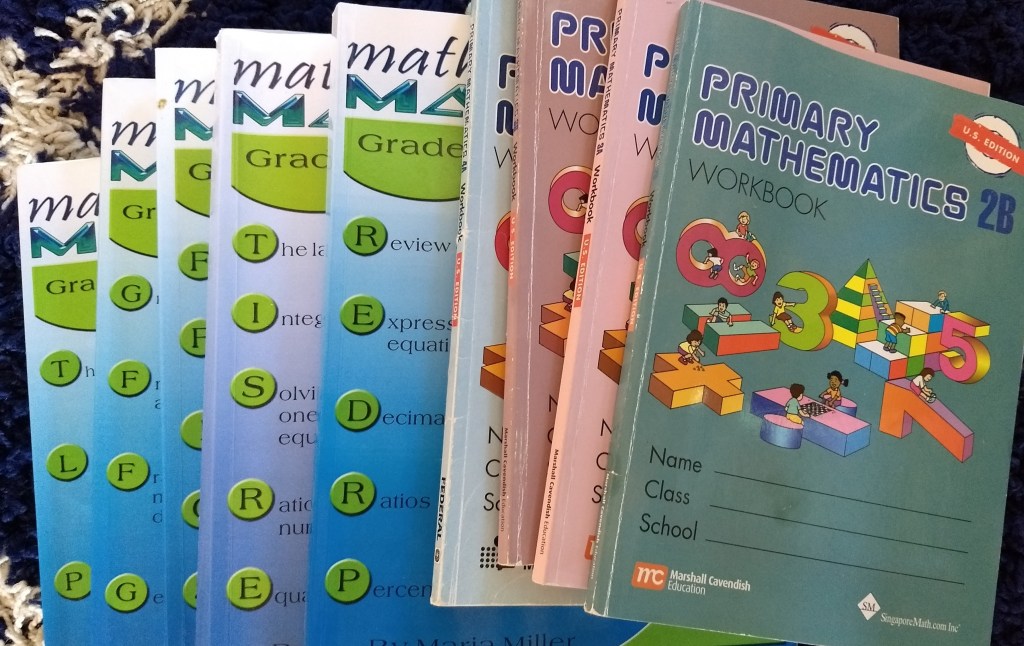
Singapore Math and Math Mammoth books
It probably helps to explain what we used over the years — and I suppose this doesn’t help anyone approaching the high school years, but it might show the progression we’ve taken and why we are going forward the way we are.
In elementary school we tried many different options, always including the living math books in the mix. We started with a “free” program called MEP (from the Centre for Innovation in Mathematics Teaching), and it worked for a year or two, but quickly moved too abstract for Sunshinegirl. We spent a few years with Singapore Math after reading so many things about how rigorous and complete it was; honestly, I felt it was lacking practice and some concepts, but I probably was missing something.
We turned to Math Mammoth in late elementary and middle school, and we only wished we had found it sooner! Math Mammoth is very complete in its coverage, provides lots of practice problems (with a purpose) and is relatively inexpensive. Each MM workbook covers half of a year and is consumable. All of the lessons and practice problems are in the one book, and the explanations were extremely thorough. It was using these books that I realized that when I went through school I was taught “this is the one way to do it, so rinse and repeat”. With MM, she (Maria Miller, the writer) explains the same concept in different ways, each lesson attacking the same idea in a different way. The long term goal (to me) was to have the student explore the different aspects and find the way that made the most sense. There was a lot of visual learning (bar diagrams to solve algebra problems, e.g.,) which is exactly what Sunshinegirl needed.
Math Mammoth only provides resources through Year 7 (equivalent to Pre-algebra), so we had to look further for high school. See my post on high school direction for where we went from there.
Our math experience
There were a lot of tears, I hate to admit. A lot of frustration over the years with various aspects of math. As mentioned, it wasn’t until middle of Middle School that Sunshinegirl vocalized what was wrong — she feels she can’t live up to the expectations of a math major. To take the further, it was hard for me to realize that everyone learns math differently, and the way I was taught in public school is NOT the way all kids learn. It is no wonder so many kids hate math by the time they graduate high school. I just feel like the worst homeschool mom because it took me eight years to figure this out!
What helped alleviate the tears? Early on I would walk through the text with her, explaining the day’s concept, and then I would say “ok, do these problems”. I’d then walk away, only to grade it when she was done. This did NOT work. Sometimes it was a focus problem that drew out the math session beyond an hour (a no-no in the Charlotte-Mason-short-lesson world). Often, though, she would struggle with a problem and not want to call me back to the table to help – to her that was admitting failure. She still is like that today. She didn’t believe me when I said that mistakes grow your brain.
Early in middle school I realized the best method FOR US: we went through the lesson together (having her do sample problems ON THE WHITEBOARD), and then we BOTH did the problems, separate, but at the same time. She had a math notebook, and I had a math notebook. I would snap pictures of the problem set for my reference, and she and I would separately work through them. With me right next to her, I could always sense the drifting of focus or the frustration of being stuck before things escalated. If I got to a problem that I knew would be tough, I could make a comment like “if you get stuck on #4, let me know — it took me a long time to see what they were asking”. We were in this together. When we were both done (yes, I would finish before her), we would walk through our solutions together. Sometimes I was wrong (I didn’t check my answers with the key), which was a lesson to her that no one is perfect.
I had the privilege of homeschooling one child, though, and I know moms with multiple students wouldn’t have the luxury of sitting and doing math problems with all of their students. Sometimes I would do them a day or two beforehand (if I had a meeting or appointment during “math” time), and that was good enough. Sometimes I would just sit at the table with her while she did math but I did other things — being nearby still gave me the chance to sense any issues before they blew up.
Hang in there
If you are blessed with students that love math and “get it”, then none of this may seem useful to you. But having been that kid that “got it”, I realize that I didn’t have the chance to explore and see math in different lights. Encourage the student that “gets it” to explore beyond the text. (For students that need more of a challenge, Beast Academy is a great curriculum — comic books, but challenging and deeper thinking.)
If you are a parent like me with a child that thinks differently than you do and seems to struggle with math, then take heart. Just remember that it isn’t all just about what math the student retains years from now, but it is the ability to logically think through problems and analyze that is the long term skill. Use a curriculum that works for your student, even if it isn’t the most rigorous. Supplement with puzzles and living math. Foster a love of math exploration. (And do a better job than I did!)
AmblesideOnline is the Charlotte Mason inspired “curriculum” put together by homeschool-mom volunteers based on the original writings of Charlotte Mason herself. AO provides “curriculum” lists and schedules for K-12th grade (Years 0-12).
Sample portion of Year 9 schedule (our modified schedule from downloaded version):
These book lists and schedules are full of living books and primary sources, many of which support a Christian world-view. There are options to pick and choose from, so no one should feel compelled to use all of the recommended books.
“House of Education” (HEO) is the upper level designation of AO. As stated in their High School FAQ:
“It is not uncommon for high school students to begin HEO in Y7 and not in Y9. The course work involved and the amount of reading definitely merit the distinction of “honors” level.”
AmblesideOnline
While the younger levels of AO included a good number of science resources, at the Y9-Y12 level there is little science included. It is intended that students use some type of science curriculum (Apologia is recommended; BJU is another suggested option) for the high school years, making sure to include lab science as required by your own home state.
What do we think?
After using AO from Y0-Y8, we are ready to customize our education a little more. Year 7 consisted of history from 800-1485 and Year 8 covered 1400-1688, and they both were heavy on British history. After finishing these time periods, we realized we seemed to have missed out on the history that was occuring around the rest of the world. British history lays the groundwork for American history, so we understand why it was the focus; Sunshinegirl really enjoys history and wanted to spend more time on other portions of the globe.
Because of that, we felt we wanted to “redo” the time periods covered in Year 7 and 8 before moving on to American history, and staying with Michigan state “requirements”, we felt a year or two of “World History” would be a better fit. We may pick and choose resources from AO to fit into our high school years, but we will no longer let AO be the spine.
One other note worth sharing is that AO is Christian in nature. While we are mainline Protestant and worship regularly, we tend towards more secular resources. This was another factor in many of the books we “skipped” in the past and the prospect of using AO going further.
Well-Trained Mind (WTM)
Well Trained Mind is not a curriculum or schedule per se, but Classical education suggestions based on the book “The Well-Trained Mind: A Guide to Classical Education at Home” by Susan Wise Bauer. This is a very helpful book full of ideas, book lists and direction for a Classical education (a methodology that supports the three main different “phases” of a child’s learning development – Grammar, Logic and Rhetoric – teaching them how to think and learn).
The book lists are thorough and full of rich literature and heavy in history, and the book provides sample schedules and expectations for the time to spend on each subject based on the age of the child. The book does NOT provide a week-by-week schedule of what pages to read in which book – that is up to you.
I do have to say that the Well Trained Mind forums are full of information on specific curriculum and books, and even though we haven’t directly followed WTM, when I have a curriculum choice to make, I check the forums for thoughts.
Susan Wise Bauer and the Well Trained Mind have written and developed books that support a Classical education, mostly focused on History and Language Arts. We own a few of the history books (Story of the World, Vol 4, The History of the Medeval World and The History of the Renaissance World) which are fascinating and complete (and have SO much more information in them than a standard public school history textbook!).
What do we think?
The Charlotte Mason method of homeschooling is considered “somewhat” Classical, but does not follow the Grammar/Logic/Rhetoric stages directly. For example, the Grammar stage (roughly elementary school age) is the time when children soak up facts and information, so a Classical education feeds that. Feeds that? Yes, with lots of memorization and language learning. At the Logic stage (roughly middle school), students start processing those facts, and at the Rhetoric stage (high school) students analyze, debate, compare/contrast the information. I was not a fan of so much memorization so early in education. I prefer the more gentle approach from Charlotte Mason — children are sponges that will soak up the information that is interesting to them; not what is force fed them. I know, I’m probably offending someone, but I knew the memorization would not work for Sunshinegirl.
A classical education approach, specifically the lists in WTM, is rich in great literature and history resources, which I do 100% agree with. At minimum, if you just want a list of “books to read before graduation” (or even “books to read” for YOU!), WTM lists are a great source!
Build Your Library (BYL)
I am not sure where or when I first found Build Your Library, but I think the first time I found it it was a list of books. When I revisited the site during the winter of 8th grade, I found a wonderful list of books for each grade and the option to purchase a curriculum guide that provided daily support on how to use the books. To be honest, had I found this prior to 8th grade year, I probably would have used the 8th grade year (it is very heavy on science and history of science, both topics we love!).
Build Your Library is Charlotte Mason inspired but, unlike AO, is secular. The book choices include the older classics but also include more recent titles, making it:
“A Charlotte Mason inspired homeschool curriculum, but with a 21st-century twist…”
Build Your Library
Without buying anything you have access to the book lists that link out to Amazon (or other sites), so in itself the site is a great resource for books. When you purchase a guide (downloadable PDF), the guide includes the booklists; the lists helpfully note which weeks it is in use, which makes it easy to only purchase/check-out-from-library the books you need for upcoming weeks! The guide also provides a week at a glance grid followed by daily tasks to complete (complete with vocabulary to look up and comprehension questions to answer). This is a complete curriculum that covers most subjects: math and foreign language are not included.
As mentioned before, the booklists contain older classics and newer resources, and they seem to run the gamut of “difficulty”. We purchased the Level 10 World History1 bundle for 9th grade, and many of the books are written for the adult level, which is what I would expect for high school. They do include, though, some graphic books (comic books on serious subjects).
What do we think?
We are planning to try this for the first year in ninth grade, so I will have to update this after our experience. (Note: We chose use Level 10 for ninth grade because of the World History and Biology it included.) I have gone through the first half of the year and made my plans, and while I love many of the books, some I chose not to use. The World History spine and a few of the science books were comic book style, which I wasn’t crazy about. I subbed those out for more standard resources. I wanted to be a little heavier on classical literature, so I swapped some books out for more classical choices (e.g., we are used to doing three Shakespeare plays a year and wanted to maintain that, but BYL only has one Shakespeare title in Level 10). I liked some of the books in Level 8 and Level 9 (which we didn’t do), so I also pulled those into 10, dropping some less-interesting books.
What I am really looking forward to is the multi-media links each week. History, Science and Art history all have weekly links to documentaries (YouTube, Amazon, e.g.) or Khan academy course videos that will bring these areas to life. While Sunshinegirl is a voracious reader, she learns best using multiple resource types all supporting the same outcome – books, hands on, videos, and projects. This part excites me the most this year (well, and the BOOKS….again, an amazing PILE OF BOOKS)!
Ursa Minor Learning
I stumbled upon Ursa Minor Learning in the winter of eighth grade, and I was greatly impressed with the book lists. Ursa Minor states that it is a Charlotte Mason inspired secular curriculum based on history and science. You got me there! History? Yes! Science? Oh yea! And it is free — each year from 7-12 is listed on the site with the list of books and resources. There are no schedules or weekly breakdowns, so it is up to you to schedule out the resources as needed.
From what I can see it is VERY history and science based. Each year covers both World and American history and various areas of science. In Year 9, e.g., the student covers Biology all year, and then spends a term each on Medicine, Engineering, and Chemistry! The science resources used are college level (Biology and Chemistry uses MIT’s OpenCourseware resources).
What we think
The lists of books are impressive (and secular), providing a challenge to both student and teacher! I have incorporated some of the resources into ninth grade because they seemed so compelling.
What I didn’t like from a homeschool-mom-trying-to-create-a-transcript is the variety of topics all covered each year. I’d rather focus on one “science” and one history “time period” than cover disjointed topics throughout the year. I don’t mind American and World history at the same time, and in fact I personally think that makes more sense, BUT, if we did both at the same time, I’d want them to complement each other and cover parallel time periods (they focus on different time periods in UM).
I think Ursa Minor was planning to provide weekly breakdowns of the readings, since it is mentioned and alluded to on some of the pages. But from what I can tell they aren’t on the site. It is still a very rich set of resources and a source for substitutes in our BYL ninth grade year.
Bottom line?
Each of the above is full of amazing living books that would provide a world-class education. AO, WTM and UM are probably equally as challenging; UM and BYL are the most secular (though WTM could be, too). BYL is the most “complete” curriculum when you purchase the guide. AO and UM are totally free; WTM and BYL have aspects that are free.
Is one perfect for you? Probably not, since one wasn’t perfect for us for high school. I ended up creating a spreadsheet that compared AO, UM and BYL for each subject, and then highlighted the books in each subject we’d use. Every child is different, and when possible, every education should be different.
So I don’t feel bad eating alphabet soup (UM+AO+WTM+BYL) for high school!
I was raised on a combination of Catholic school (3 years) and Public school (10 years), graduating at the top of my class; homeschooling never even entered the picture. My first encounter with homeschooling was hearing of the negative effects it had on a family I remotely knew only a few years before I decided to homeschool; the kids were mostly behind in schooling and seemed awkward and lacking social skills.
My oldest, Rockman, started kindergarten in our local public school and graduated valedictorian in his class of 200.
So how did I end up homeschooling my youngest?!?
It’s a funny story, actually. It really started as a joke.
After the birth of Sunshinegirl, I decided to work part time at the company I had been at for seven years. They were accommodating and allowed me to continue my IT job on a limited schedule. The spring before Sunshinegirl was to enter kindergarten, though, a typical big-company reorg occurred, and I wasn’t happy in my new role. My husband half-jokingly said if I wasn’t happy that I should just quit and homeschool our daughter. Ha ha.
I am not sure why the idea intrigued me, but I decided to just look into it for fun. I read up on some methods online and attended a “So you are thinking of homeschooling” at our local Homeschool resource center. I always thought homeschool would be just like “real school”, just at home. Workbooks and textbooks and tests and stress. Nope!
Somehow along the way I read about Charlotte Mason methods, and I was intrigued. Early on something I read mentioned that “public school can kill the love of learning” and that homeschool should nurture that love. Love of learning. Hmm.
As a typical type A, left-brained good test taker, I went through my public school career achieving A’s all the time, but did I have a love of learning? I really don’t think so. I did what I had to do, memorizing my facts and verb conjugations, finishing the test, and then moving on. I wasn’t necessarily enjoying it; that wasn’t what school was for!
The idea that kids could be nurtured to love to learn struck me. The idea that children at a young age could be encouraged to listen to great literature, hear the true stories of history, see beautiful art with their own eyes and indulge in classical music and enjoy it all amazed me.
At a young age I taught Naturegirl some basic sign language so that she could communicate before she could speak. (It was extremely effective, though 90% of the time she signed “more cracker”). Similarly, children can be READ great literature and understand it long before they can read.
Kids are a lot more intelligent than traditional thinking/teaching suggests.
The idea that I could homeschool by reading wonderful literature to my daughter and exposing her to “culture” astounded me. I could do that! Could I teach her to read? There were methods for teaching that made perfect sense, so yes. Could I teach her math? I have a college degree in Math, so I figured I could. (For a few years of college I thought I would work towards a teaching degree, but I fell in love with coding/IT, so never pursued it. The idea of teaching has never left my radar.)
So there I was, ready to do it, and I had the most supportive husband through it all. We decided to do it, and I never looked back. (Of course, I had my doubts throughout the years, but I never loved homeschooling any less.)
And here I am, about to start four years of high school homeschool with my daughter. This is a chronicle of that adventure.
Back before kindergarten when I was researching methods of homeschooling, I quickly learned about the Charlotte Mason method. Charlotte Mason lived 100 years ago and had the belief that children were whole persons and not just a mind to fill. She wrote a whole series of books that are used heavily by homeschoolers today, particularly the Home Education volume. I will be honest and say that while I have read parts of them, I never read through them all. I did use some more recently written books on the subject and read heavily through forums and how-to’s on various sites, including Ambleside Online.
What we like and “did” the Charlotte Mason way:
Read real, “living” books instead of text books (books written by subject matter experts, not textbook writers)
Read classic literature from a young age (kids can understand good writing long before they can read it themselves)
Kept lessons relatively short to match the attention span of the child
Used “narration” as the “assignments” for each reading
Incorporated nature study, and famous art work, poems and musical pieces into weekly lessons
What did this look like?
From a young age kids are able to comprehend classic works of literature even if they cannot read the words themselves. Even upper elementary and middle school students that would normally have trouble reading a volume of text themselves could easily understand the text when read to them outloud, either by a parent or from a recording (e.g., librivox.org).
We started kindergarten (“Year 0.5” as it was referred to then, “Year 0” now) with a cozy book nook where we would sit and read through the books together. When I finished reading a story or a history, SunshineGirl would tell me in her own words what I just read to her, a concept called narration. Narration requires excellent listening skills and allows the child to process the reading/telling in her own mind and choose the important parts. Narration is a precursor to good writing; it teaches the child how to choose the important topics and organize information. In the earlier years, all of the narrations are done orally, but starting late elementary/middle school age, some of the narrations are put to paper. Even at the high school level some narrations are still told out loud.
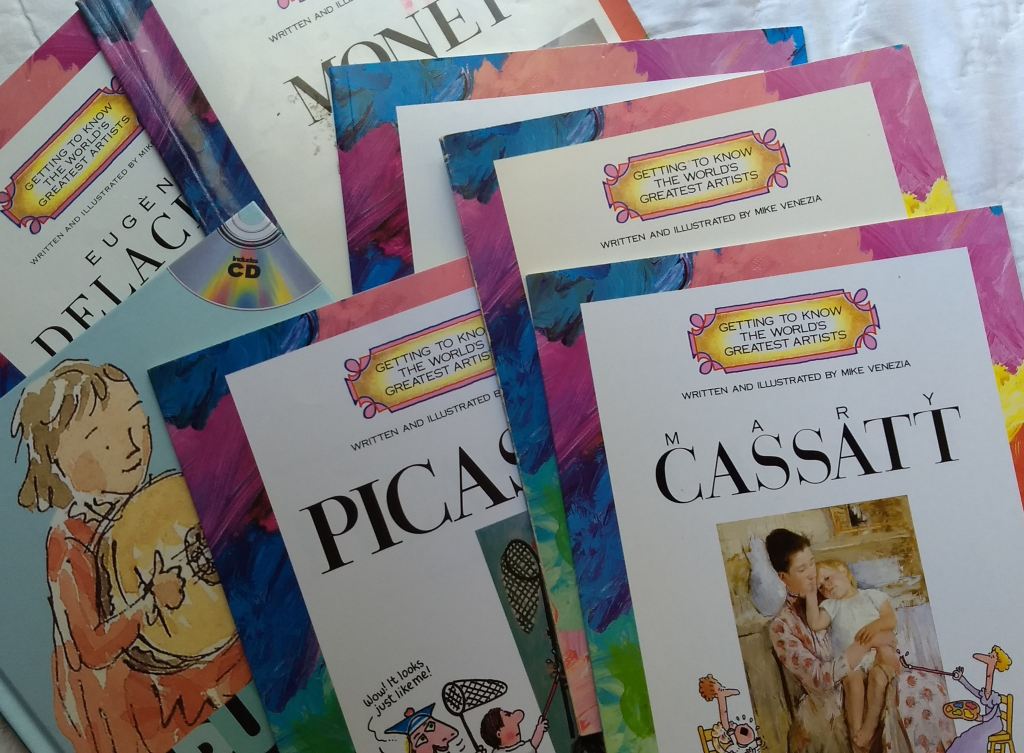
We did picture study weekly by spending a few minutes looking at a photo of a famous work of art. We’d remove the photo and then tell each other all of the details that we could remember in our head. We’d often post the photo on the refrigerator for the week to remind ourselves of what we saw. Often we spent some time on learning about the artist himself using the web, or books such the series of books by Mike Venezia.
Music study and poetry were similar to art study, except we would listen to one piece a week (YouTube is a great resource, as are CDs from thrift stores!) or read one poem a week. Art, music and poetry usually involved the same artist for six weeks, providing some continuity.
Other components of the Charlotte Mason way included nature study and short lessons. In the early years we had nature journals and would venture out to draw “nature” that we found. We would research what we found after returning to the house. Short lessons allowed Sunshinegirl to focus on a lesson in her attention span instead of fighting with the boredom that set it. Books were spread over twelve week terms, so one small part was read in a given week, allowing time to digest the content for a week before reading the next passage.
I’m not doing Charlotte Mason justice in my description of what we did, so if you are interested, please look at all of her principles.
So what is this AmblesideOnline that I keep mentioning
AmblesideOnline (AO) is a non-profit website that provides information, book lists and schedules for homeschooling K-12 (Year 0 – Year 12) * using Charlotte Mason’s principles and even book suggestions. Each year has a list of books, many of which are public domain (free) and weekly schedules on when to read each. The schedules include almost all subjects, including history, literature, science, geography, artist/music study, and suggestions for math and foreign language.
We had to choose our own math curriculum and foreign language resources, and we chose to supplement with science and spelling/grammar/writing curricula as needed.
AmblesideOnline was a wonderful (and did I mention, free!) resource that made homeschooling the early years easy. The volunteer homeschool mom moderators that maintain the information have spent years vetting the books and putting together useful schedules. I would print the schedule (two pages a trimester “Term”) and click the links to either the public domain book or the link to purchase (found right in the curriculum lists), and then off we’d go for the Term.
* NOTE: Year X does NOT necessarily correspond to Xth grade. If you start with AO in kindergarten, it is feasible your child will finish twelfth grade in Year 12, but AO is more challenging and rigorous than many curricula, so for those that switch in between or need extra time, I don’t think it is abnormal for a child to graduate after Year 10. Some children need extra time, and they even have years 3.5 and pre-7 available for those that need a catch-up year.
So what’s next
I will save my thoughts for other posts, but I can say we are deviating from AO for high school. We have loved using it through eighth grade, but we find we need to make a change to support Sunshinegirl’s learning style. AO through high school I have no doubt would create a very intelligent, worldly-wise and well-read adult that would succeed in any university. I would highly recommend others to look into it and determine if it is a good fit. For us, we have decided to go a little more custom for high school.
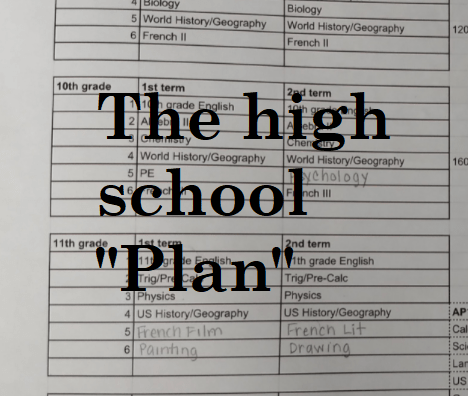
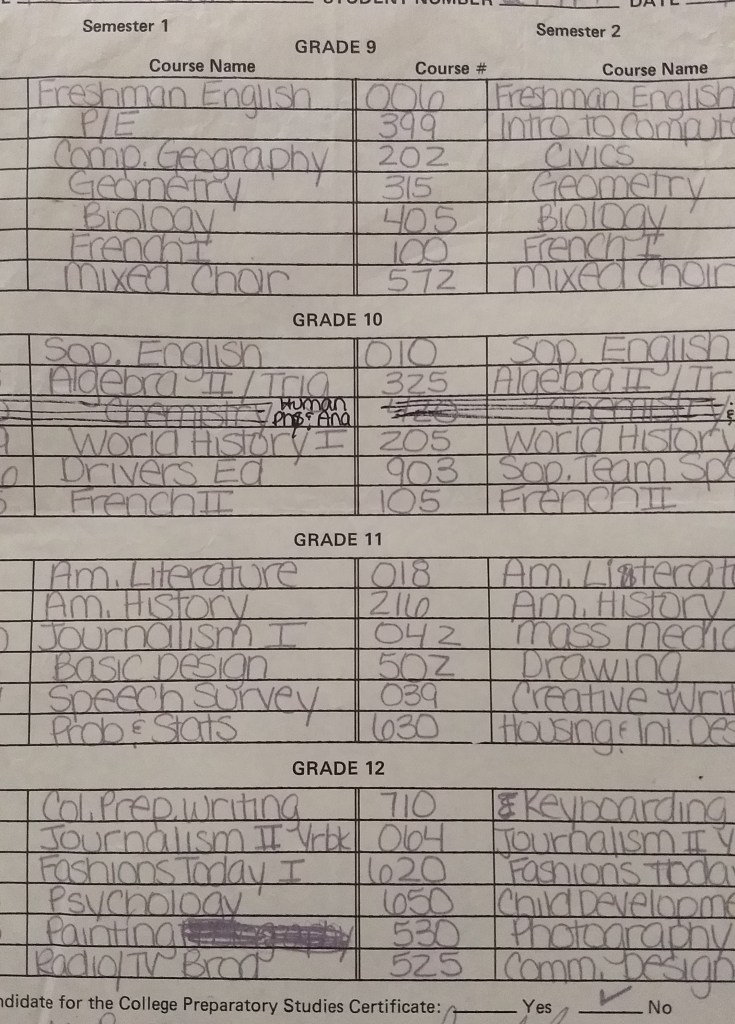
I remember back in eighth or ninth grade being asked by my teachers or guidance counselors to make a “four-year plan” for my high school career. I came across that plan recently, and I had to laugh at the absurdity of it! The ninth grade year was spot on (I am guessing we had already picked that year or were about to), but tenth through twelfth grades weren’t even close to what I ended up taking (“Mass Media”, “Fashion 1”?). I had even left unchecked the “Pursuing College Prep certificate”. In fairness, I changed schools (well, moved to a new state) after ninth grade, so some (most) of the courses weren’t even an option, but the original spirit of that first schedule was lost in the move as well.
My original High School plan as written at the beginning of high school.
I thought I’d do the same for Sunshinegirl, giving her the option to look four years out and at least set down some goals. I told her my story (and showed her my hilarious plan) and said that I didn’t expect her to follow that schedule 100%. It was simply to get her thinking about what is required and what freedom she has to explore other topics. The sky’s the limit with homeschooling since we could potentially create a class on any topic! We could have both a college prep curriculum and choose courses that preview her college and future careers.
We started with the traditional grid, broken down into four years, six-seven lines and two columns (semesters) per year. Before handing the schedule off to her to work on, I plugged in the Michigan Merit Curriculum requirements for graduation (each state has its own required–and recommended–courses for graduation, so you would have to find your own). Since I was creating this in Google sheets (Microsoft Excel or Word work great, too), I was able to boldface the required courses so that it was easy to see what was required and what could be modified.
This exercise was useful for both of us. For me, I could plan ahead beyond a year and make sure proper pre-requisite knowledge was covered in other courses. For her, this process let her put her academic “likes” and propensities down on paper as rough goals. It made her think about “do I want/need to take Calculus senior year?”, “What, if any, AP courses/tests would I want to tackle?”, and “What courses could fulfill my academic passions?” (When in high school were you ever asked to consider your passions when picking classes!?)
Below is what she picked at the end of eighth grade. We’ll circle back each year and fill out the same sheet, and I will post that progression on this site.
Sunshinegirl’s high school plan, as written at the end of eighth grade.
I’ve had the luxury of homeschooling one child from day one of her school career, thus I’m no expert in what the majority of families are facing. Most families either have A) multiple children (a built in classroom full of some socialization) or B) are not starting homeschooling from the beginning.
For families that are starting homeschooling after the student has already been in public schools, I am sure that can be tough. In some cases, the student asked to be homeschooled or was part of the decision, so hopefully in those cases there isn’t as large of an adaptation period that will occur. For those students that are starting the learning-at-home process not based on their own free will (parents/educators decided it was best or pandemics that force kids to be at home), I can only imagine the struggle.
These are the things we’ve learned to provide some of the “school” experience at home!
Leading up to first day of school
In “real” school years, kids have the routine of going “back to school” shopping and attending open house/orientations. Why can’t homeschool students have those experiences, too?
Back to school shopping — who doesn’t like fresh school supplies and a great first day of school outfit. I always tried to take each of my kids out separately for this yearly tradition. Include coffee or lunch, and let them work off a school supply list that you have put together based on your homeschool needs.
A back-to-school outfit for the first day of school? You bet! Does it have to be fancy? Ha! Our tradition is to get new pajamas or pajama pants to wear the first day – why not!? We homeschool, therefore we can! Since day one we’ve known being able to “school in your pajamas” was unique to homeschooling, so why not make it a fun tradition.
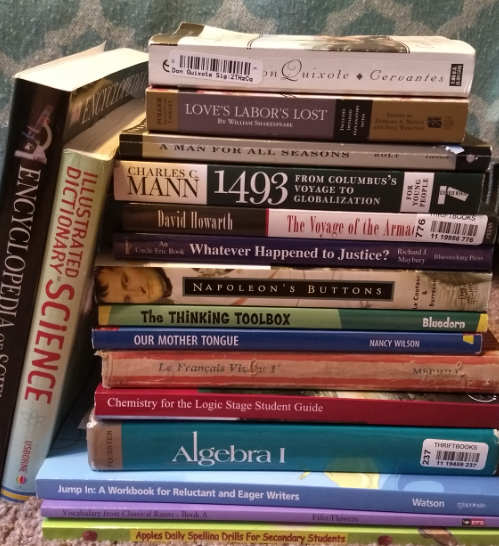
Orientation? You can do that, too! While by the late middle school age I included Sunshinegirl in some of the curriculum decisions, she never really saw the big picture until orientation. I slowly procure all of the books over the summer, and while I don’t hide them from her, I just stash them in the pile. On Orientation Day I have the overall schedule and a big pile of books! Who doesn’t love a BIG PILE OF BOOKS! (Ok, maybe I’m weird, but I LOVE a pile of books!) We walk through the books as a family (Mom-Teacher, Dad-Principal, and Sunshinegirl-Student) — it is a big deal!
Eighth grade book pile at orientation
First day of school
In public school kids wake up, put on their new outfit, eat a good breakfast, and head to school with the new backpack and a filled lunchbox — after the requisite first-day-of-school pics (that mom will inevitably post on Facebook 3 minutes after the kids are gone). You can do the same with homeschool!
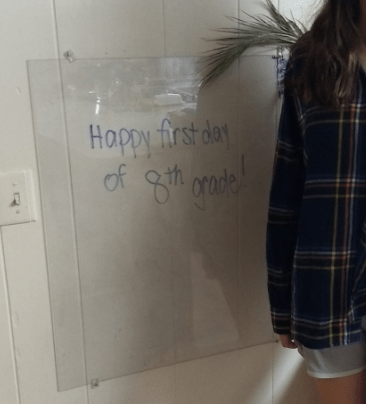
Take those pics! Get a pic of the students in their pajamas with the new backpack on. Write on your big whiteboard (you have one, right?) “Welcome to Xth grade” and get the pic next to it. Take the photos outside in the sunlight (because it will be light outside since your homeschooler doesn’t have to leave the house at 6:45am in the dark to catch the bus to school!).
Lunchbox? Of course! Since kindergarten I have “packed” a special first day of school lunch for Sunshinegirl — with special lunchbox treats that I don’t normally have around the house. She doesn’t eat it at the kitchen table, but at her desk “like the other kids would” (though I know that 99% of schools eat in a cafeteria, but shhh). Tradition. 🙂
A place of learning
Ok, I mentioned the “whiteboard” above. For the past few years we have had a 3×4 plexiglass (clear — read: “blends in with the wall when erased”) whiteboard in our kitchen for working out math problems or conjugating French verbs, but this past year we realized it just wasn’t big enough. Yes, it is my kitchen; no, it isn’t the most aesthetic thing, but we opted for the larger 4×6 board, and it makes all the difference. I would say we use it mostly for math problem instruction, but we have used it for other subjects just for a change of pace. Tired of drawing molecules or conjugations on paper? It is so much more fun to do it on the whiteboard with a variety of colored markers! You can write a quote of the week at the top, or write an extra “to-do” list in the corner. The possibilities are endless!
As far as a regular study space, we’ve moved around the house through the years — I know many homeschool families have a dedicated “homeschool space”, but we’ve gotten away from that. She used to have a desk in our three season room (near our bookshelves), but since we live in Michigan that didn’t work out too well in the winter. But we do have certain spaces that we associate with learning: the kitchen table is for math work, the couch is for reading (both together and independently), and Sunshinegirl’s desk in her room (or even the floor…) is for independent work (with the door open, so I can walk by and make sure learning is happening!).
Why is a regular place important? Students need to be able to enter the “school” mindset. Expecting a new homeschooler to do school work in his bedroom is probably not realistic. A new homeschooler isn’t used to his bedroom being a place of learning, so focus will not be at its highest. A new desk in his room, or a designated spot somewhere else in the house is probably more appropriate. That way when the student enters that spot at the designed time of day (see “A time for learning”, below), his learning hat goes on, just as it would when he walked into the classroom at home.
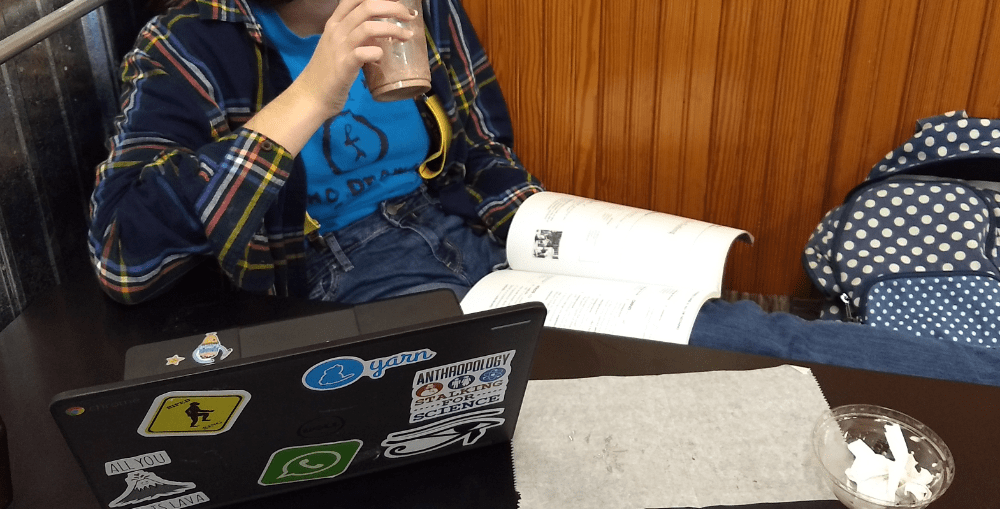
Tip: For a fun change of pace from the “standard place of learning”, I highly recommend homeschooling “elsewhere”. It is a treat to the student to be able to spend a morning at the local coffee shop or the library doing schoolwork. Learning a foreign language (that you both know)? Regularly go for coffee and speak only that foreign language. The hour spent at the coffee shop practicing the language is priceless for learning!
A time for learning
ad·verb /ˈadˌvərb/ noun 1. a word or phrase that modifies or qualifies an adjective, verb, or other adverb or a word group, expressing a relation of place, time, circumstance, manner, cause, degree, etc
We’ve talked about “place”, so now it is time to talk about “time” (and hopefully the combination creates a positive “manner”!). Homeschooling provides for a lot of flexibility, especially with “time” — if a student isn’t at his best at 7:30am (when normal high school starts), then start homeschooling at 8:30am. Have a doctor’s appointment mid-day? Just stop schooling and take care of it.
Does that mean homeschooling should just fit in “whenever”? Probably a bad idea. Set a “regular” schedule and try to stick with it. Public schoolers get a schedule of each of the 6-7 classes for each semester, so provide the same for your student. Does that mean math is always from 8-9am? Nope. Some days it may only take 30 minutes, and others 90 minutes. But can you get in the groove and have a suggested order of subjects for the day, and an expected start time? That is what works for us.
So what have we done?
In 8th grade, Sunshinegirl was expected to start “school” at 8:15 (though we did PE for part of the year, which was 7:45-8:15, since we are both “early exercisers”). She would work through her Language Arts, Literature, and History readings while I was working, and then late morning we’d come together for any “together” readings for the day. We’d break for lunch (sometimes with a lunchtime viewing of videos related to school), and after lunch, per her request, we tackled Algebra. Once we got through that (and I say “got through”, but that is another story!), we moved on to French. She would usually have some independent French work to finish after we completed the lesson together, so ultimately she was usually done by 2:30-3pm.
“Wait, I’ve read that homeschool goes much faster than public school. If I did the math right, you did 6+ hours of work minus a break for lunch! That seems long!”
Yes, it probably is. And yes, most homeschool parents will tell you that work can be done in less time. First, I want to note that once she is done at 2:30, she is done. No daily homework. So really the 5 ½ hours of school were dense, productive, flexible and what we needed in our school. And it varied – she took part in the public school’s homeschool program 1-3 days a week for the past few years, so at least one of the school days was shorter than the others to accommodate that. But it worked. We had a weekly schedule that was our guide, and it worked.
The “extras”
Homeschool doesn’t mean sitting at your desk everyday, trudging through the lessons with no variety. We incorporate “extras” that the public schoolers DO, and those things they can’t DO but wished they could!
Spirit week: You know them from high school. A week in the fall and a week in the spring where each day has a “theme” and students dress up to match the theme. “Superhero day”, “School color day”, “twin day”, “Future career day” (funny story – they had this at our high school, and my son says “Mom, I need a Star Trek uniform”. “Why?”, “So I can wear it for Future Career day – I can be a flight engineer for the USS Enterprise” – yes, he was kidding, and yes, I bought him the shirt!). Make up your own days, or follow these Homeschool spirit week ideas.
Field trips: This is the beauty of homeschooling – more flexibility for field trips! Visit the museum or an art show or a rock show or a local farm. It is all wonderful learning. One thing I learned, though: visiting museums during the week inevidiably leads to running into crowds of public school kids on THEIR field trips. Plan to visit after lunch — many schools do field trips in the morning, eat lunch at their destination, and then head back to school.
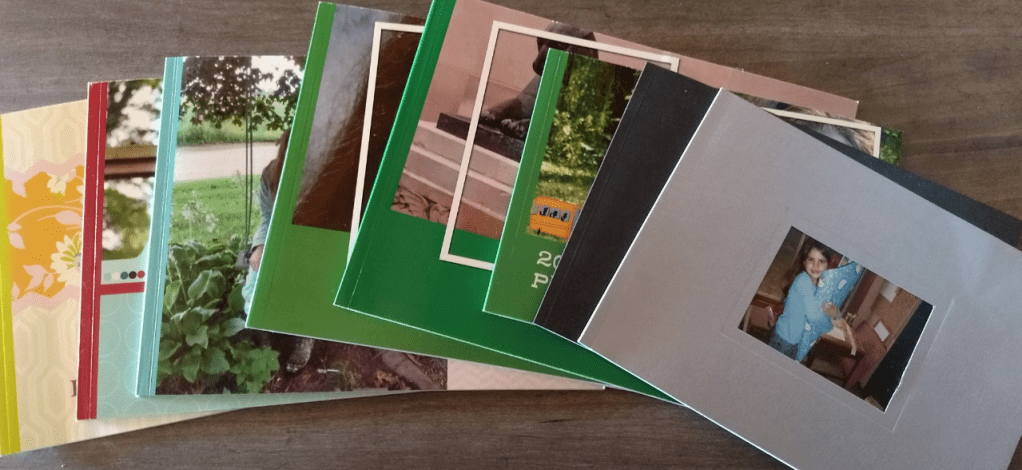
Yearbooks: Yes, I said yearbooks. Take pictures of the learning place, first day of school, science experiments, field trips, extra-curricular activities, and art projects. Use a service like Shutterfly or Walgreens to make a small 5×7 soft covered book ($10?) with all of the photos. We have one for each year sitting on our bookshelf, and Sunshinegirl takes them out occasionally and does the “oh, do you remember when…” thing.
So make it fun, but make it unique. Bring in the fun “public school” aspects, but focus on and create the unique homeschooling traditions as well.






 Top of Her Class of One