Featured

The Plan: Chemistry and Algebra 2

Yes, it is January. Yes, we started 10th grade in August. Yes, I am just not getting around to writing this post. Better late than never?

I’ve chosen to combine into one post the “plan” for 10th grade math and science. Both are fairly typical “textbook-based” subjects, so we will tackle them together.

Chemistry

Well, I can tell you that our “plan” deviated less than a month into Chemistry. Last year we started with a “typical” high school Biology textbook, but then decided that CK-12 Biology was a better fit due to the multi-media nature. So this year we started with CK-12 Chemistry (regular version, not Flexbook version 2). We originally chose to use CK-12 because of the wealth of embedded videos and activities related to the content; we chose to use the v1.0 book for two reasons:

  1. The original online text has the content grouped into pages that easily fit one lesson “day”. The Flexbook v2.0 breaks each chapter into subtopics, so you would cover multiple in a day. For me to batch these up into lesson days was more difficult, versus just knowing “do the next section” today.
  2. The original online text has separate “books” with worksheets, tests/quizzes and teacher guides; most of those could be downloaded as PDF and easily printed. The v2.0 has online quizzes and tests, which by default are adaptive. Last year we found the adaptive piece didn’t work well for us, so I was creating my own custom tests from the online back of questions and printing.

Well, after a month we realized that those preferences really didn’t matter. The embedded content wasn’t as engaging as in Biology, and reading the lessons online was tougher for this more math intensive/problem based subject matter. We decided to use a “real” textbook. (I personally always prefer “real” books over online reading — while I have read some books on Kindle, I always prefer the ease of use of a “real” book. Creature of habit!)

We already had a copy of Holt, Rinehart, and Winston Modern Chemistry c2009. It was much easier to follow along with the math (I like following with my finger, which you cannot do on a tablet), and it provided many section and chapter review questions right in the book. I did not purchase a teachers’ edition (though I would like to have one if they were a reasonable price used!).

Chemistry is not my student’s favorite subject. Not even close. Like, near the bottom of the list of all possible classes. But so far we are getting through it.

For Lab work we are using the Home Scientist’s Standard Chemistry Lab manual. The PDF is free to all, but refers to chemicals and tools obtained in their Chemistry set. The labs will be focused more on the second half of the year when we get into the “meat” of Chemistry topics.
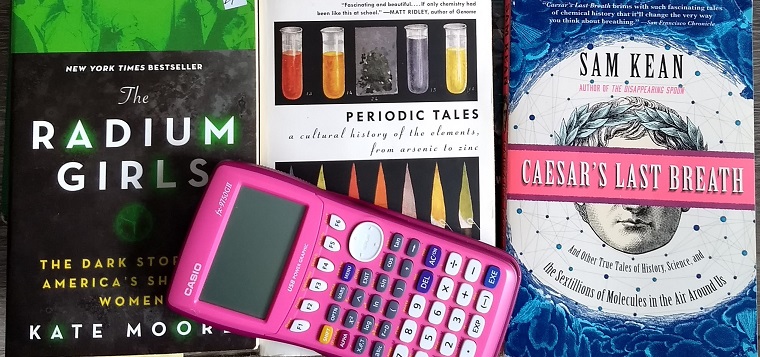
We chose to use Build your Library (BYL) Year 11 for this year, which does include a Chemistry component. The schedules use the CK-12 Chemistry v1 book (which is another reason we started down that road), so we had to just switch out for comparative chapters in the Holt textbook. The supplemental books, though, in BYL are what we really are looking forward to. Periodic Tales, Caesar’s Last Breath, and Radium Girls are the three main books we plan to read (we already read Napoleon’s Buttons). These are the “real” books that make the connections to what seems like a tough subject (chemistry), and these are the ones that make Chemistry bearable for my student.

Algebra 2

Math is math, at least to my student. As I mentioned before, I majored in math, and I love the problem-solving aspects and the beauty of math. Her, not so much.

There isn’t much to say about Algebra 2. I did spend quite a bit of time trying to decide which traditional Algebra 2 textbook to use. (I wanted to teach her, so I felt a standard text would work better than one designed for homeschoolers.) It came down to two final options:

Larson texts are highly acclaimed, but I wasn’t sure if that one would be too advanced. The Holt text was very graphing-calculator and exploration-based, where Larson was slightly more in depth with “here is how it works” and “here is why”. I talked to a friend that teaches high school Algebra 2, and she understood my thoughts and concerns exactly — she has taught from both books. In the end, I chose the Larson text. It is the text I would want to learn from, though my student is totally different from me, so that isn’t necessarily a valid reason! 🙂 I wasn’t a fan of relying so much on technology in the Holt text; the Larson text still has a fair amount of graphing calculator use, but only after knowing how to do it manually. So far, I think Larson has been the good choice.
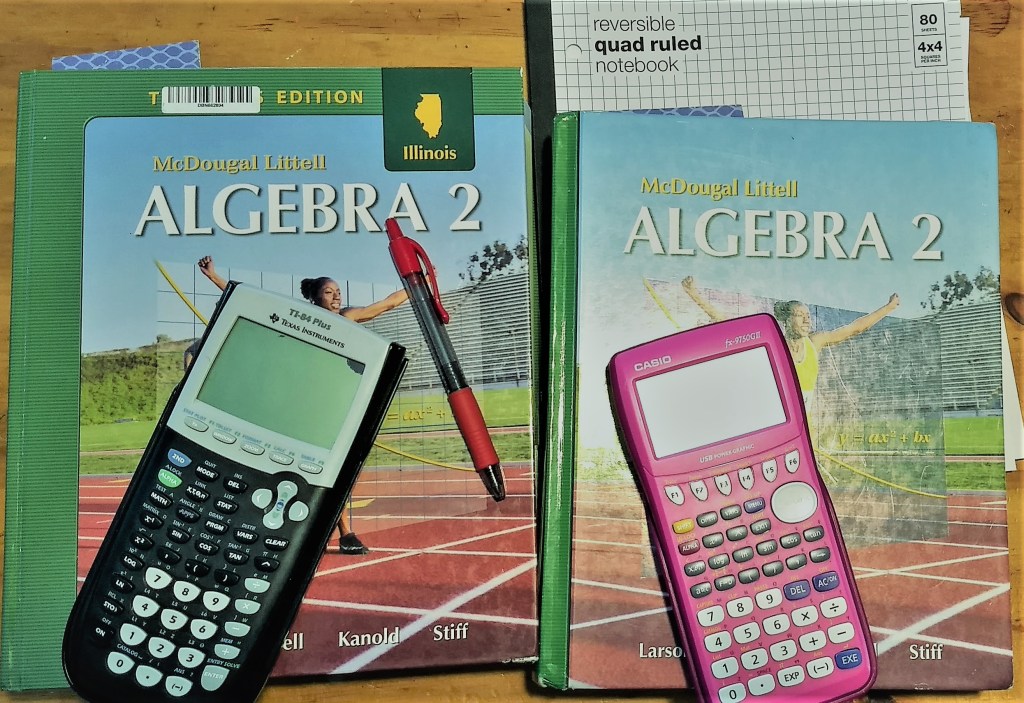
We have no supplemental books with the Algebra 2 text. Each day we go through the lesson together, and then we (separately) work out the assigned problems. I did give in and purchase a teachers’ edition, which has been very helpful in checking answers.

Conclusion and Hopes

Hopefully these resources help this year. I really want my student to love math and science. I know I should probably rely less on textbooks to cultivate this love, but at the same time I now understand how schools/teachers “teach to the test”. I want her to succeed in tests and college, so I want to make sure she gets full exposure to the content. It is a balance, I suppose. Being EXPOSED to content with some basic textbooks, while taking time to EXPERIENCE the content with living books and activities.
Featured

Our Homeschool history – Where we’ve been

We can’t talk about high school until you know where we’ve been.   It is an understatement to say that we haven’t been consistent with curriculum.  As her learning styles changed (or I realized what they were!), and I learned what works and what doesn’t, we’ve adjusted over the years.  The one constant has been AmblesideOnline (www.amblesideonline.org).

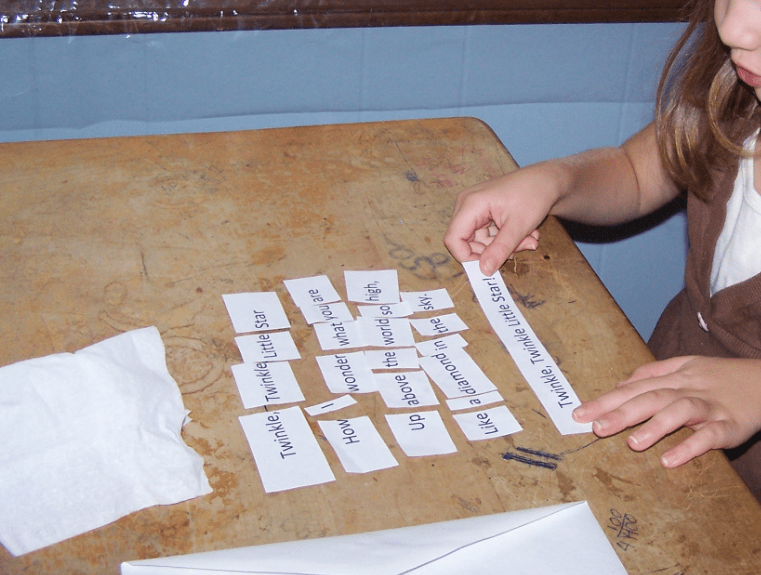
In kindergarten we followed the AmblesideOnline (AO) plan for Year 0.5, supplementing with American history and science resources that were interesting.  We used whole-word learning for reading instruction — taking familiar nursery rhymes, printing them out, and cutting up each word, learning to rearrange them like a puzzle back into the original sentence. 

Sunshine girl in kindergarten working through Twinkle, Twinkle Little Star.


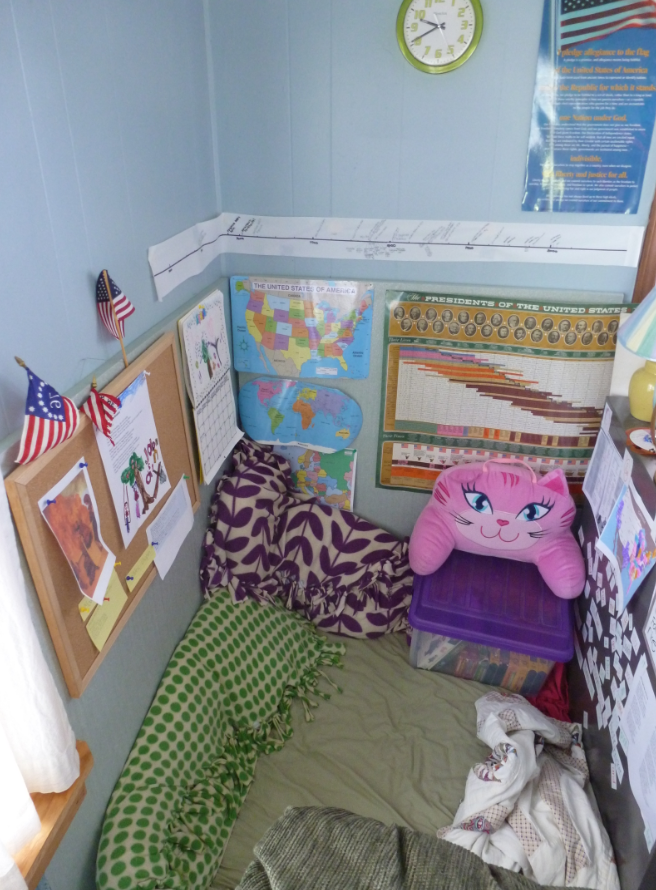
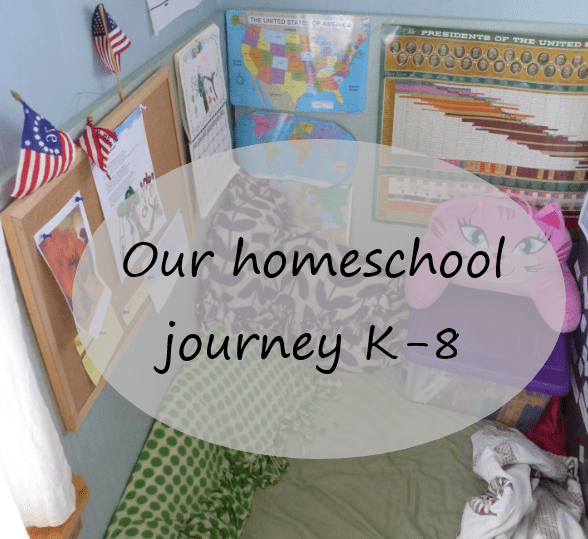
We worked through MEP math (https://www.cimt.org.uk/projects/mepres/primary/index.htm), supplementing with fun math games and readers.  We had an amazing book-nook created by a metal cabinet (great for word magnets!) and an old futon cushion.  Complete with homemade homeschool t-shirts, it was an amazing year — gentle, yet “school”.

Our kindergarten book-nook – enclose in a corner of the room with a metal bookshelf.

Elementary school was similar to kindergarten (minus the awesome book-nook since we moved to a new house), following the schedules and books laid out by the wonderful moderators of AmblesideOnline.  We never followed it to the letter — some books we substituted with other books we had on hand, and we always added science of some kind (NOEO Science and Elemental Science/Sassafras Science for various years).  We used MEP math in 1st grade, but quickly found it wasn’t the method Sunshinegirl needed.  We adjusted, choosing Singapore Math, and we moved along.  

Middle school became more rigorous, and it was becoming more clear what my creative, right-brained daughter needed for schooling.  We continued with AO, following most of the suggestions (though by eighth grade we found ourselves modifying quite a bit).  For math we switched to Math Mammoth for 5th-7th grades, finding it to be more rigorous, yet more conceptual — providing many ways of looking at the same math problems. For 8th grade we used Foerster Algebra 1, switching to CK-12 Algebra for the last term (more about that later).  Science was a combination of Ellen McHenry books (Biology), Elemental Science (Chemistry) and CK-12 (Earth Science and Chemistry).

Bottom line, AmblesideOnline was the spine that created the base history, literature, citizenship, and science, but then we used an eclectic list of other resources to round out the math, science, and some additional history and literature.  

Would I have done it differently looking back?  

Nope – each choice was made at the time for a reason, but that didn’t mean it had to stay the choice if we outgrew a solution.  We were structured yet flexible.  We evolved!

Going forward, I know that we have to be flexible and evolve as well; the difference is that Mom isn’t making all the choices for high school, but it is a group effort by Mom and Sunshinegirl.

The Plan: Physics

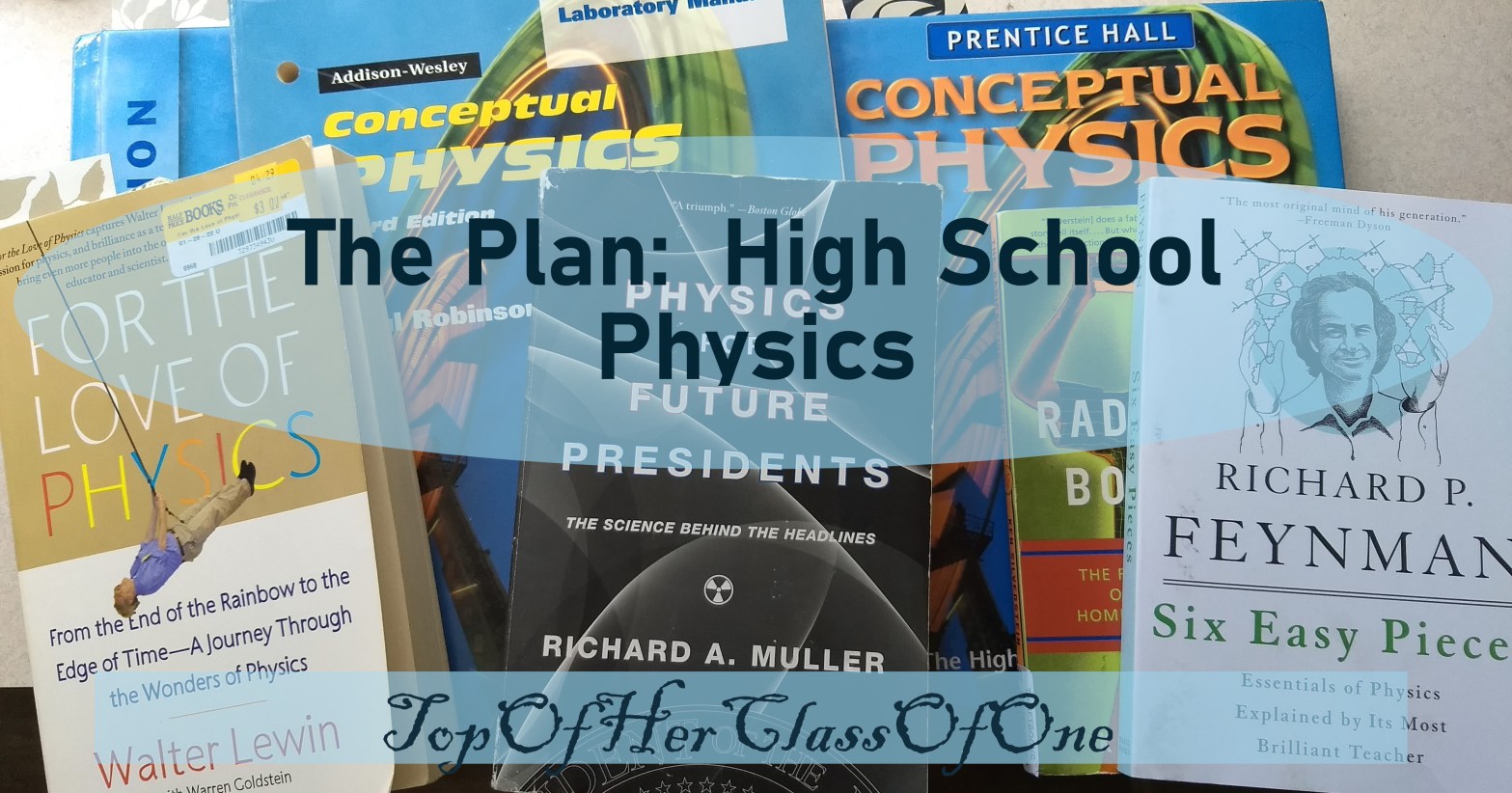
Science isn’t Sunshinegirl’s thing, so she says. Chemistry was NOT a hit in 10th grade, so I really spent a lot of time looking for the best resource to make Physics more bearable. As I wrote in “The Reality: Chemistry and Algebra 2“, I wish I would have used Conceptual Chemistry, but at least I could atone for my discretions for Physics. I hope to be redeemed with Paul Hewitt’s Conceptual Physics (Pearson).

I was able to find the 2006 version fairly inexpensive — the Student Text, the Teachers’ Edition, and the Laboratory Manual (the Tests are on the way). I originally stumbled on the textbook in its college format (for $1 at a thrift store — I LOVE thrift stores!), and while it was good, when I realized there was a High School edition, I was on it. In the textbook, the author states very plainly that this book focuses on the concepts and creating a love for physics — the math is only used for illustration purposes. Yes, there is math in the book, but I doubt it is as much as a standard text. If your student is planning to be a Physics or Math major, this may not be the text (or could be used at a younger level as an intro); if your student doesn’t necessarily plan to major in a STEM subject, this might be the book! At least I hope!

I am writing this as we are one week in to her Junior year, and we’ve only gotten through two chapters. (Yes, two chapters in one week, though the first the author states to cover “in a day and move on to the fun stuff”.) The author states that most chapters are independent and can be done in any order or omitted if needed. For the first time for us, I went through the textbook and my currently plan does NOT have us going through the entire book. (I even considered starting with the chapter on Rainbows as a warm up, and then returning to the first unit — Mechanics.) I want her to understand Physics and what it is and how it applies to real life. I have strong faith that this book will do that for us.

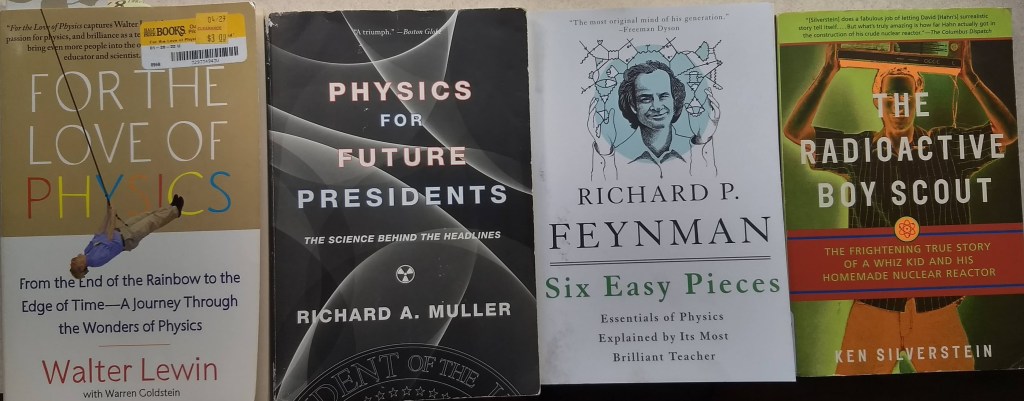
On the side we plan to work through a few other Physics books. We have:

  • For the Love of Physics by Walter Lewin (professor at MIT — look up his lectures on YouTube): This book has chapters on most “standard” Physics topics — the author explains the topics with the beauty and reality, and no math.
  • Physics for Future Presidents by Richard A. Muller: This book covers those topics of physics/science that are in the news and tend to be more political. Terrorism (the physics of a dirty bomb), Greenhouse effect/global warming, bombs, and other hot topics are covered.
  • Six Easy Pieces by Richard P. Feynman: A great scientist of the 20th century and a great lecturer — explains basic physics for all.
  • The Radioactive Boy Scout by Ken Silverstein: A true story about a Michigan Boy Scout that was able to create a feeder reactor in his backyard shed. I picked this partially because Sunshinegirl is a Scouts (Scouts BSA, which is what the program is called now instead of Boy Scouts). I pre-read this at Scout camp over the summer and loved the science of it.

I put together a schedule that omits some chapters, aligns chapters of the above four books, the Laboratory Manual, and Crash Course Physics; hopefully this makes a complete and enjoyable year that might….dare I wish…spark a love of science again.

The Reality: French 3

Ok, so really this is the PLAN and the REALITY since I never got to putting together a post on our plan. I’ve learned a lot about language acquisition this year, so here goes.

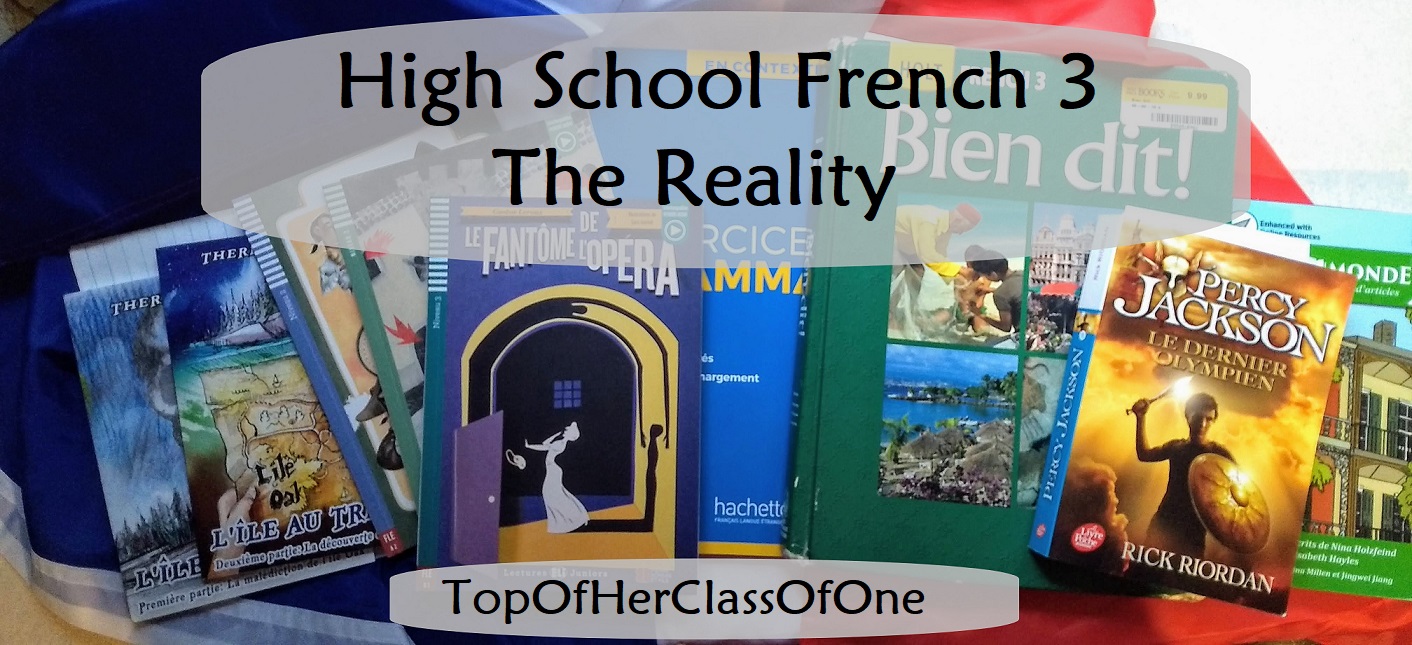
We started with the Holt Bien Dit 3 textbook. From what I can gather, very few standard school textbooks have a French 4 option — it appears schools sometimes use the French 3 texts for both years, so I thought we’d try that.

After using this series of textbook for French 1 and 2, and starting the third year, I realize it isn’t meant for a homeschool situation. For French 1 and 2 it was somewhat useful since it provided the grammar necessary to learn the language. For French 3, it was useful, but I didn’t feel it was taking her to the level of fluency as fast as I would have likes.

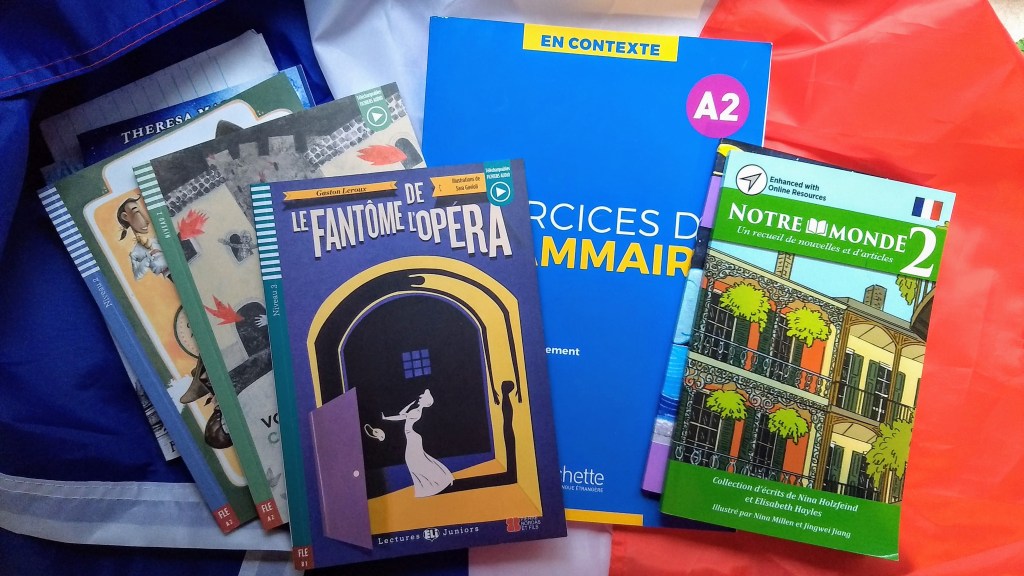
And then I found resources that (I think) European countries use: ELI readers and Hachette CEFR leveled grammar books.

Around March of this school year we finished Chapter 6 in the Bien Dit 3 textbook, and I felt we needed to step it up and “get real”. I did my research, and instead of continuing to Chapter 7, we decided to do the following each day:

I think this was the key (lol, at least for me!). Duolingo provided the warm-up; we would each go into a separate room and work through our respective lessons (yes, I did them, too). Once we were done, we would come together and work through one of the readers; she would first read the chapter to herself, and then I would read it again out loud. Having two readings made it easier for comprehension. Note: The ELI readers have links to online resources AND audio files of the chapters. We never used the audio files since I can butcher my way through reading French, but for learners that do not have that option, I think they would be valuable.

After the readings, she would answer the end-of-chapter questions located right in the book. Yes, there are comprehension and grammar exercises right in the readers!

The ELI readers vary in content, but we chose to read the “classics” retold. What a great way to introduce classic French literature (The Three Musketeers, Phantom of the Opera, Cyrano de Bergerac, and Perceval Ou Le Conte Du Graal.

One more great thing: some of them are FREE online. Always love free!

Once we worked through the reading and discussion, she would work through a section of the En Contexte A2 Exercise de Grammaire. She generally considered this homework (she prefers to do her French right before bed, since she says she falls asleep thinking about French…hey, it can’t hurt!). She would check her own work on the exercises, and then I would check the “Bilan” sections (end of section review); I would use the Bilan score as a test/quiz grade.

Instead of the typical final exam based on grammar and vocabulary from the textbook, I decide to go a different route. Why test on specifics when the goal of learning a language is to be able to communicate? There was no studying for this test (which was relieving to her!).

Exam:

  • Speaking component: combination of her reading passages out loud (looking for pronunciation) and conversational French
  • Listening component: I would read a passage and she would answer questions (either out loud in French or written)
  • Writing component: She would read a passage and write about it, either open format or answering short answer questions.

This was far more relaxed than a normal French exam, and I think it honestly assesses the goal of language learning. A standard “exam” would have assessed the specific vocabulary learned in a given period; this assesses overall fluency.

Her final project for the class was to write a story, and she nailed it. Though, I didn’t realize that Google docs can easily spell and grammar check in French, so there were not very many errors (and she even used the passe simple, which if you know French, is only a older literary tense).

Grading: Chapter tests, En Contexte Bilan, and various speaking, writing, comprehension, and listening grades (including the exam).

The Reality: Chemistry and Algebra 2

As we approach the end of her 10th grade year, it is becoming more clear that she is adverse to math and science. Can she do well in those subjects? Yes! Does she want to? Nope. That is ok. Her passions are in history, language and art, but I still insist on covering the science and the math.

Chemistry

As written in my Plan post, we deviated from the plan after a month or so of Chemistry. Both the CK-12 Chemistry and Modern Chemistry books cover about the same material, and both are strong in the mathematics of Chemistry (I still don’t remember that much math from when I took it in high school or college!). We ended up going back and forth between the books throughout the year, depending on what I felt was the best presentation of information. Most of the content was from Modern Chemistry, though, since we just preferred the physical book in hand.

I felt that the amount of time spent on the math detracted from the overall learning of concepts. If I was a Chemistry teacher, I am sure I would be able to balance that better, but going through the content together, we ended up spending a lot more time on the math. The ideas of Chemistry were lost.

To make up for this, I decided not to do the final 4-5 chapters of the Modern Chemistry book (the ones that survey different areas of chemistry, e.g., Nuclear or Organic Chemistry). Instead we dug out the copy of Joy of Chemistry by Cathy Cobb. This book has ZERO math and ALL concepts; as a bonus, each chapter starts with a demonstration that introduces the concept. Each day we read through a chapter together, did the demonstration, and then she wrote a one page written “narration” on the concepts learned. I hope this helped.

For her final exam, I am sticking to the big picture chemistry questions, focusing on short answer questions where possible. For someone that enjoys writing, short answer questions in chemistry are more palpable. (Multiple choice tests are not her strong point). I am going back to the beginning and asking the big questions: how is the periodic table arranged and what do all the numbers really mean? what is the difference between an acid and a base, and what do they have to do with OH-, H3O, pH and pOH? what does the ideal gas law tell us between the relationships of its variables?

Yes, there is some math on the final exam — have to be able to show oxidation numbers and how to calculate the limiting agent in a reaction, but that isn’t the focus. I want to make sure the concepts that she does end up remembering are those that have some real-world application to a non-scientist.

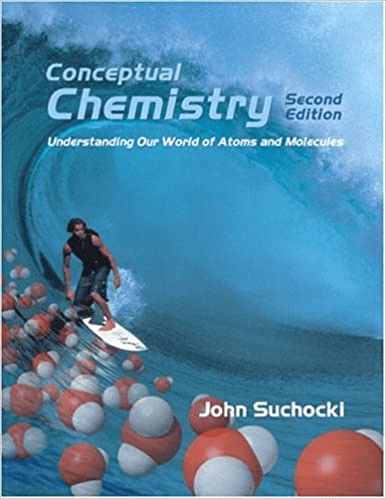
In retrospect, I wish I had found Conceptual Chemistry by John A Suchocki. When researching books for Physics for 11th grade, I had found Conceptual Physics, and saw that it had good reviews/recommendations as being more about the concepts than the math; ideal for non-STEM students. It was then that I noticed there were other books in the series, including the Pearson Education Conceptual Chemistry. If you have students that are self-proclaimed non-scientists, it might be worth a look. I cannot recommend it personally, but I probably would have tried it had I known.

Grading: Most of her grades were the chapter test, as well as the final exam. A few lab grades factored in.

Algebra 2

I really like the Holt McDougal Larson Algebra 2 book that we used. I felt the explanations were clear, the extra sections(which we sometimes used, but sometimes not) helpful, and the problems accessible and applicable to real life. Having the teachers’ edition was extremely helpful, but I continued to work out all of the same problems she did — she would check her work off of my solutions. (Yes, I believe there is a solutions manual, as well as some online sources with worked out solutions for those homeschool parents with far less time on their hands. But who doesn’t love working on Algebra 2 problems! 😉 )

Grading: Chapter tests and the final exam. BUT…

I did throw in a final project of “math creativity”. I used a Pre-Calculus Creativity Project guide that I found online from multiple sources. Who says math can’t appeal to the self-proclaimed non-math minded!

High School French 2 – The Reality

In my previous post laying out “The Plan” for French 2, I listed a few directions that we would go this year, so I will address each of those “wish list items” individually.

Note: Bear with me. I am so behind on these posts, so I am just going to free-form write quickly to share my thoughts.

Speaking/Storytellings

I had done so much research at the beginning of the school year on TPRS — Teaching Proficiency through Reading and Storytelling (aka, Total Physical Response). I was very excited to try this, thinking we’d have a great time acting out the stories laid out in “comic book” fashion, having real conversations related to the current chapter. The Reality: as animated as Sunshinegirl can be sometimes, she wanted NOTHING to do with acting out these stories. Sigh.

Nevertheless, we persisted. Each week we repeatedly worked through one TPRS story from one of the two books that we had. I had gone through both resources and keyed the stories to match the chapter we were working on in Bien Dit 2, so it was helpful to hear our chapter’s vocabulary in context. The first exposure was me reading the story with her looking at the illustrations. The second was me reading with her silently reading along; I would then follow up with questions about the reading. By the end of the week, she would be able to tell the story back to me. At the end of the three week unit (one chapter in Bien Dit 2 took three weeks), she would receive a “Speaking” grade based on her picking one of the three stories we had done and telling it back to me. I think this made some impact, but it wasn’t what I had hoped. Still, it was a good experience…I need to figure out how to continue something similar for French 3.

Writing

We started the year using the 1-3-10 writing — we would do this the third week of each chapter as the “writing” grade. About halfway through the school year she asked if she could just have 15-20 minutes to write instead, so we transitioned to that. She didn’t like having to stop and restart each time (too many timers to cause pressure), and the 15-20 minute writing experience seemed to work for us. I did see the most progress during the year with her conjugating tenses; her first writing had wrong endings (she was hurrying, so she would just throw the “il” form on for everything!), but by the end of the year there were tenses and correct endings. Progress!

Reading Comprehension

We used the Bien Dit 2 reading comprehension section at the end of each chapter, but to be honest, they were somewhat difficult for her (and sometimes for me). Some of it was poetry, and I have to admit, I am not good with poems in English, let alone in French. Towards the end of the year we switched to reading reader books and using that as the reading comprehension grade each chapter. Reading comprehension will become more prominent in French 3, 4 (and 5, if we make it that far), so I will have to come up with a better plan (reading literature and stories).

Listening, Vocab, Grammar, Verbs

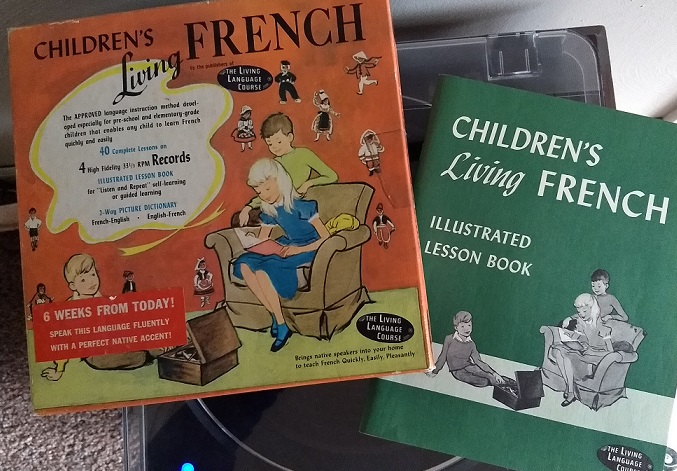
The rest of the “grading scheme” went as specified in my original post. Listening required her to listen to the 1950s record albums from Living language and answering questions. Vocab/grammar/verbs was the typical end-of-chapter test most teachers give (I would write them each chapter myself). Pretty straightforward.

The “Other” stuff

Comprehensible Input Readers

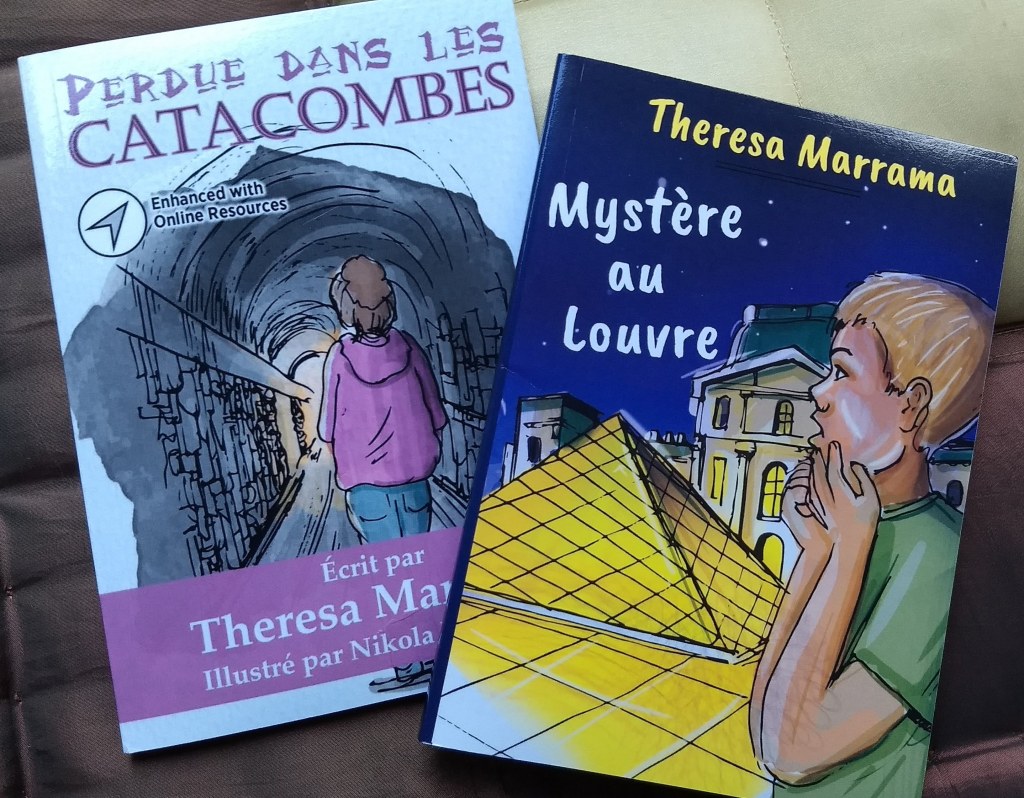
Towards the end of the year I knew we would have a few extra weeks after we finished the textbook, so we transitioned to reading French language readers designed for Intermediate readers. We used two books written by Theresa Marrama: Mystere au Louvre and Perdue dans les Catacombes. Catacombes had online review questions at the end of each chapter which were great for reading comprehension — Sunshinegirl found them easy to do. For Louvre, I had her narrate each chapter in English to ensure she understood what was going on. Neither book gave her any trouble — both she knew exactly what was going on. Perfect for French 2. She was even excited about the Catacombes in general and so she did a short report (en Francais) on them. Bonus! Both books are available at Theresa’s site, other TPS sites, and on Amazon.

Note: We read Alice: La Liste by Cecile Laine at the start of the year, and despite part of the story about the main girl character working on her black belt (Sunshinegirl is a black belt), it didn’t appeal. I think, though, it was too early in the year to read an intermediate-level book. If I had her re-read it now, it probably would have been enjoyed more.

We also subscribed to Frenchpod101 lessons and worked through one of those a day for the last month of class (after we were done with the textbook). The 10-15 minute podcasts focused on a conversation — talking through the vocabulary, grammar, and cultural aspects (in English). After listening to each recording, Sunshinegirl would take the vocab quizzes, and after each lesson or two there would be an assessment on all of the content. Some of the features are free, but we chose to pay for a year license so that we could get some of the bonus features. There are downloadable PDF guides (which, IMHO, are better than each lesson’s page), and you can download the podcasts as MP3 to take on the go. Sunshinegirl started about halfway through Level 2 (there are placement tests), while I started with Level 3 (there are five Levels, which means it takes you quite a way through the learning).

One final resource we found and liked this year: Easy French YouTube videos. We’d often turn to a video when we finished a lesson early. The slower French videos are great for second year French students.

Overall

I think Sunshinegirl learned a lot this year, which will really set the foundation for future years. French 3 will start to focus more on reading literature and experiencing real-world culture. My goal is to spend a LOT more time speaking together, listening to authentic French speakers (more movies, tv, recordings), and reading real books (starting with two more readers from Theresa Marrama and then working up to Le Petit Prince by the end of the year). We’ll see!

High School Geometry – The Reality

This is a follow-up post to the beginning-of-the-year post on my Plan for Geometry for this school year. In this post I will discuss how Geometry went and whether we stuck to the Plan.

As I mention in my Plan for Geometry post, Sunshinegirl has never claimed to be a “mathy” person. While I think I have mentioned before that ANYONE can be a “mathy” person if he/she puts her mind to it (see the great resources by Dr. Jo Boaler and youcubed.org), my student hasn’t yet decided that she wants to love math.

BUT, this year I think helped. Sunshinegirl is very visual and enjoys art. Geometry is full of shapes and symmetries, as well as logic, all of which were suited for my student. I had high hopes for this year in terms of boosting her confidence with math, and I think all went well.

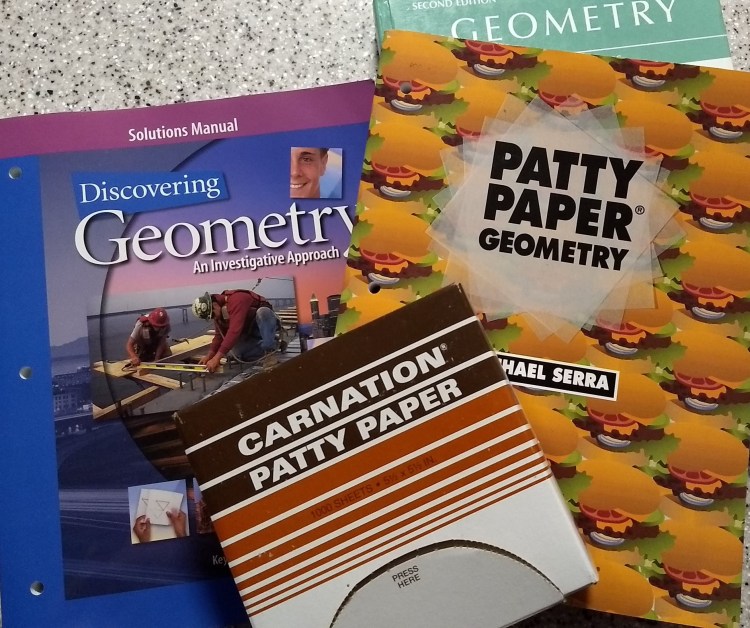
First, I cannot say enough good things about the textbook that we used – Discovering Geometry by Michael Serra. I AM a mathy person, and I really haven’t been in love with any of the texts we have used over the year (well, I did like the Math Mammoth series that we used). This book was different, and at times I felt it was written exactly for my daughter.

Chapter 0 (yes, zero) starts out with Geometry and Art. What better way to start the school year of geometry for my art-lover. The rest of the book is written to allow for exploration and investigation. Students are not given conjectures and theorems but are expected to use constructions (compass, protractor, straight-edge, ruler, and/or patty paper) to explore and discover the conjectures. In fact, the conjectures ONLY show up as fill-in-the-blank statements (though I found a complete list online for reference).

I remember my Geometry experience in ninth grade: two-column proof after two-column proof and my stack of theorems on note cards. This book is not like that. Two-column proofs aren’t even discussed until the last chapters of the book. Instead, flowchart proofs are used instead throughout the book, which are much more intuitive. The regular chapters are not “proof-heavy” either. The idea of each chapter is to explore the concepts and then solve real-world problems. A few proofs would be worked through either as section material or exercises.

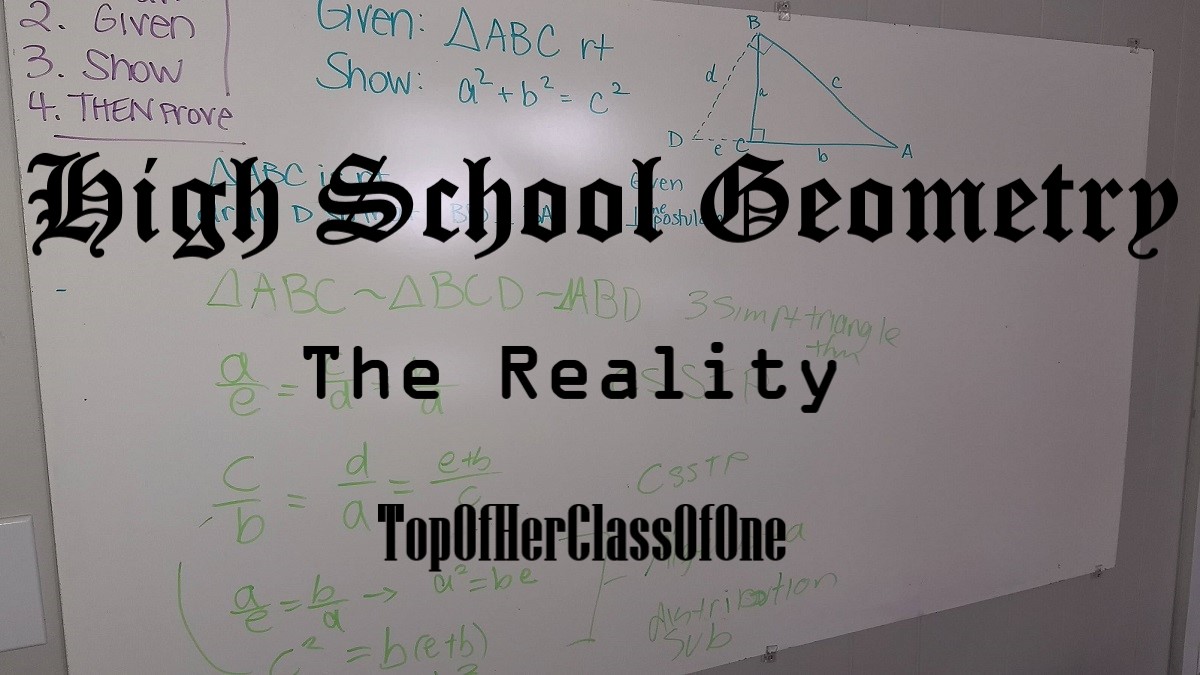
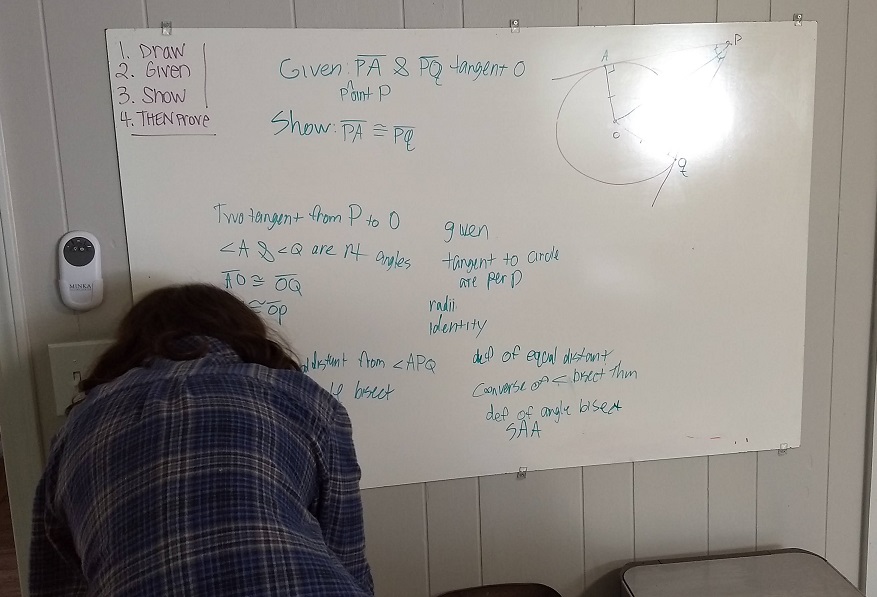
The final chapter of the book brings everything together and is ALL proofs. It explains the logic, the terminology, and then has the student prove almost everything from the book. We spent almost a month going through this chapter, and it was the best month of math for my daughter. We simply focused on a few proofs a day, and many were completed on our whiteboard in the kitchen. We would work through them together (without me first looking at the answer key). I explained to her that real mathematicians don’t sit at a table with paper and pencil by themselves; mathematicians stood with other mathematicians at whiteboards and worked through problems together. She loved the cooperative nature of the proofs, and she was doing very well at putting them together in all of their two-column formalness. This was a HUGE success.

Not only did having that final chapter on proofs solidify logic and proofs, but it served as a review of the entire year. We touched every chapter in that section, so it really was an end-of-the-year review/exam. Brilliant.

I highly recommend this textbook to any student of geometry that may be somewhat reluctant. And even for those that are strong in math. Personally, I was always strong in math, but I think I would have enjoyed this book — exploration is such a good learning tool.

Note: I had mentioned in my Plan that we would also use Michael Serra’s Patty Paper Geometry. There were so many patty paper explorations in his regular textbook that we never ended up using the book. It looks like a great resource (I would recommend it if you do NOT use the Discovering Geometry textbook).

I can’t say enough good things about geometry this school year. I highly recommend this text!

High School: Book Reviews

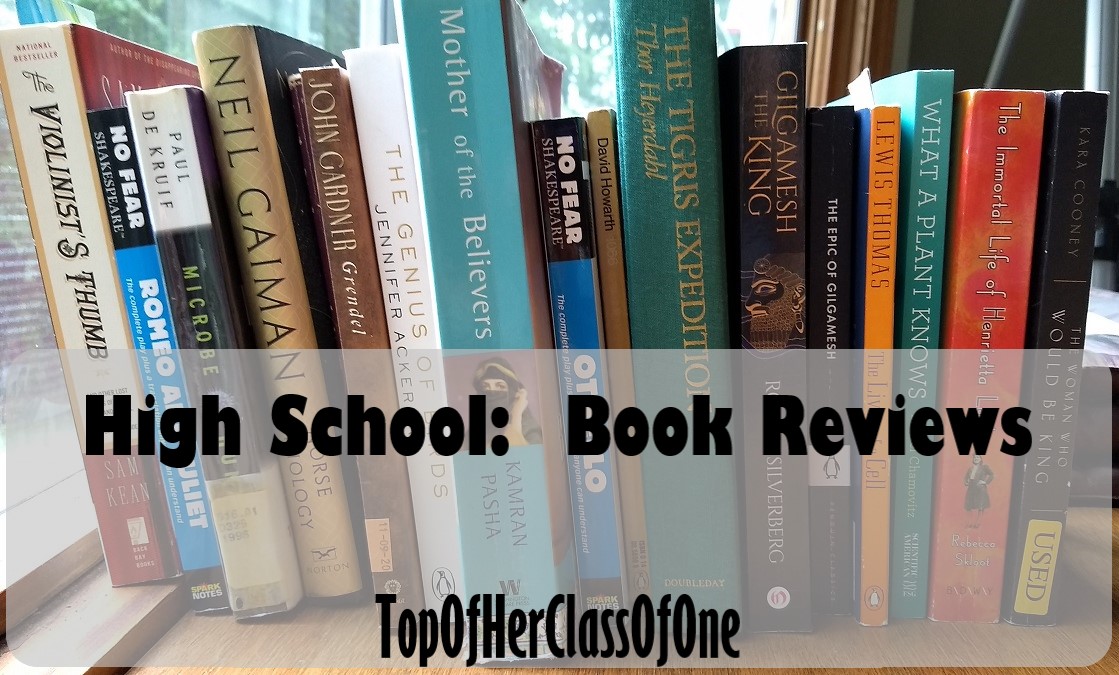
This post isn’t so much about a specific subject, but more of a “technique” I find both useful and memorable. We’ve always used “living books” where possible in homeschool (AmblesideOnline the early years, and Build Your Library now), and I initially wanted a method of reflecting on the books that we read. I think I may have read this suggestion somewhere years ago, but I don’t recall for sure, or even where I saw it (if I did read it somewhere, I apologize for not giving credit where due). A few years ago we started regular “book reviews”.

The format is simple:

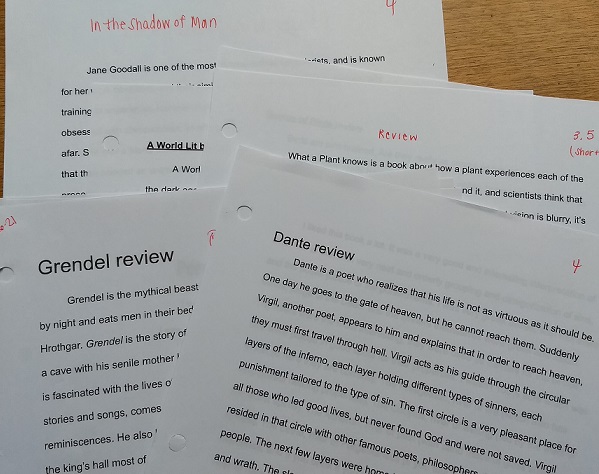
First paragraph(s): Summarize the book in a “typical” book report style. Narrate the main points of the book

Second paragraph(s): Explain whether or not you liked the book and why.

The benefits:

  1. Creates “closure” to the reading of the book. While she may have written other essays or had tests on the book, the book review is the last step with it.
  2. Allows her to reflect on the entire book and recall its main points. “Narration” is key in a Charlotte Mason education, and while narrating an entire book isn’t standard practice (generally “narrations” are done for more manageable chunks), it is still an exercise in recall. Doing this allows the student to piece together all of the parts of the book and discern what the author is trying to say.
  3. An exercise in composition. I used all of the book reviews as part of her English/Language Arts grades, even if the book was for another subject. Writing effective and grammatically correct essays are important.
  4. Allows the student to honestly say why (or why not) she liked a particular book. Opinions and feedback should be always encouraged in school. This will also help me as an instructor in the future determine which types of books might be the best fit.
  5. Memorable record of the school year. Having the book reviews all together in a binder at the end of the year is a sort of time capsule. Since all book reviews will have the same format from year to year (though the required “length” increases each year), it will be easy to compare her writing/style from one year to the next by putting different reviews side-by-side.

We try to have her write the book review close to the time that she finishes the book, but to be honest, often we bulk some of them up at the end of the term. Doing it that way also puts a closure to the current term: exam week is 1) exams and 2) book reviews.

I know this was a short post, but wanted to share this “beloved” and useful technique that we use in our homeschool.

High School Biology – The Reality

I had high expectations for Biology this year, knowing Sunshinegirl loved all things nature. The “rest” of Biology (microbiology, for example) could have gone either way — and different parts went different ways.

The Textbook

We started the year using the CK-12 Chemistry 1.0 book, but we quickly found that she had a rough time reading the chapters on a screen. She wasn’t retaining the information on her own, so we switched to using the Miller-Levine Biology book. The book is full of information and real-life applications, so it was a great Biology spine. We would read through the chapters together and discuss everything; Sunshinegirl preferred interactive Biology, not individual work.

What we were lacking were resources to go along with it — tests, quizzes, and worksheets. I was trying piece them together, but it was getting to be a bit much. Purchasing the teachers’ guide and/or worksheets just wasn’t turning out to be an option (either very expensive or too “used”…long story).

About halfway through the school year we switched back to CK-12 Biology, but this time we used the Biology Flexbook 2.0 option. The 2.0 option includes embedded videos and extra resources (readings, Interactives, videos) to supplement the material — a true multi-media learning experience. I took the time to do the Teacher “certification” course for Flexbook 2.0, and that really made me realize this would be a good option for us. As a “teacher”, I could take the base Flexbook (textbook) and customize it! I could rearrange (or add!) chapters, add content pages, update existing pages, modify the daily quizzes, and assign work. When we were in the infectious disease chapter, I could easily add a paragraph about COVID and some embedded YouTube videos about it. If I wanted to go into more detail about taxonomy, I could add those details very easily.

Built into the Flexbooks are daily “Practices” (online quizzes) that cover that particular section. The Practices are adaptive, meaning as students get questions right (or wrong), it adjusts. The issue we found is that the question bank covers more than what was in the reading; the questions are on a “topic”, but different textbooks go into more/less detail. She was getting questions that did not apply to the section she read. In addition, she was having issues with the “fill-in-the-blank” questions; they were very picky on spelling, capitalization, and hyphenation. So instead of using the out-of-box Practices, I started building my own from the CK-12 question bank. I could easily replace the standard Practices with my custom quizzes.

After a while, associating a quiz per section (we would cover 3-5 sections a day) was getting tedious, though, so I went to building quizzes that I could print. I would build a quiz that covered multiple sections all in one. Once those are built, you can request either a PDF or HTML version of them, either with or without the answer key. This became the standard for the rest of the year. It was still a few hours of work on my part each week to create and print those quizzes, but the resources were all there — I just had to pull them together.

Note: We looked at using the CK-12 Biology 1.0 worksheets and quizzes since they were “close” to the 2.0 book. The v1.0 is more of a typical book and has associated PDFs with worksheets, tests and quizzes for the instructor to simply print. There is no online quiz option, only the worksheets.

The Living Books

The living books that she read this year were mostly well received. I read through as many as I could, and I enjoyed the reads myself.

Lives of a Cell: Notes of a Biology Watcher by Lewis Thomas

I Contain Multitudes by Ed Yong

The Violinist’s Thumb by Sam Kean

The Sixth Extinction: An Unnatural History by Elizabeth Kolbert

The Microbe Hunters by Paul De Kruif

The Genius of Birds by Jennifer Ackerman

In the Shadow of Man by Jane Goodall *

What a Plant Knows by Daniel Chamovitz

Soul of an Octopus by Sy Montgomery *

* The two starred books were biology-related books that I let her choose on her own. She LOVED them both and keeps them in her own book collection (instead of in the homeschool section). She was inspired by both books. Here is a portion of her book review:

“…The chimps have complex hierarchies and as many feelings as we do. They use tools in everyday life, and sometimes they even innovate with human objects. Goodall named each and every chimp, and walked with them, groomed them, and even cared for them sometimes. Her work inspired many more to come.

Including me! I love this book so much! I’m keeping it on my shelf and reading it again. It mirrored the number one thing on my list of greatest wishes: to someday be adopted by wild animals. I want to be trusted by animals and adopted somehow and this book helped me to believe I can do it!”

The Labs

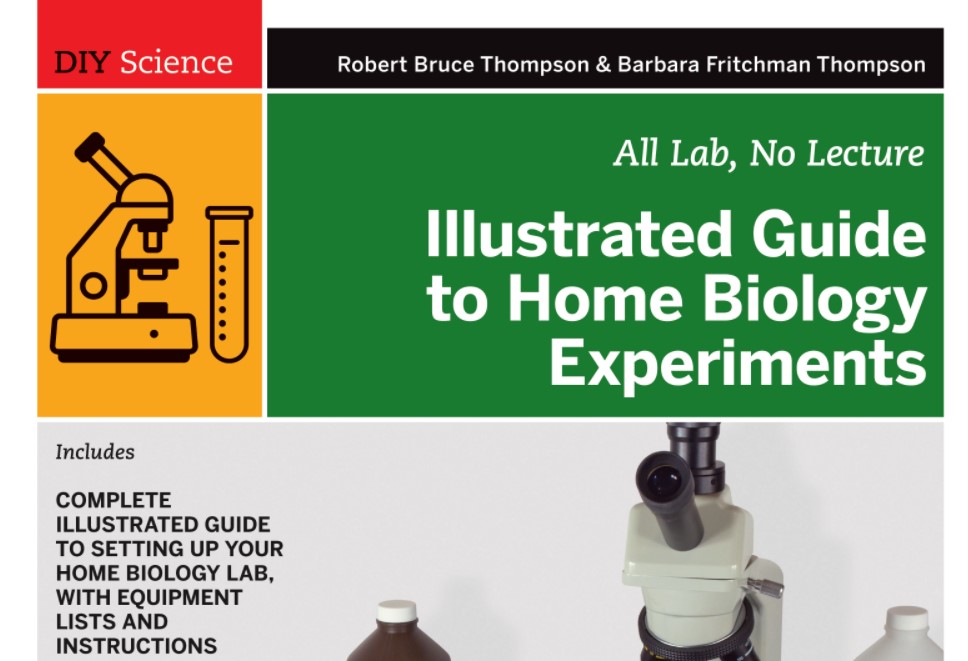
For the most part, we used the Illustrated Guide to Home Biology from the Home Scientist. The labs were very detailed, but we were not always getting the results we wanted. We had most of the kit already (from another kit), but did have to purchase a few things to complete it. What we didn’t purchase were a lot of the “pre-prepared slides” and such, and those were used a bit more than I had realized (used once, but many labs had a “pre-prepared” component).

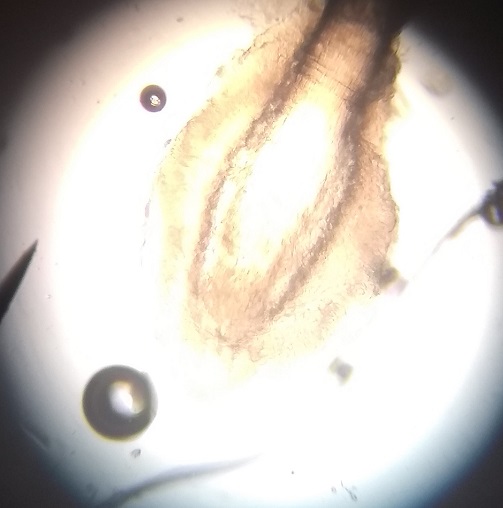
The labs were helpful, but I think it was the lack of importance we placed on them that made them fizzle. I scheduled labs for Friday afternoon, which in hindsight probably wasn’t the best time. That being said, the book and kit were invaluable. I may not have gotten Sunshinegirl to ever write up a good lab report, but she did explore and have fun drawing what she saw in the microscope.

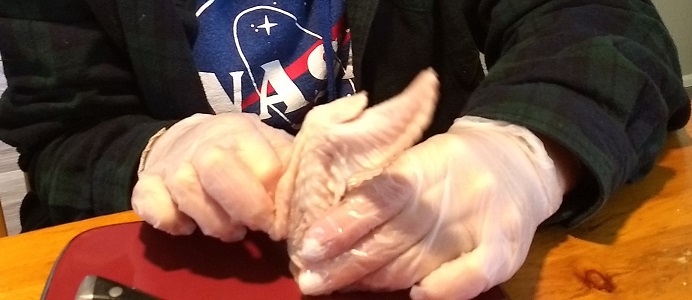
One last note on Biology labs: we chose not to do the “standard” dissection. The idea of cutting open a fetal pig or frog just wasn’t what my nature lover wanted to do. BUT, I did find resources online for using grocery-store chickens. I put that whole chicken in front of her, and she explored the bones, the ligaments, the tendons, and tried to make sense of the mostly-missing giblets. The chicken wing dissection was most interesting (finding the ligaments that make the wing move!), so I recommend you Google “chicken wing dissection” and review your options.

Final Notes

This year was a challenging year overall for Sunshinegirl. Getting used to “high school level” courses and what was expected of her was the biggest obstacle. Biology didn’t turn out as I hoped. Instead of wonderfully neat lab reports and well-organized class notes, it ended up as an exploration of all things Biology. In my opinion, allowing for exploration is key to keeping interest in the sciences. The lab reports and notes will come later as far as I am concerned.

Biology was a success.

High School World History 1 – The Plan

Ahh, history. The subject I think I hated the most in high school. I did fine in all of my history classes, getting A’s in them all, but I never enjoyed them. Most of the classes were dry — the teacher basically read from the dry textbook, and tests were about regurgitating dates and names. I think I mentioned in my “Where we’ve been” posts that history is more than dates — it is the stories and the real people behind what has happened.

We had been using AmblesideOnline‘s history plan since kindergarten (for the most part, with some additions and substitutions), but for high school I wanted to 1) stay closer to what the state mandates are (World History, American History, Economics/Government), and it would be hard continuing with Y9 of AO. We had to strike out on our own.

The goal: World History through around 1600, with Geography interspersed

We are using Build Your Library’s Year 10 curriculum (BYL10) this year as our base, using most of the books that are suggested in that plan for history. While I find the books amusing, I couldn’t bring myself to assigning the Cartoon History of the Universe books by Larry Gonick as our “spine”, so we opted to read a section from CK-12 World History instead each week. (Sunshinegirl will read through some of the Cartoon History books, but more on her own free time.) We hope to make it through half of the CK-12 World History book this year, using the second half for next year (World History 2 – 1600 – present).

Other than this main switch, we are using most of the books listed in the BYL10 curriculum. Since I am slow and didn’t create this “Plan” blog prior to the start of school, I can tell you that we have made it through the Africa and The Woman Who Would be King books, along with the other spine we are using, World History in Documents. (All books are linked in the BYL10 site).

Some of our History and Geography books – World History 1

Since our state (Michigan) mandates that World History classes contain “geography” as well (there is no separate mandate for a “geography” course), I opted to supplement with a standard Geography text. I chose Glencoe Geography from the few choices out there, and I am using one that is a few editions behind (less than $10 on Amazon). Sunshinegirl reads 2-3 sections of the book each week; we opted to start midbook with Northern Africa and the Middle East since it corresponded to the history we are doing. We will make it through about half the book this year, and then use the same book for Europe and the Americas next year for World History 2.

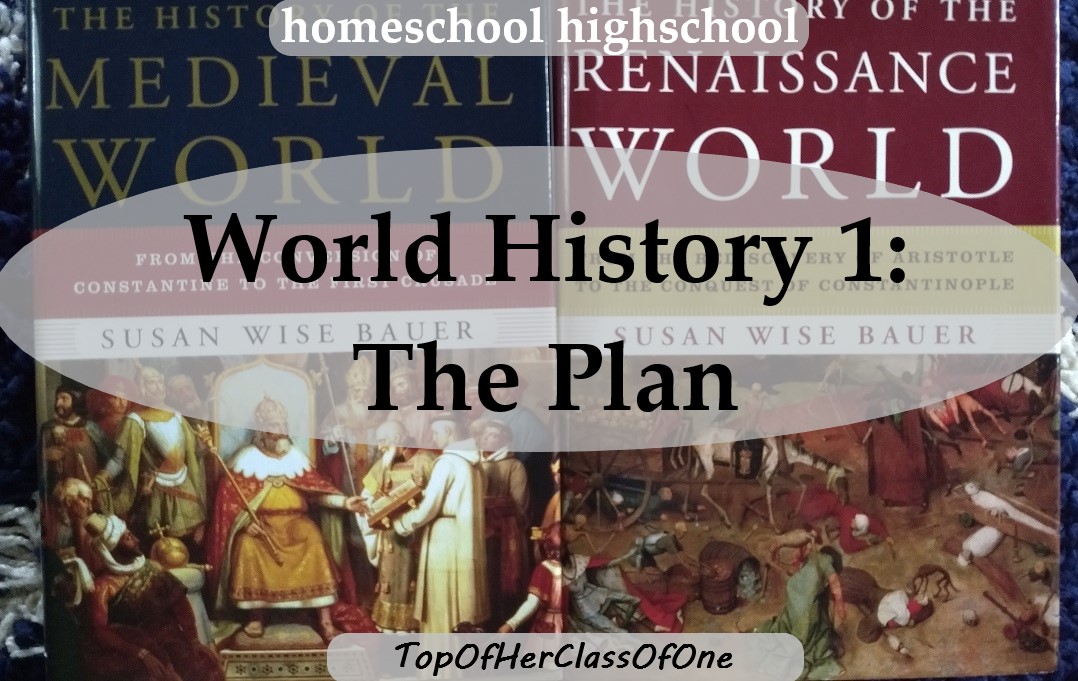
I had evaluated Susan Wise Bauer’s History of the Medieval World and History of the Renaissance World as potential spines, but I determined they were a little too “deep” as a spine for Sunshinegirl. We enjoy starting our school day with a read, and I had the books anyway, so we start the day reading one chapter of those books. The goal is to get through both by the end of the school year. While the content is varied (NOT just Western History), for a ninth grader it would be tough to use as a spine, unless that student loved history and had a great memory for names. It is a great supplement to what we are learning and what we have learned over the years — I chose it since it did have Asian and Middle Eastern history in it as well. The chapters each focus on one area of the world, and the book is laid out chronologically, so one chapter may be on Charlemagne in the Holy Roman Empire, and the next might be on ancient Korea and Japan. Each chapter has a map outlining the territories of that chapter, which is an amazing asset (and connects “world history” with “geography”).

Finally, since I think most textbooks are dry, and while they serve a purpose as a spine, I like to supplement them all, that left us with a Geography textbook but no “living books” to go with it. So far this year I have two books planned to supplement Geography, one we have completed already and one that we are about to start. We started the year with Thor Heyerdahl’s The Tigris Expedition. We had read Kon Tiki last year for Geography and really enjoyed it, so the chance to read a similar book that focused on Sumerian and Indus Valley cultures was perfect. Both books chronical Thor Heyerdahl’s adventures building boats using the methods of the time periods he is examining, and then attempting to use the boats to show that their range and construction out perform what contemporary experts predict. The Tigris was built in what is though to be the ancient Sumerian style, and Heyerdahl set out to prove that the boats were not simple short-voyage river boats as thought, but long-range seafaring vessels.

The other book we plan to read jumps forward in history quite a ways, really outside of our World History range, but after reading Galileo’s Daughter by Dava Sobel last year, we wanted to read another of her books. We chose Longitude, the eighteen-century quest to find a method for calculating a person’s longitude.

The final question: how will we do assessments (tests)?

History is a set of stories, and to be honest, I don’t want to rely on tests that memorize facts and dates. The plan this year for assessments is to use regular written narrations. At least three history reading a week are designated as either outline or written narrations. Sunshinegirl is expected to write at least a page summary of the reading, analyzing what she read as she sees fit. The bulk of her “grades” fall into this category; they are graded on a scale of 0-4 (4 being “exceeds expectations” and 0 means “nothing turned in”). The other portion of her grade will be on projects and essays; the first main project will be a comparative exercise on the main river valley civilizations that we have covered this first semester. Instead of memorizing dates, I’d much rather see the stories analyzed, classified, and connections made. So for now, no tests!

The final aspect of any good “social studies” course is to focus on current events. This year (2020) has been a big year for “big events”, including the 2020 US presidential election. I don’t have any formal requirements for current events as far as school goes — Sunshinegirl just naturally is interested in listening to the news (NPR) daily and commenting on the state of the nation and the world. We have supported our “coverage” of the election by adding in Richard Maybury’s Are you Liberal? Conservative? or Confused?. AmblesideOnline’s curriculum used many of Maybury’s “Uncle Eric” series books, so we continued this year with that since it would help explain Republican versus Democrat, etc.

We’ll see how the year goes. Hopefully we can make it as far as I plan, so we can be on track for World History 2 next year (unlike my high school experience, I hope we don’t run out of time before hitting the “present”).

High School French 2 – The Plan

I started my language-learning career in 9th grade like most high schoolers — other than short enrichment elective courses early in middle school, my schools (and I attended two different districts in two different states for middle school) did not offer foreign language until high school. Some studies show that language-learning is most natural in early childhood, so I took that to heart when planning homeschool. If you’ve read my “Where we’ve been: World Languages” post you will know we started in kindergarten and have gone through various stages of German, Latin and French. French is what I learned in high school, so we opted to go that route for high school so I could be (possibly) better equipped to teach it.

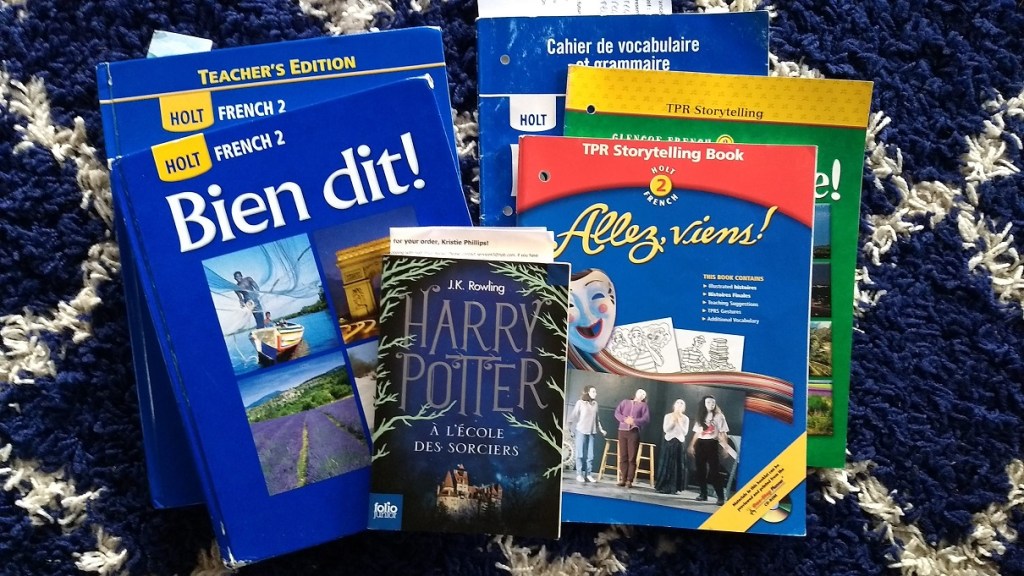
We started French in 6th grade, so now that we are in 9th grade, we are starting “officially” at the French 2 level. In 7th grade I took the time to look at textbook reviews and chose Bien Dit 1 for French 1. Now that we are officially in French 2, after looking at textbook reviews and samples again, I ended up deciding to continue with Bien Dit 2 for 9th grade. (Note: we use an older edition; you can get them used on Amazon for under $10). I choose this as our spine since it seemed to be the most “advanced” in scope and sequence when compared to other standard public school textbooks — far more tenses are covered in BD2 than in other texts.

When we used BD1 in 7th grade, we struggled using it as our only resource. We’d walk through the lessons, and I would assign the exercises as homework — this is what we did in my high school class, so why not, right? We didn’t seem to have as much interaction with BD1, so I knew that using BD2 we’d have to do something different.

I did some research prior to 9th grade on methods for teaching foreign language, and I came upon a few variants of the same idea: use real resources (books, videos, skits) in the classroom that are at level for the student. TPRS (teaching proficiency through reading and storyingtelling) and CI (comprehensible-input) were the buzzwords when it came to foreign language instruction. Since kindergarten I have had foreign language story books in our classroom, reading those to Sunshinegirl for fun. TPRS with the aid of CI takes this further; making this a central part of the learning experience is key.

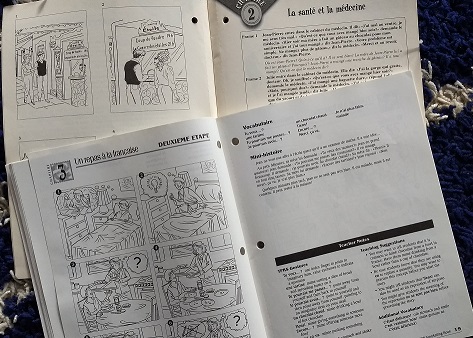
I won’t go into the details, but what I found out is that there are special TPRS readers (think of leveled reader books you buy for kids learning to read) that are written for the specific year of learning (first year, second year, etc.), and each usually has a glossary of words, and some have comprehension questions. There are also TPRS guides that correspond to many of the standard public school textbooks (not for Bien Dit, unfortunately). Each of those focuses on short storytelling sessions with comic-book-like pictures as a prompt for the students; teacher can read the story while the students look at the images, and if you have an active class, they can act out the story as it is read a second or third time.

Allez-Vien and Bon Voyage level 2 TPR Storytelling supplement guides

The other piece of this different view on foreign language is how to assess (read: “grade”) students. In my French class in high school, we were given grades on homework, journals, tests/quizzes, and sometime projects/skits/etc. Experts are finding that assessment for foreign language should not be on those categories, but should be in the different aspects of learning a language: reading comprehension, speaking, listening comprehension, and writing. Using standards based grading changed my way of looking at learning French, and to be honest, I wish we had had that in high school. (Don’t get me wrong — my high school experience was fantastic – Madame Butler really taught as a lot, much of which is still with me 30 years later. But I realized that in high school I was good at reading and writing, but not so good at listening and speaking. If we had equal chances to be assessed on all four things, I might be more fluent.)

So what are we going to do?

Note: This was written after the plan was developed and a few months into school, so it isn’t so much “what are we going to do” as “what are we doing so far”. Not a plan, but the current plan…

Ok, enough talking about the background. I will include more links at the bottom to some of the resources I found, but I wanted to get into what we are actually doing for French 2.

First, as I mentioned in the previous section, I wanted to change how I handled grades/assessments. No longer would a grade be given on the end-of-chapter test that is standard with the textbook. I wanted to really assess on the different aspects of language learning.

We are using the Bien Dit 2 book as our spine, and we spend three weeks on each chapter (which works out to about a full school year). The third week of each chapter is assessment week. My gradebook has five lines for grades for each chapter, and this is how each is assessed:

  1. Speaking/Storytelling: We use TPRS storytelling supplements for other textbooks and walk through one “story” a week. At the end of week 3, Sunshinegirl gets to pick one of the stories, and she has to “tell” me the story by just using the “comic” illustrations as a guide. She doesn’t have to stick to the story as was written in the book, but it just has to go along with the pictures somehow. It isn’t something memorized; it promotes natural language using images as prompts.
  2. Writing: I found on one of the TPRS/CI websites the idea of the 1-3-10 free write. In this for us, I give Sunshinegirl a prompt (generally the topic of the current chapter in the textbook), and then for 1 minute she has to write about it. The timer stops, pencil is down, and she counts the number of words written. We then reset the timer for 3 minutes, and when the clock starts, she rewrites the words from the 1 minute drill and continues on with her writing. The timer stops again, she counts the words, and then the timer is reset for 10 minutes. Again, the 10 minutes starts with rewriting the words from the previous session, but then continues for the full 10 minutes. I think having the break in between the sessions (about a minute or so) gives time to process and think about what she is going to say. The grammar and spelling aren’t perfect, and that is fine. But words are coming out at a normal “pace”. I generally grade this on the usage of the vocabulary and verbs from the current chapter; I don’t penalize for attempting constructs that we haven’t learned yet.
  3. Reading comprehension: The Bien Dit 2 book has a section towards the end of each chapter that has some excerpt of French literature followed by reading comprehension questions. I have Sunshinegirl do that section on her own.
  4. Listening comprehension: I found years back a set of LP records for learning French, each track being a separate “story” of about 2-3 minutes in length. There is an accompanying book that has the script in both French and English, followed by some questions about what was spoken. I generally choose one of the tracks that is in line with what we know and play that for her listening comprehension assessment. She loves them because they are retro 1950s conversations, and they are clear and easy to follow.
  5. Vocab/grammar/verbs: I can’t ignore the vocabulary and grammar we learned from the book over the past three weeks, so I do give a “standard” chapter test. It has a list of vocabulary to translate, sentences to translate both to and from French, and verb conjugations.
c1950s Living Language Course record set

This has worked well in terms of assessments. I don’t keep grades on daily work, which usually consists of pages from the Bien Dit 2 workbook and sometimes verb “quizzes”.

My gradebook showing each “section”, its weight and the grading scale (1-4).

What do we do on a typical day of French class? Glad you asked!

Because I know being immersed in the language is important, we are now starting our French time with 10-15 minutes of free read. I encourage her to read something that is a bit challenging for her current French level, but something she knows in English. I ordered the first Harry Potter book, and she is working through that. (While I work through Stephen King’s “The Body”, since I am a fan of the movie “Stand by Me”.) We both sit and read next to each other, but silently. It sets the stage for French class.

Next we usually go on to do one of the following:

  1. Do our TPRS lesson of the week (2-3 days we practice this).
  2. Watch an “Easy French” episode on YouTube. Very easy to understand, and it explains new language ideas clearly and totally in French.
  3. Just talk. Sometimes just having a conversation is fun!

Finally, we open up the textbook, read the current lesson (usually we do 2 pages a day, which is how the book is broken up), and then we do all of the book exercises together out loud. (We don’t always do the “discuss with your group” exercises.) Her homework is to do the corresponding lesson in her Bien Dit 2 workbook.

Final thoughts

I am hoping my level of French can keep up with Sunshinegirl’s. I want to be able to be “immersive” in our classes, but I have to honestly say I am not totally there yet. Though I took four years in high school and a year in college, I never got to the fluent level, but I do remember a lot (and I have retained the decent accent that Madame taught us). I think the best way to learn is to immerse yourself, and hopefully I am doing enough to help her learn. Our goal for some years now has been to go to Quebec for a week and somewhat immerse ourselves – hopefully once the pandemic goes away we can make that a reality.

Links

Disclaimer: I have no affiliation with any of the links below — I am not making any money off of the links. Feel free to purchase resources from wherever you are comfortable.

There are many links in the post itself, but I wanted to consolidate them in one handy list:

Bien Dit 2 on Amazon
Bien Dit 2 workbook on Amazon
Bien Dit Scope and Sequence
Easy French on Youtube
Alice, La Liste (our first TPRS reader)
TPRS reader shop
1-3-10 free write (download the worksheet for the writing)
French Standards Based Grading info
More Standards Based Grading info
Ohio’s rubrics for grading (I do not live in Ohio, but this is a good list)
Other French language posts on my Pinterest board