
Ok, so really this is the PLAN and the REALITY since I never got to putting together a post on our plan. I’ve learned a lot about language acquisition this year, so here goes.
We started with the Holt Bien Dit 3 textbook. From what I can gather, very few standard school textbooks have a French 4 option — it appears schools sometimes use the French 3 texts for both years, so I thought we’d try that.
After using this series of textbook for French 1 and 2, and starting the third year, I realize it isn’t meant for a homeschool situation. For French 1 and 2 it was somewhat useful since it provided the grammar necessary to learn the language. For French 3, it was useful, but I didn’t feel it was taking her to the level of fluency as fast as I would have likes.
And then I found resources that (I think) European countries use: ELI readers and Hachette CEFR leveled grammar books.
Around March of this school year we finished Chapter 6 in the Bien Dit 3 textbook, and I felt we needed to step it up and “get real”. I did my research, and instead of continuing to Chapter 7, we decided to do the following each day:
- 30 minutes of Duolingo
- Read together from one of the leveled French ELI readers (A2 or B1: Junior and Senior)
- Work through a section of Hachette’s En Contexte A2 Exercise de Grammaire
I think this was the key (lol, at least for me!). Duolingo provided the warm-up; we would each go into a separate room and work through our respective lessons (yes, I did them, too). Once we were done, we would come together and work through one of the readers; she would first read the chapter to herself, and then I would read it again out loud. Having two readings made it easier for comprehension. Note: The ELI readers have links to online resources AND audio files of the chapters. We never used the audio files since I can butcher my way through reading French, but for learners that do not have that option, I think they would be valuable.
After the readings, she would answer the end-of-chapter questions located right in the book. Yes, there are comprehension and grammar exercises right in the readers!
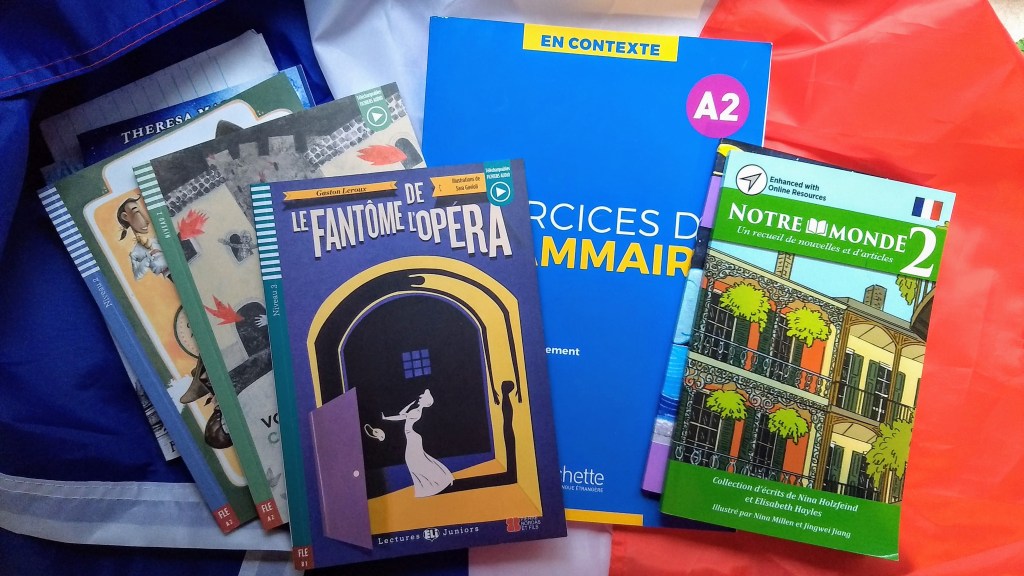
The ELI readers vary in content, but we chose to read the “classics” retold. What a great way to introduce classic French literature (The Three Musketeers, Phantom of the Opera, Cyrano de Bergerac, and Perceval Ou Le Conte Du Graal.
One more great thing: some of them are FREE online. Always love free!
Once we worked through the reading and discussion, she would work through a section of the En Contexte A2 Exercise de Grammaire. She generally considered this homework (she prefers to do her French right before bed, since she says she falls asleep thinking about French…hey, it can’t hurt!). She would check her own work on the exercises, and then I would check the “Bilan” sections (end of section review); I would use the Bilan score as a test/quiz grade.
Instead of the typical final exam based on grammar and vocabulary from the textbook, I decide to go a different route. Why test on specifics when the goal of learning a language is to be able to communicate? There was no studying for this test (which was relieving to her!).
Exam:
- Speaking component: combination of her reading passages out loud (looking for pronunciation) and conversational French
- Listening component: I would read a passage and she would answer questions (either out loud in French or written)
- Writing component: She would read a passage and write about it, either open format or answering short answer questions.
This was far more relaxed than a normal French exam, and I think it honestly assesses the goal of language learning. A standard “exam” would have assessed the specific vocabulary learned in a given period; this assesses overall fluency.
Her final project for the class was to write a story, and she nailed it. Though, I didn’t realize that Google docs can easily spell and grammar check in French, so there were not very many errors (and she even used the passe simple, which if you know French, is only a older literary tense).
Grading: Chapter tests, En Contexte Bilan, and various speaking, writing, comprehension, and listening grades (including the exam).
 Top of Her Class of One