This is a follow-up post to the beginning-of-the-year post on my Plan for Geometry for this school year. In this post I will discuss how Geometry went and whether we stuck to the Plan.
As I mention in my Plan for Geometry post, Sunshinegirl has never claimed to be a “mathy” person. While I think I have mentioned before that ANYONE can be a “mathy” person if he/she puts her mind to it (see the great resources by Dr. Jo Boaler and youcubed.org), my student hasn’t yet decided that she wants to love math.
BUT, this year I think helped. Sunshinegirl is very visual and enjoys art. Geometry is full of shapes and symmetries, as well as logic, all of which were suited for my student. I had high hopes for this year in terms of boosting her confidence with math, and I think all went well.
First, I cannot say enough good things about the textbook that we used – Discovering Geometry by Michael Serra. I AM a mathy person, and I really haven’t been in love with any of the texts we have used over the year (well, I did like the Math Mammoth series that we used). This book was different, and at times I felt it was written exactly for my daughter.
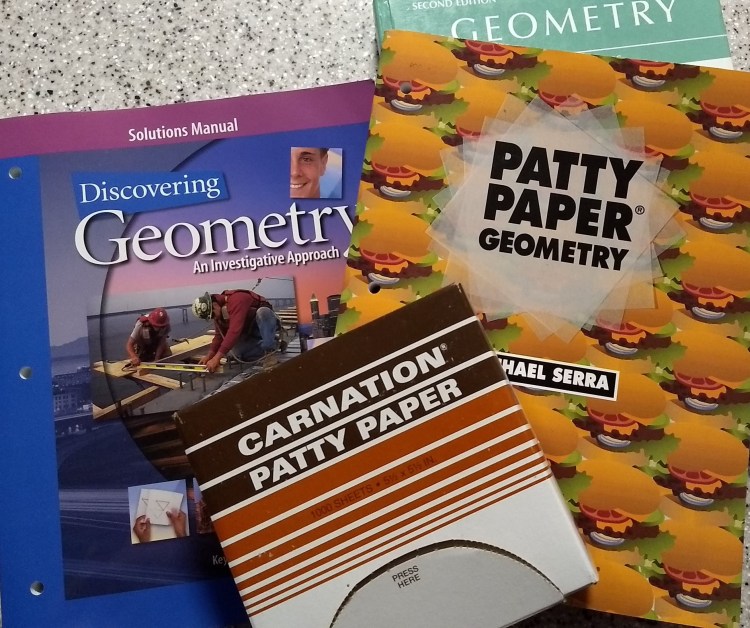
Chapter 0 (yes, zero) starts out with Geometry and Art. What better way to start the school year of geometry for my art-lover. The rest of the book is written to allow for exploration and investigation. Students are not given conjectures and theorems but are expected to use constructions (compass, protractor, straight-edge, ruler, and/or patty paper) to explore and discover the conjectures. In fact, the conjectures ONLY show up as fill-in-the-blank statements (though I found a complete list online for reference).
I remember my Geometry experience in ninth grade: two-column proof after two-column proof and my stack of theorems on note cards. This book is not like that. Two-column proofs aren’t even discussed until the last chapters of the book. Instead, flowchart proofs are used instead throughout the book, which are much more intuitive. The regular chapters are not “proof-heavy” either. The idea of each chapter is to explore the concepts and then solve real-world problems. A few proofs would be worked through either as section material or exercises.
The final chapter of the book brings everything together and is ALL proofs. It explains the logic, the terminology, and then has the student prove almost everything from the book. We spent almost a month going through this chapter, and it was the best month of math for my daughter. We simply focused on a few proofs a day, and many were completed on our whiteboard in the kitchen. We would work through them together (without me first looking at the answer key). I explained to her that real mathematicians don’t sit at a table with paper and pencil by themselves; mathematicians stood with other mathematicians at whiteboards and worked through problems together. She loved the cooperative nature of the proofs, and she was doing very well at putting them together in all of their two-column formalness. This was a HUGE success.
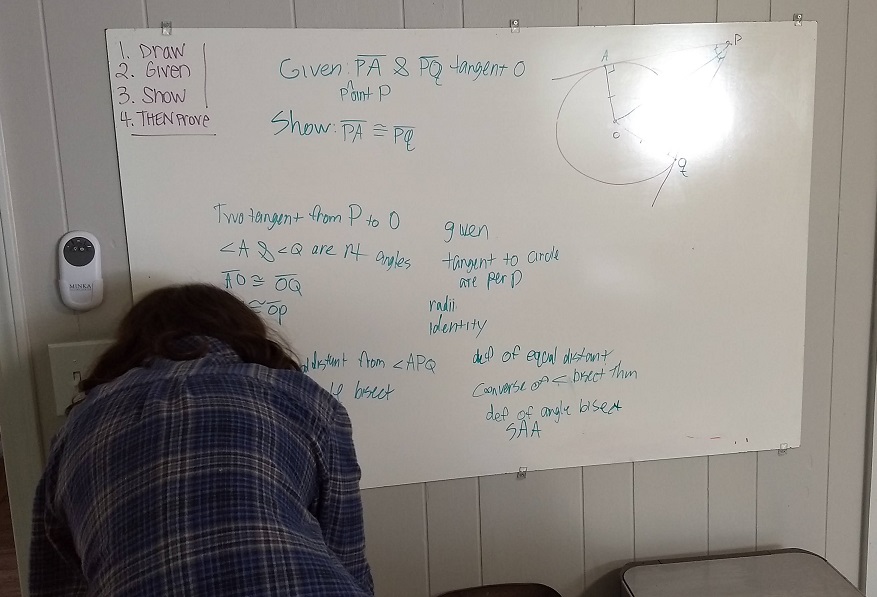
Not only did having that final chapter on proofs solidify logic and proofs, but it served as a review of the entire year. We touched every chapter in that section, so it really was an end-of-the-year review/exam. Brilliant.
I highly recommend this textbook to any student of geometry that may be somewhat reluctant. And even for those that are strong in math. Personally, I was always strong in math, but I think I would have enjoyed this book — exploration is such a good learning tool.
Note: I had mentioned in my Plan that we would also use Michael Serra’s Patty Paper Geometry. There were so many patty paper explorations in his regular textbook that we never ended up using the book. It looks like a great resource (I would recommend it if you do NOT use the Discovering Geometry textbook).
I can’t say enough good things about geometry this school year. I highly recommend this text!
 Top of Her Class of One