Ahh, history. The subject I think I hated the most in high school. I did fine in all of my history classes, getting A’s in them all, but I never enjoyed them. Most of the classes were dry — the teacher basically read from the dry textbook, and tests were about regurgitating dates and names. I think I mentioned in my “Where we’ve been” posts that history is more than dates — it is the stories and the real people behind what has happened.
We had been using AmblesideOnline‘s history plan since kindergarten (for the most part, with some additions and substitutions), but for high school I wanted to 1) stay closer to what the state mandates are (World History, American History, Economics/Government), and it would be hard continuing with Y9 of AO. We had to strike out on our own.
The goal: World History through around 1600, with Geography interspersed
We are using Build Your Library’s Year 10 curriculum (BYL10) this year as our base, using most of the books that are suggested in that plan for history. While I find the books amusing, I couldn’t bring myself to assigning the Cartoon History of the Universe books by Larry Gonick as our “spine”, so we opted to read a section from CK-12 World History instead each week. (Sunshinegirl will read through some of the Cartoon History books, but more on her own free time.) We hope to make it through half of the CK-12 World History book this year, using the second half for next year (World History 2 – 1600 – present).
Other than this main switch, we are using most of the books listed in the BYL10 curriculum. Since I am slow and didn’t create this “Plan” blog prior to the start of school, I can tell you that we have made it through the Africa and The Woman Who Would be King books, along with the other spine we are using, World History in Documents. (All books are linked in the BYL10 site).

Since our state (Michigan) mandates that World History classes contain “geography” as well (there is no separate mandate for a “geography” course), I opted to supplement with a standard Geography text. I chose Glencoe Geography from the few choices out there, and I am using one that is a few editions behind (less than $10 on Amazon). Sunshinegirl reads 2-3 sections of the book each week; we opted to start midbook with Northern Africa and the Middle East since it corresponded to the history we are doing. We will make it through about half the book this year, and then use the same book for Europe and the Americas next year for World History 2.
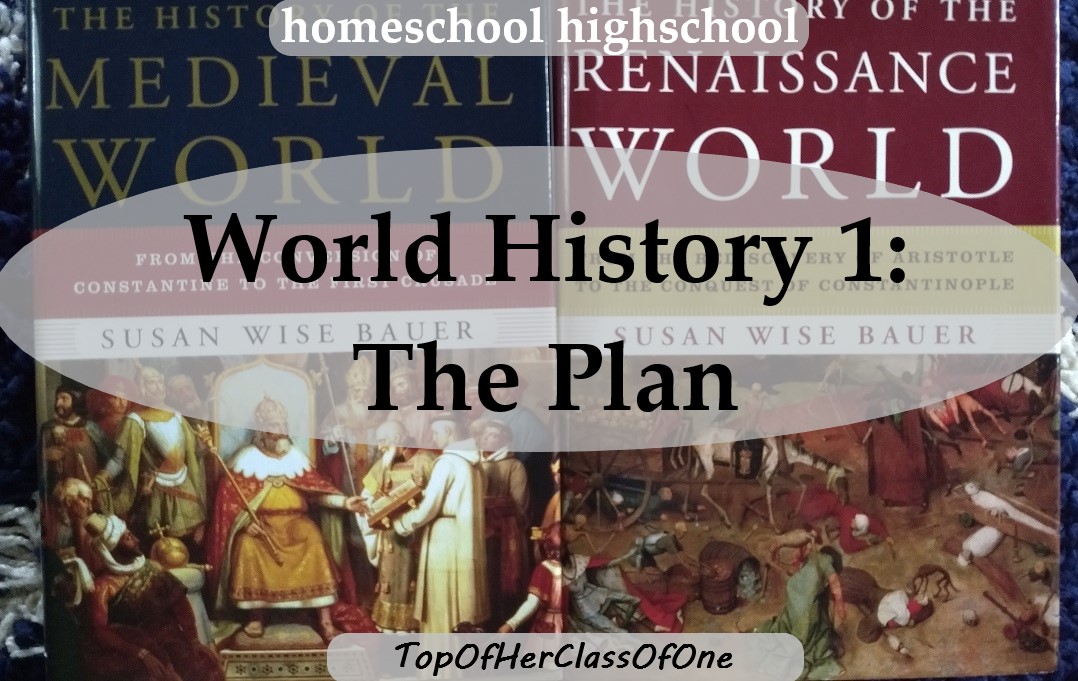
I had evaluated Susan Wise Bauer’s History of the Medieval World and History of the Renaissance World as potential spines, but I determined they were a little too “deep” as a spine for Sunshinegirl. We enjoy starting our school day with a read, and I had the books anyway, so we start the day reading one chapter of those books. The goal is to get through both by the end of the school year. While the content is varied (NOT just Western History), for a ninth grader it would be tough to use as a spine, unless that student loved history and had a great memory for names. It is a great supplement to what we are learning and what we have learned over the years — I chose it since it did have Asian and Middle Eastern history in it as well. The chapters each focus on one area of the world, and the book is laid out chronologically, so one chapter may be on Charlemagne in the Holy Roman Empire, and the next might be on ancient Korea and Japan. Each chapter has a map outlining the territories of that chapter, which is an amazing asset (and connects “world history” with “geography”).
Finally, since I think most textbooks are dry, and while they serve a purpose as a spine, I like to supplement them all, that left us with a Geography textbook but no “living books” to go with it. So far this year I have two books planned to supplement Geography, one we have completed already and one that we are about to start. We started the year with Thor Heyerdahl’s The Tigris Expedition. We had read Kon Tiki last year for Geography and really enjoyed it, so the chance to read a similar book that focused on Sumerian and Indus Valley cultures was perfect. Both books chronical Thor Heyerdahl’s adventures building boats using the methods of the time periods he is examining, and then attempting to use the boats to show that their range and construction out perform what contemporary experts predict. The Tigris was built in what is though to be the ancient Sumerian style, and Heyerdahl set out to prove that the boats were not simple short-voyage river boats as thought, but long-range seafaring vessels.
The other book we plan to read jumps forward in history quite a ways, really outside of our World History range, but after reading Galileo’s Daughter by Dava Sobel last year, we wanted to read another of her books. We chose Longitude, the eighteen-century quest to find a method for calculating a person’s longitude.
The final question: how will we do assessments (tests)?
History is a set of stories, and to be honest, I don’t want to rely on tests that memorize facts and dates. The plan this year for assessments is to use regular written narrations. At least three history reading a week are designated as either outline or written narrations. Sunshinegirl is expected to write at least a page summary of the reading, analyzing what she read as she sees fit. The bulk of her “grades” fall into this category; they are graded on a scale of 0-4 (4 being “exceeds expectations” and 0 means “nothing turned in”). The other portion of her grade will be on projects and essays; the first main project will be a comparative exercise on the main river valley civilizations that we have covered this first semester. Instead of memorizing dates, I’d much rather see the stories analyzed, classified, and connections made. So for now, no tests!
The final aspect of any good “social studies” course is to focus on current events. This year (2020) has been a big year for “big events”, including the 2020 US presidential election. I don’t have any formal requirements for current events as far as school goes — Sunshinegirl just naturally is interested in listening to the news (NPR) daily and commenting on the state of the nation and the world. We have supported our “coverage” of the election by adding in Richard Maybury’s Are you Liberal? Conservative? or Confused?. AmblesideOnline’s curriculum used many of Maybury’s “Uncle Eric” series books, so we continued this year with that since it would help explain Republican versus Democrat, etc.
We’ll see how the year goes. Hopefully we can make it as far as I plan, so we can be on track for World History 2 next year (unlike my high school experience, I hope we don’t run out of time before hitting the “present”).
 Top of Her Class of One