I started my language-learning career in 9th grade like most high schoolers — other than short enrichment elective courses early in middle school, my schools (and I attended two different districts in two different states for middle school) did not offer foreign language until high school. Some studies show that language-learning is most natural in early childhood, so I took that to heart when planning homeschool. If you’ve read my “Where we’ve been: World Languages” post you will know we started in kindergarten and have gone through various stages of German, Latin and French. French is what I learned in high school, so we opted to go that route for high school so I could be (possibly) better equipped to teach it.
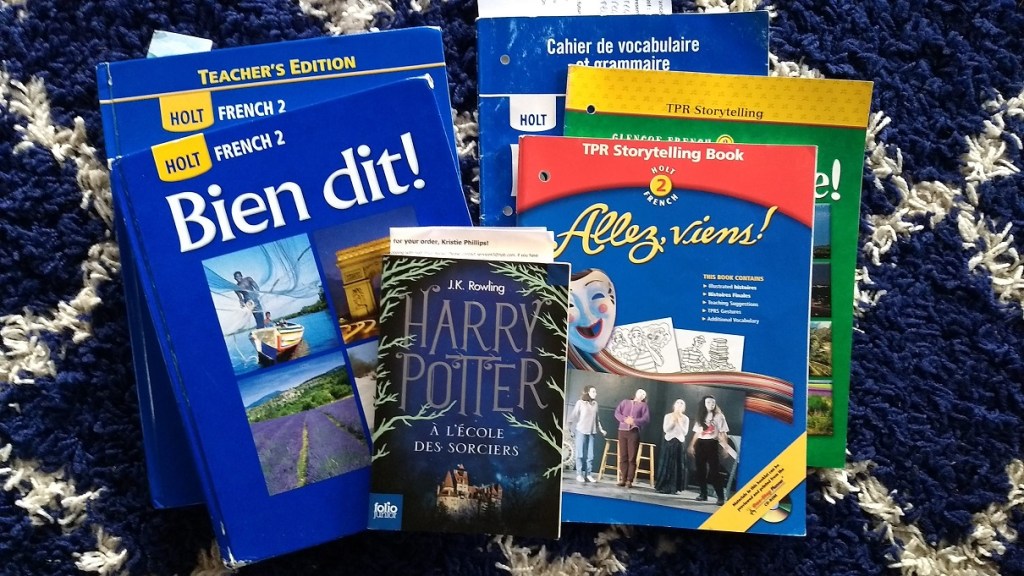
We started French in 6th grade, so now that we are in 9th grade, we are starting “officially” at the French 2 level. In 7th grade I took the time to look at textbook reviews and chose Bien Dit 1 for French 1. Now that we are officially in French 2, after looking at textbook reviews and samples again, I ended up deciding to continue with Bien Dit 2 for 9th grade. (Note: we use an older edition; you can get them used on Amazon for under $10). I choose this as our spine since it seemed to be the most “advanced” in scope and sequence when compared to other standard public school textbooks — far more tenses are covered in BD2 than in other texts.
When we used BD1 in 7th grade, we struggled using it as our only resource. We’d walk through the lessons, and I would assign the exercises as homework — this is what we did in my high school class, so why not, right? We didn’t seem to have as much interaction with BD1, so I knew that using BD2 we’d have to do something different.
I did some research prior to 9th grade on methods for teaching foreign language, and I came upon a few variants of the same idea: use real resources (books, videos, skits) in the classroom that are at level for the student. TPRS (teaching proficiency through reading and storyingtelling) and CI (comprehensible-input) were the buzzwords when it came to foreign language instruction. Since kindergarten I have had foreign language story books in our classroom, reading those to Sunshinegirl for fun. TPRS with the aid of CI takes this further; making this a central part of the learning experience is key.
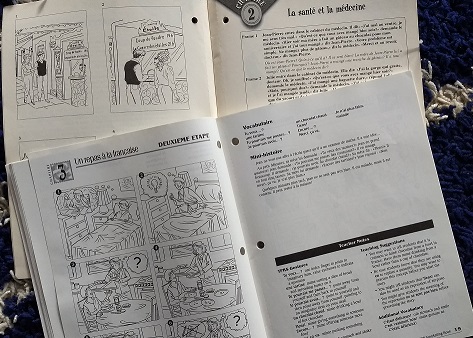
I won’t go into the details, but what I found out is that there are special TPRS readers (think of leveled reader books you buy for kids learning to read) that are written for the specific year of learning (first year, second year, etc.), and each usually has a glossary of words, and some have comprehension questions. There are also TPRS guides that correspond to many of the standard public school textbooks (not for Bien Dit, unfortunately). Each of those focuses on short storytelling sessions with comic-book-like pictures as a prompt for the students; teacher can read the story while the students look at the images, and if you have an active class, they can act out the story as it is read a second or third time.
The other piece of this different view on foreign language is how to assess (read: “grade”) students. In my French class in high school, we were given grades on homework, journals, tests/quizzes, and sometime projects/skits/etc. Experts are finding that assessment for foreign language should not be on those categories, but should be in the different aspects of learning a language: reading comprehension, speaking, listening comprehension, and writing. Using standards based grading changed my way of looking at learning French, and to be honest, I wish we had had that in high school. (Don’t get me wrong — my high school experience was fantastic – Madame Butler really taught as a lot, much of which is still with me 30 years later. But I realized that in high school I was good at reading and writing, but not so good at listening and speaking. If we had equal chances to be assessed on all four things, I might be more fluent.)
So what are we going to do?
Note: This was written after the plan was developed and a few months into school, so it isn’t so much “what are we going to do” as “what are we doing so far”. Not a plan, but the current plan…
Ok, enough talking about the background. I will include more links at the bottom to some of the resources I found, but I wanted to get into what we are actually doing for French 2.
First, as I mentioned in the previous section, I wanted to change how I handled grades/assessments. No longer would a grade be given on the end-of-chapter test that is standard with the textbook. I wanted to really assess on the different aspects of language learning.
We are using the Bien Dit 2 book as our spine, and we spend three weeks on each chapter (which works out to about a full school year). The third week of each chapter is assessment week. My gradebook has five lines for grades for each chapter, and this is how each is assessed:
- Speaking/Storytelling: We use TPRS storytelling supplements for other textbooks and walk through one “story” a week. At the end of week 3, Sunshinegirl gets to pick one of the stories, and she has to “tell” me the story by just using the “comic” illustrations as a guide. She doesn’t have to stick to the story as was written in the book, but it just has to go along with the pictures somehow. It isn’t something memorized; it promotes natural language using images as prompts.
- Writing: I found on one of the TPRS/CI websites the idea of the 1-3-10 free write. In this for us, I give Sunshinegirl a prompt (generally the topic of the current chapter in the textbook), and then for 1 minute she has to write about it. The timer stops, pencil is down, and she counts the number of words written. We then reset the timer for 3 minutes, and when the clock starts, she rewrites the words from the 1 minute drill and continues on with her writing. The timer stops again, she counts the words, and then the timer is reset for 10 minutes. Again, the 10 minutes starts with rewriting the words from the previous session, but then continues for the full 10 minutes. I think having the break in between the sessions (about a minute or so) gives time to process and think about what she is going to say. The grammar and spelling aren’t perfect, and that is fine. But words are coming out at a normal “pace”. I generally grade this on the usage of the vocabulary and verbs from the current chapter; I don’t penalize for attempting constructs that we haven’t learned yet.
- Reading comprehension: The Bien Dit 2 book has a section towards the end of each chapter that has some excerpt of French literature followed by reading comprehension questions. I have Sunshinegirl do that section on her own.
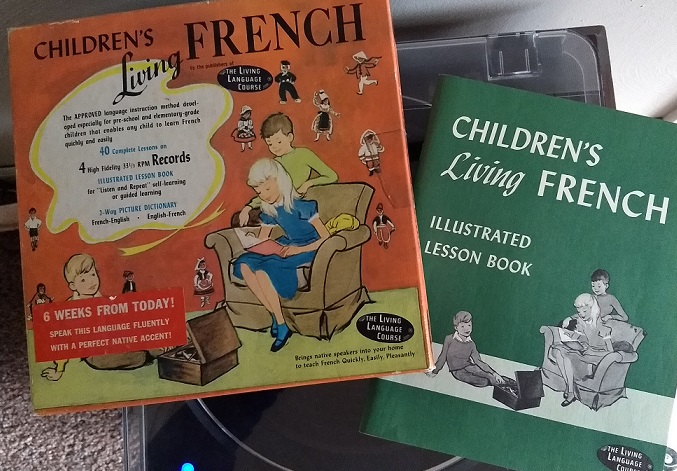
- Listening comprehension: I found years back a set of LP records for learning French, each track being a separate “story” of about 2-3 minutes in length. There is an accompanying book that has the script in both French and English, followed by some questions about what was spoken. I generally choose one of the tracks that is in line with what we know and play that for her listening comprehension assessment. She loves them because they are retro 1950s conversations, and they are clear and easy to follow.
- Vocab/grammar/verbs: I can’t ignore the vocabulary and grammar we learned from the book over the past three weeks, so I do give a “standard” chapter test. It has a list of vocabulary to translate, sentences to translate both to and from French, and verb conjugations.
This has worked well in terms of assessments. I don’t keep grades on daily work, which usually consists of pages from the Bien Dit 2 workbook and sometimes verb “quizzes”.

What do we do on a typical day of French class? Glad you asked!
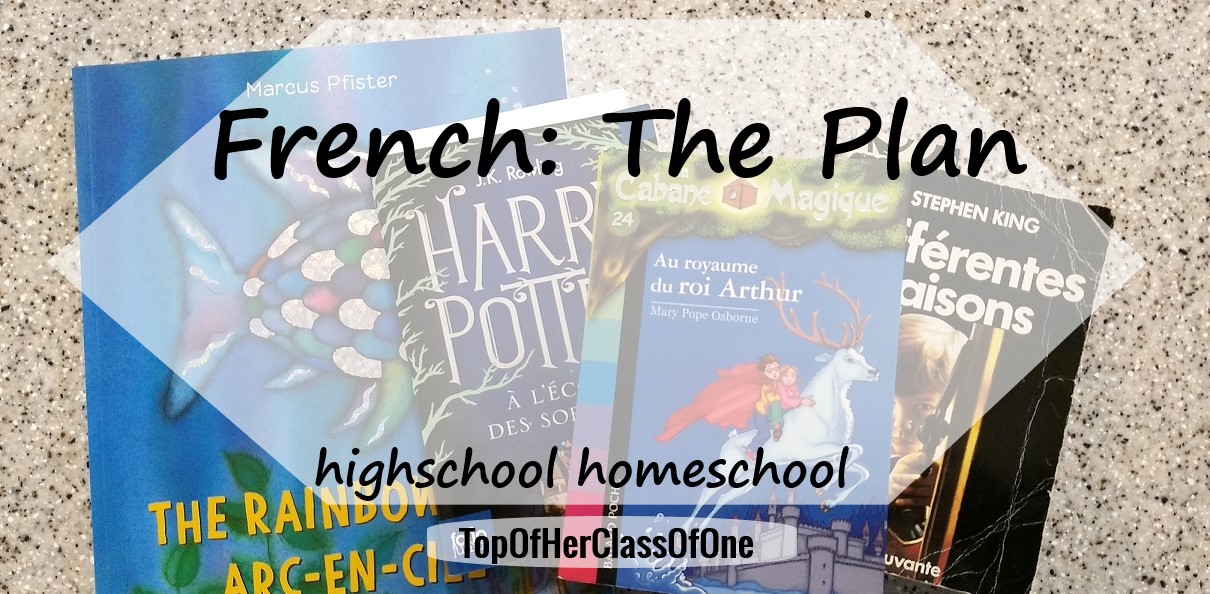
Because I know being immersed in the language is important, we are now starting our French time with 10-15 minutes of free read. I encourage her to read something that is a bit challenging for her current French level, but something she knows in English. I ordered the first Harry Potter book, and she is working through that. (While I work through Stephen King’s “The Body”, since I am a fan of the movie “Stand by Me”.) We both sit and read next to each other, but silently. It sets the stage for French class.
Next we usually go on to do one of the following:
- Do our TPRS lesson of the week (2-3 days we practice this).
- Watch an “Easy French” episode on YouTube. Very easy to understand, and it explains new language ideas clearly and totally in French.
- Just talk. Sometimes just having a conversation is fun!
Finally, we open up the textbook, read the current lesson (usually we do 2 pages a day, which is how the book is broken up), and then we do all of the book exercises together out loud. (We don’t always do the “discuss with your group” exercises.) Her homework is to do the corresponding lesson in her Bien Dit 2 workbook.
Final thoughts
I am hoping my level of French can keep up with Sunshinegirl’s. I want to be able to be “immersive” in our classes, but I have to honestly say I am not totally there yet. Though I took four years in high school and a year in college, I never got to the fluent level, but I do remember a lot (and I have retained the decent accent that Madame taught us). I think the best way to learn is to immerse yourself, and hopefully I am doing enough to help her learn. Our goal for some years now has been to go to Quebec for a week and somewhat immerse ourselves – hopefully once the pandemic goes away we can make that a reality.
Links
Disclaimer: I have no affiliation with any of the links below — I am not making any money off of the links. Feel free to purchase resources from wherever you are comfortable.
There are many links in the post itself, but I wanted to consolidate them in one handy list:
Bien Dit 2 on Amazon
Bien Dit 2 workbook on Amazon
Bien Dit Scope and Sequence
Easy French on Youtube
Alice, La Liste (our first TPRS reader)
TPRS reader shop
1-3-10 free write (download the worksheet for the writing)
French Standards Based Grading info
More Standards Based Grading info
Ohio’s rubrics for grading (I do not live in Ohio, but this is a good list)
Other French language posts on my Pinterest board
 Top of Her Class of One