It seems like most school districts follow the same plan for high school science: Biology, then Chemistry, and then Physics. The sciences move from the least to most math-intensive as students progress through the parallel path of Algebra-Geometry-Algebra-Pre-Calc-Calculus. I had Biology in ninth grade, so that is what we’ll do, too!
Sunshinegirl has ALWAYS been fascinated by animals, so she has the zoology portion of biology down. I can ask her anything about any animal on earth, and either she knows for sure or has a good idea. As we’ve touched on other realms of “Biology” over time — evolution (yes, we believe in it), cellular processes, and DNA — she has been intrigued. (She watches PBS Nature episodes on demand FOR FUN!) Knowing her nature, I suspect (and am hoping) that this year of Science is a success.
A textbook!?
I know of all science years I wanted this on to be not only “solid” but full of true laboratory experiences (minus the dissection — she is VERY against that). I looked into a few options, but I kept coming back to the “textbook” model. If you’ve read any of my other posts, you know that we have been textbook-adverse for years, leaning heavily instead on “living books”. Can’t you do both?
I narrowed it down to using the online Biology textbook from CK-12 or Miller-Levine Biology. Both seemed to be highly recommended and a complete Biology course. Both were supported with a schedule for the labs that I was planning on using (see below for details on that). Two things eventually made us sway towards using CK-12: 1) the multi-media aspects of CK-12 (in-text links to supporting videos and activities) and 2) that it was the recommended book to use with the Build Your Library plan I had already purchased. I did go ahead and buy a used copy of Miller-Levine Biology (for under $10 on Amazon for a slightly older edition) to have as a resource (or to use when the Internet is down!).
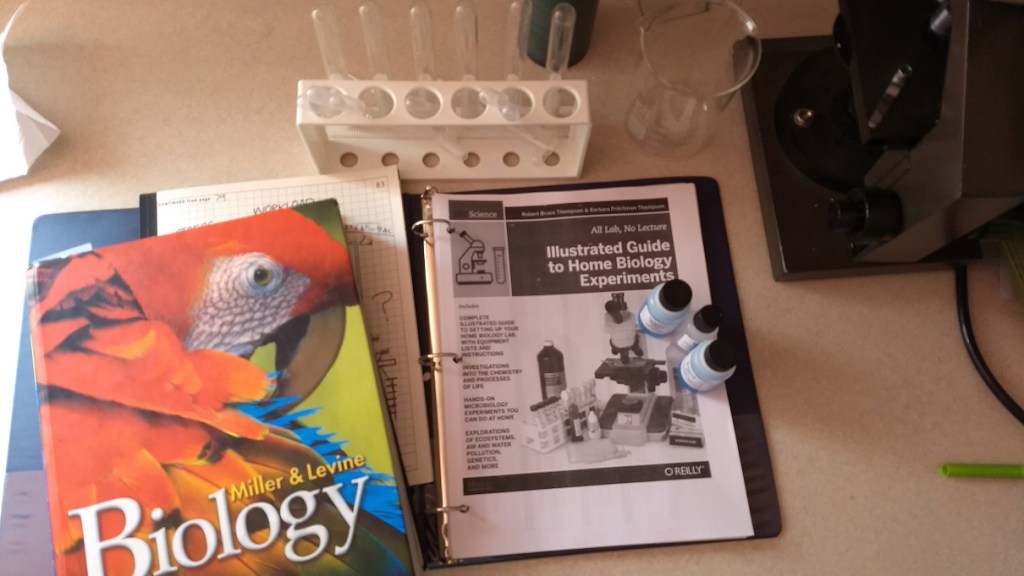
Update after week 1: After a week of using CK-12, we realized that Sunshinegirl reading from a screen wasn’t working out. We switched to Miller-Levine Biology, and we are working through it together (it has more detail/information, so we decided to work through the text together).
Labs
Up to this point our “labs” have been somewhat underwhelming and relying on items that are readily available at the grocery store. I didn’t want that for this “big” science year; I wanted this to be more in line with good public school Biology. I wanted real experiments with real chemicals and supplies. Luckily there are many resources for that!
I found the Illustrated Guide to Home Biology online for free — you can download the PDF (or order it from Amazon for a cost). What is brillant is that you can order pre-made “kits” that support the experiments and labs found in the manual — saves me having to hunt down chemicals and supplies. The Home Scientist offers various varieties of the kits from basic to super-extra. I luckily have a lot of the labware (test tubes, slides, etc.) already (one of my most amazing garage sale finds EVER), so I ended up purchasing the “refill” kit. I am hoping that kit gets us by most of the experiments.
Another EXTREMELY helpful touch from the Home Scientist is correlation guides for the major homeschool biology curriculum. Each guide specifies which experiment(s) to do with each correlating chapter in the text. (Note: While the Home Scientist also recommends CK-12 or Miller-Levine, it also has guides for BJU and Apologia.
Living Books
I gave in and decided to use a textbook this year, but we intend to use it more as our “spine”. It will be our jumping-off point for the different topics to ensure that we cover all of the Michigan “standards” for Biology. But along with the labs/experiments, the “Living Books” will be where the real learning happens.
There are so many great books out there that cover biological topics written by experts in their fields that are truly accessible reading for a high schooler. Books that have real stories and experiences of the author that make science more than just facts on paper.
Some of the books are from the Build Your Library Level 10 booklist (with the associated reading schedule in the guide we purchased), and others are pulled from other Charlotte Mason or Classical booklist. What do we hope to read this year?
Lives of a Cell: Notes of a Biology Watcher by Lewis Thomas
I Contain Multitudes by Ed Yong
The Violinist’s Thumb by Sam Kean
The Sixth Extinction: An Unnatural History by Elizabeth Kolbert
The Microbe Hunters by Paul De Kruif
The Genius of Birds by Jennifer Ackerman
And more (some from BYL and others related to the above)
THIS will be the most exciting portion of Biology class this year!
Expectations
I have high expectations for Biology, so I’m hoping that I don’t get those hopes up. I think Sunshinegirl could really get into Biology (minus the dissection, of course — the animal lover she is!), so I want to make this a true learning experience.
 Top of Her Class of One
2 years ago my daughter wasn’t ready for high school biology, but we’d already done general science. I found Sonlight’s History/Science/Bible level J: The History of Science. It was great! She read literature books all about the how and why of various scientific discoveries instead of just learning a bunch of facts. She did much better when we finally did biology last year because of it. This year she’s doing Holt’s physical science.
LikeLiked by 1 person
We looked at Sonlight very early on, and I often used the book lists to supplement our own studies. The idea of reading great literature books about subjects is just so much nicer than textbooks. Glad that worked for you! (I love teaching the history of science…science makes so much more sense in “context”!).
LikeLike