I love science (now). In high school and college, not so much. I did just fine in my high school and college science classes, but I was that kid that could learn anything and took tests well. I just wasn’t “into science”.
My public-schooled son, Rockman, is a science-nerd; he’s majoring and minoring in various science and math fields right now. He was the one that helped bring science to our household, and it spilled over into my daughter’s homeschool education. Science, like math, isn’t a subject to be memorized and regurgitated, but a subject to explore and play with. Science has a history, which is fascinating in itself.
Does Sunshinegirl like science? She will profess that it “isn’t her thing”, but what she means by that is “I love to explore and experiment with science, but I hate memorizing terms”. I need to keep that love for exploration alive in high school, but first I want to tell you where we have been.
As mentioned in other posts, we followed AmblesideOnline for K-8th grade, and science is somewhat built into those years’ curricula. Many living books are on the schedule to address the various science disciplines. For example:
The Handbook of Nature Study by Anna Botsford Comstock
The Mystery of the Periodic Table by Benjamin Wiker and Jeanne Bendick The Sea Around Us by Rachel Carson
It Couldn’t Just Happen by Lawrence Richards
The Elements: A Visual Exploration of Every Known Atom in the Universe by Theodore Gray – selected elements
Albert Einstein and the Theory of Relativity by Robert Cwiklik
Ordinary Genius by Stephanie McPherson
Archimedes and the Door of Science by Jeanne Bendick
Galileo and the Magic Numbers by Sidney Rosen
Eric Sloane’s Weather Book by Eric Sloane
The Life of the Spider by Jean Henri Fabre
The Wonder Book of Chemistry by Jean Henri Fabre
First Studies of Plant Life by George Francis Atkinson
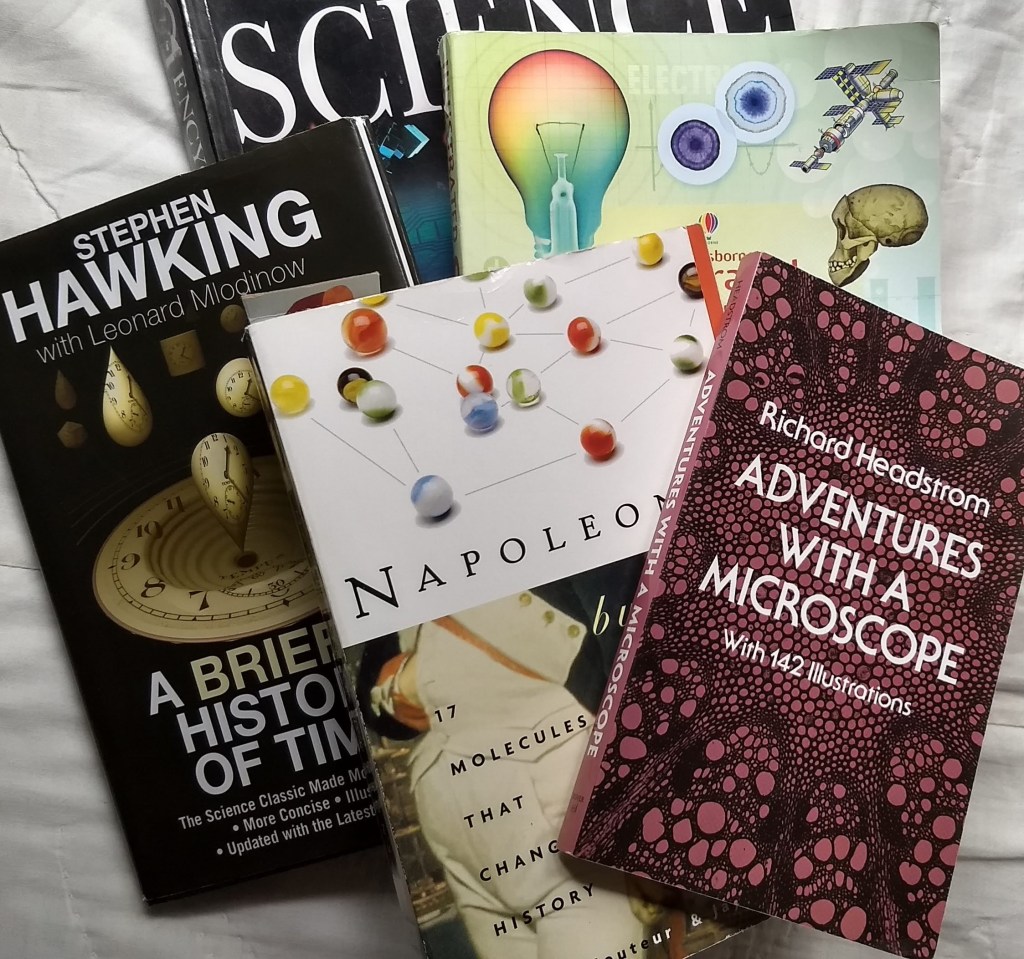
Adventures with a Microscope by Richard Headstrom
Signs and Seasons: Understanding the Elements of Classical Astronomy by Jay Ryan
Great Astronomers by R.S. Ball
Napoleon’s Buttons: 17 Molecules That Changed History by Penny Le Couteur and Jay Burreson
The Chemical History of a Candle by Michael Faraday
Johannes Kepler: Giant of Faith and Science by John Hudson Tiner
Phineas Gage: A Gruesome but True Story About Brain Science by John Fleischman
A Briefer History of Time by Stephen Hawking
William Harvey and the Discovery of the Circulation of the Blood by Thomas Henry Huxley
The above is the list of books for Years 6-8 as defined in the AO curriculum, and the boldfaced ones are the books we used at least partially. These are great examples of living books on science topics (Napoleon’s Buttons, Phineas Gage, The Elements and Life of a Spider being our favorites!).
Since we have a very “sciency” household, I wanted something more structured for science in addition to these resources, so we used various “curricula” over the years in addition to the AO suggestions.
Note: we did drop some of the AO options — some because we were covering the topics with other resources, and others because they were more Christian in worldview.
Sixth grade – Bite-sized Physics
In sixth grade we started out with Life of Fred pre-algebra with Physics, but we quickly found that as much as I wanted to like LOF, it wasn’t for us. I did some research, and I ended up finding Bite-Size Physics by Science Jim. They were a series of short books on various Physics topics, and at the time they seemed to be about what we needed. While I the link above is to a site that sells the books, previously I had bought them (I thought) from Science Jim’s site, but he no longer makes any reference to them.
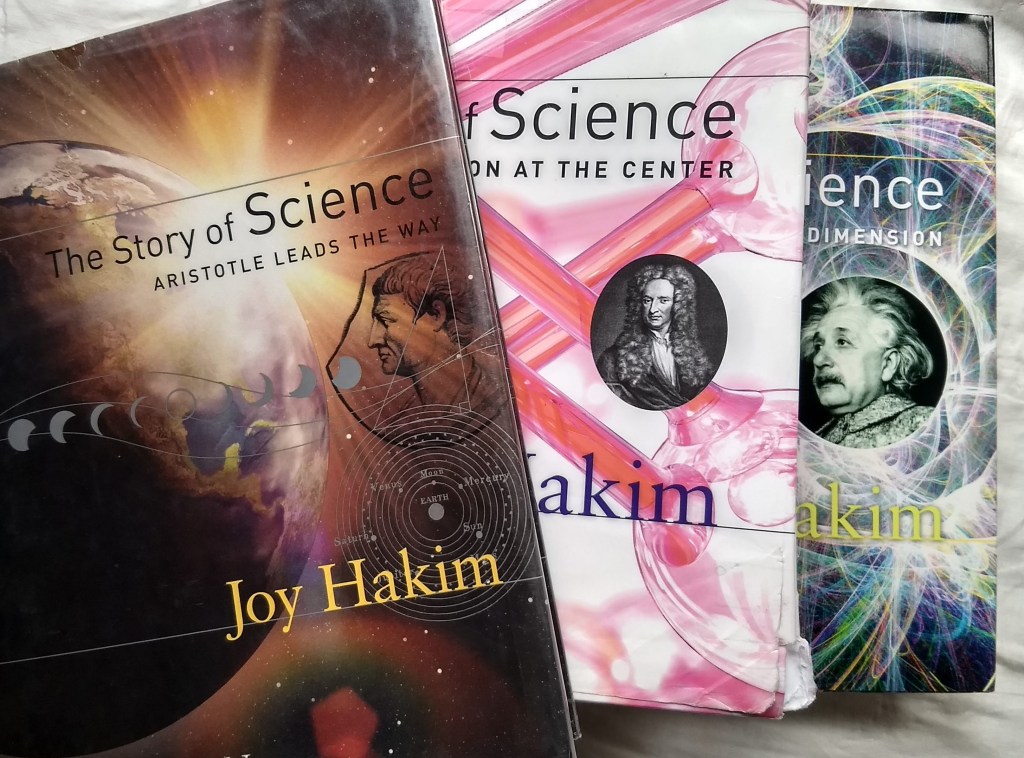
In addition to the AO readings and Bite-sized Physics, I had Joy Hakim’s three book series on the Story of Science, so we started this year with The Story of Science: Aristotle Leads the Way. This book series was designed in a “textbook” format but covers the history of science over thousands of years. Knowing the history behind the science and the scientists themselves brings to life the concepts of science. We greatly enjoyed reading through these books. (Note: We did purchase the “guide” that went with this book but ended up not using it. Sunshinegirl would write a written narration of the chapter after we read it, but more often we spent time discussing what we read — which is far more important than “worksheets”.)
Seventh grade – AO + BHP + 25 Rocks + CK-12
Seventh grade was a little more eclectic, with the main resource being the Big History Project. This was more of the history of the world from a scientific standpoint. I had found this resource the previous summer and loved it — the best part is that it was FREE. It is all online, is multimedia, and it encourages students to take in the information, process it, and question. BHP can be used in middle or high school as a full curriculum (there are forums dedicated to using it in the classroom) or accessed by adults interested in the topics. You can follow it from start to finish or you can pick and choose the sections you want to cover; there is a Science scope and sequence that we followed since our focus was more on the science. Sunshinegirl loved doing this, and I regret that we didn’t finish it all (though it is the pre-historic history that really interests her, and we did get through all of that).
In addition, we wanted this year to be about Earth history AND Earth science somewhat, so we supplemented with the book 25 Rocks by David Prothero. Rocks are a big deal in our household (Rockman is majoring in geophysics), so this was the perfect book. Written at the adult level, some went over Sunshinegirl’s head, but she was engaged and a few years later still recalls bits of it when we see something related on PBS or elsewhere.
To round out the “Earth Science” year, we spent the last six weeks working through the CK-12 Earth Science for Middle School text online (again FREE). This was to cover the basic topics and vocabulary.
I should also note that we continued with the Joy Hakim Story of Science series this year on the side. This year, we did not read this book together — this book was something Sunshinegirl read on her own and wrote a narration on, but it was important to me to keep working through the series. She read The Story of Science: Newton at the Center — each chapter is a quick read and includes numerous photos, diagrams, and sidebar histories. Highly recommended for fifth thru seventh-ish grade classes.
Eighth grade – Chemistry
After spending two years piecing together science, I wanted to go back to using a full “curriculum” that included lab work. In the elementary years we used resources from Elemental Science (as well as the Charlotte Mason-friendly Sassafras series), so I thought we’d go back to this. We chose to use Chemistry for the Logic stage, a Classical science curriculum for the middle school years. We purchased the Student workbook and the teacher guide, as well as two of the recommended reference books.
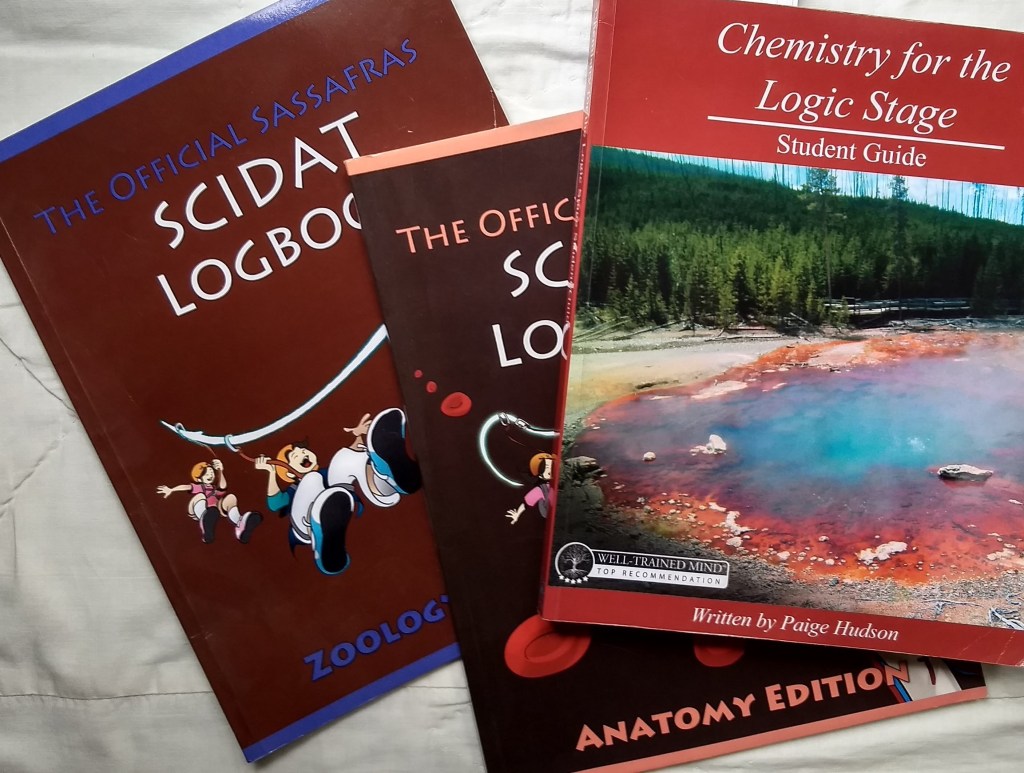
The experiments and activities each week were easy to follow, using mostly household or easy to purchase supplies, and guided the student through writing the lab report. Each week there was a recommended reading or two from the reference books (which required written narration), periodic table memorization, a diagram to work through, and the experiment. It was easy to use and did not require much “mom-time”, and I think all in all Sunshinegirl was fine with it.
The structure of the course and the labs were good, but we sometimes struggled with the readings. One of the resource books is reviewed online as “useful for AP Chemistry” preparation, so some of the concepts were a bit over her head, so we just acknowledged that and moved on.
To round out the year to ensure basic concepts were understood at an eight grade level, we switched to CK-12 Physical Science for middle school (the Chemistry chapters). She read through the chapters and wrote narrations in her science notebook, and she seemed to find this easy to understand. This was a preview for high school since we were looking to use CK-12 for Biology, and I am glad we tried it. It seemed thorough, and it was easy for me to create a “class” and daily “assignments”. She would just need to log in, go to her assignments for that day, and do the readings. (We also used CK-12 for Algebra 1 for the last two months of the year.)
Eclectic
So as you can tell, we didn’t stay consistent with Science, but used what made sense at the time and what was best for the time. We adapted to her learning, and I think it went well. Do I like switching mid-year? Not really. But if it makes sense and increases understanding, I will do anything.
And that is what homeschool should be able — meandering and finding what “works” for each student. In all, she had a well rounded science experience — the highlights being the Big History Project, Napoleon’s Buttons, Chemical History of a Candle, and 25 Rocks.
 Top of Her Class of One