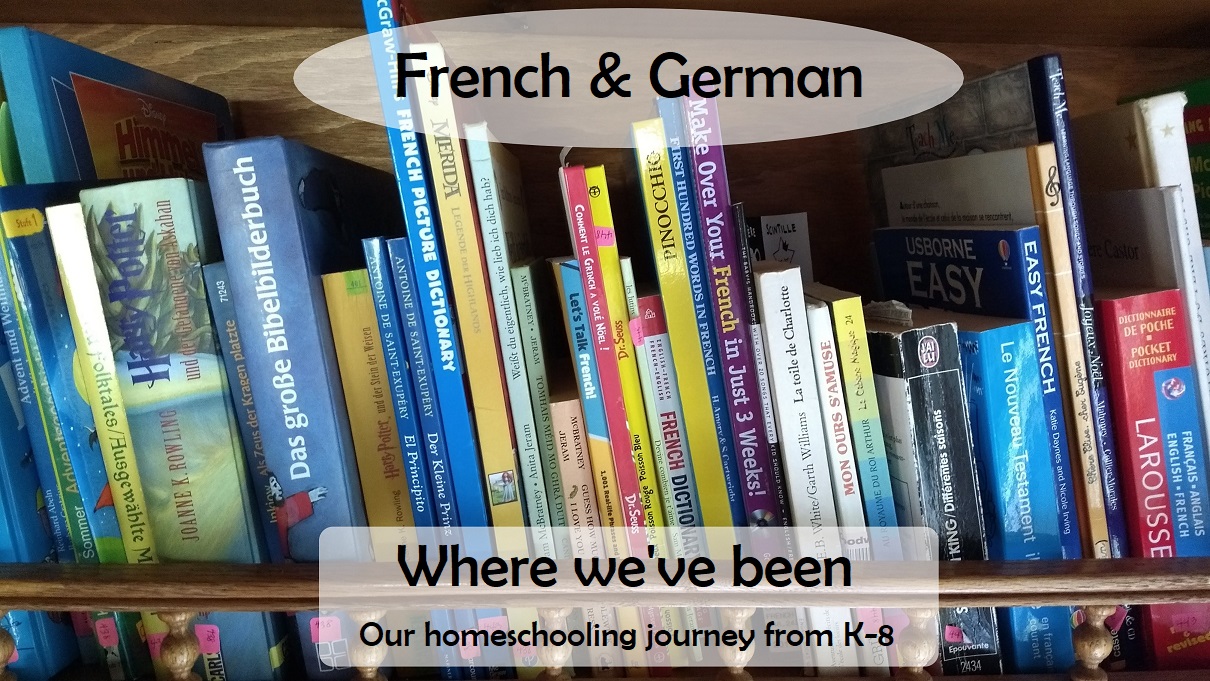
Foreign Language – Parlez-Sie Franzosisch?
Yes, I wrote that on purpose. I read early on that language learning happens best at a young age when native language acquisition is still taking place. So why not start a language in Kindergarten? Sounds great!
I studied French for four years in high school and two more semesters in college before giving up — my language “acquisition” did not begin until my high school years, and I felt I just wasn’t getting it. My original intent was to double major in math AND French, with the idea that I would teach high school, so dropping French wasn’t taken lightly. Thanks to a wonderful teacher in high school (thank you, Madame Butler!), I did have a better than average grasp on the language even after all of these years, so I figured French would be our first choice.
Well….Sunshinegirl had a friend whose mother (a good friend of mine) is German and spoke only German to him (while his father spoke only English). Sunshinegirl wanted to be like him, so she asked if we could learn German! She very thoughtfully asked — it wasn’t just a kindergartener’s whim. Knowing that my family has a lot of German in it (which was part of her reason, as well), I agreed, though I knew ZERO German. We could learn together — I already knew one language, how hard could it be?
Charlotte Mason advocates multiple modern languages (plus Latin) to be learned at a young age, so I thought — why not try both! I gathered some basic materials for both German and French, and we started out the year. Quickly we realized that was too much, and after much discussion (which did include Sunshinegirl — I try to include her in education decisions, even at a young age), we decided to go with German. We spent the elementary years trying to learn German — it is MUCH harder to learn than French, for what it’s worth!
In fifth grade I cried “uncle”. Even though I spent MUCH more time trying to learn the language (much of it using audio lessons — Audio Tutor, which was renamed Audiotrainer/Deutschtrainer, now 50 languages — was a HUGE help, Sunshinegirl was grasping the language faster than I could keep up. We used Rosetta Stone for a year, and we read a lot of stories and watched a lot of movies in German.
I convinced her to switch to French in sixth grade, explaining that I couldn’t adequately teach her German anymore, but I could teach French. I told her that if she tried French for middle school, she could decide what she wanted for high school (since I could find high school level German programs if needed).
What did we use?
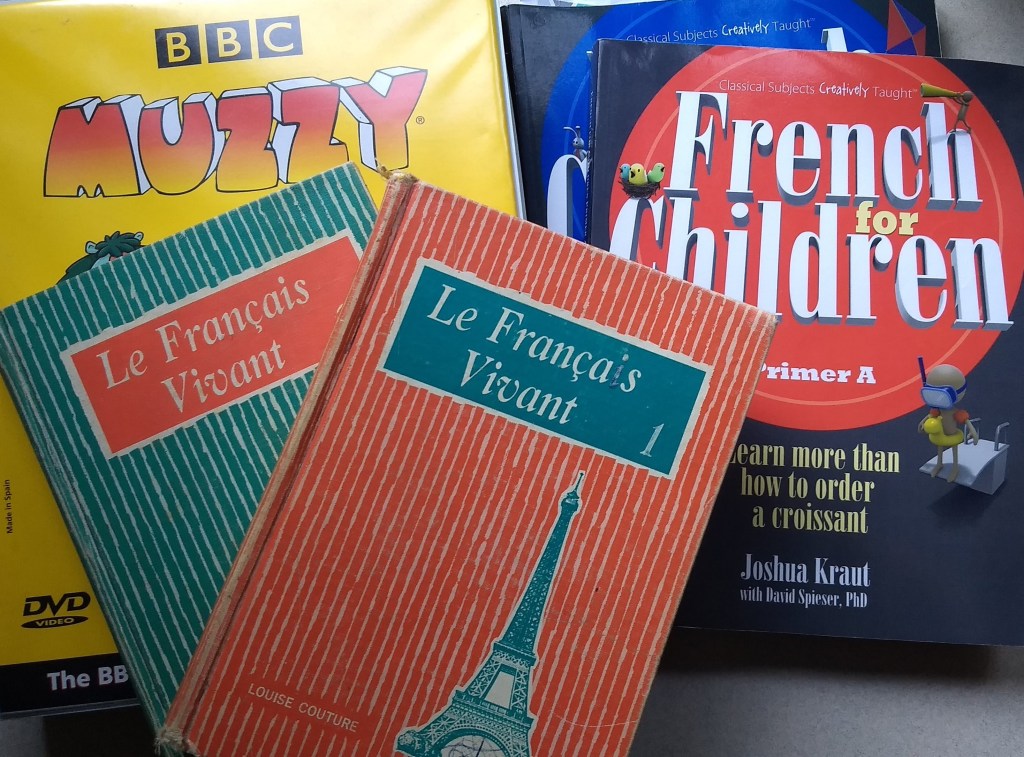
In sixth grade we used Classical Academic Press’s French for Children series (Primer A and B) (having used the Latin for Children for two years and was happy with it). It was a gentle introduction created for grades 4-7. She learned basic French from it, but after Primer A and B (which is a full year course together), there was not a “next-step”.
In seventh grade we jumped in with a French 1 textbook (ask any Charlotte Mason advocate — textbooks are evil! They are far from “living books”.) I know, crazy, but I wanted some structure to our days. We’d still watch movies and listen to audio lessons (we used 50 Languages French as well, though she finds them boring), but a textbook would provide the grammar structure. After looking through multiple textbook “scope and sequence” and the few comparisons and reviews that I could find online, I chose the Bien Dit series. French teachers seemed to comment that it had more content “sooner” than the other alternatives (Bon Voyage and Allez viens). The great thing is that you can get used, older editions for less than $10 on Amazon, so this was an inexpensive way to try it out. It did provide structure, but I felt we weren’t speaking “enough”. Part of that is on me — I needed to go deeper than the textbook — but hindsight is 20-20.
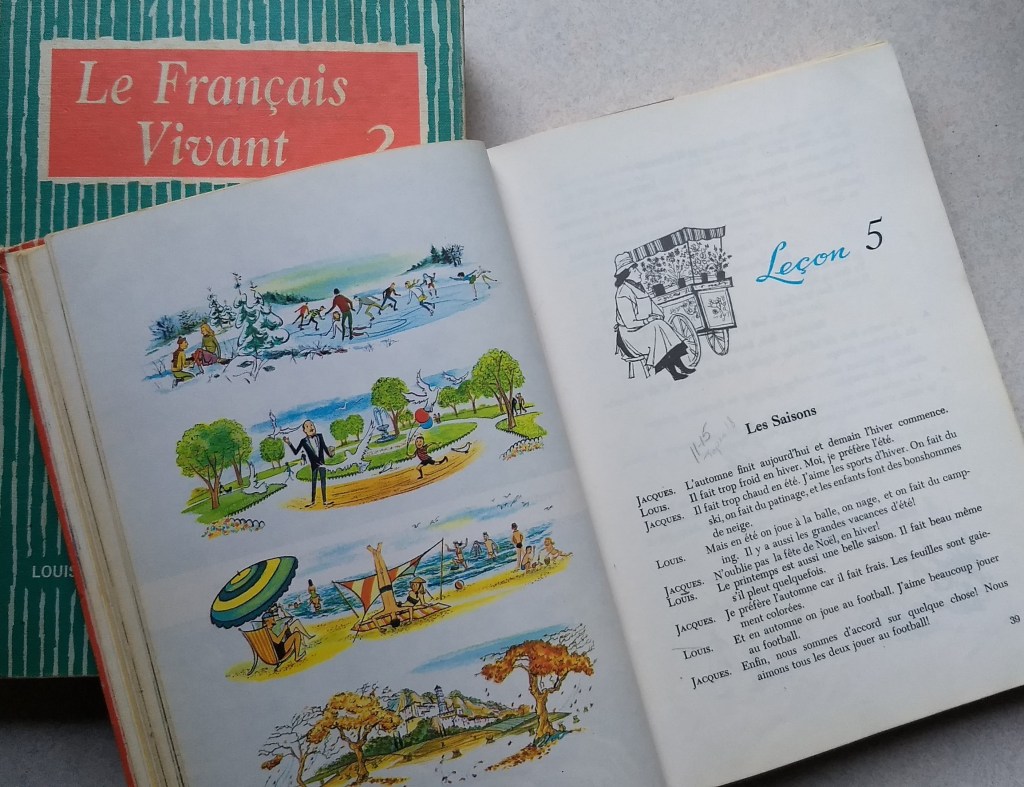
In eighth grade I knew we needed to spend more time on natural “speaking”, and I didn’t want to jump into a French 2 textbook (I wanted to call eighth grade year “French 1”), so I spent time trying to find the perfect curriculum that would guide us. I stumbled on two books at a thrift store — Le Français Vivant 1 and Le Français Vivant 2 by Louise Couture, both textbooks from 1965 (complete with wonderful 1960’s style illustrations and charm), so we decided to try book one for French 1. The focus on the text was to read, hear, and repeat out loud lessons in order to practice speaking. It wasn’t flashy, but it had simple stories with lots of repetitive lessons that really gave real-life practice. Sunshinegirl didn’t like the fact that it was so repetitive, but the goal was to speak common sentences and constructs over and over to make them come naturally in natural language, and I think this is what we needed. I realized towards the end of the year when it dove into the Conditional and Subjunctive tenses, though, that this was probably a college-level text. She took it in stride and practiced those tenses, even knowing that a normal French 1 course barely gets through le présent, le passé composé and possibly le futur tenses.
You can’t learn a language through a book, and you can’t even learn one from listening to audio. The only way to truly learn is to experience the language the way natives do. I find that I, personally, seem to “learn” the most when I read a French novel (nothing too difficult — I’m barely Intermediate Mid in level) or speak the language. We often would go shopping or for coffee on Friday afternoons and declare it German or French speaking time. She loved the fact that we could speak to each other in a public place and confuse others. Hey, whatever motivates you, I suppose.
 Top of Her Class of One