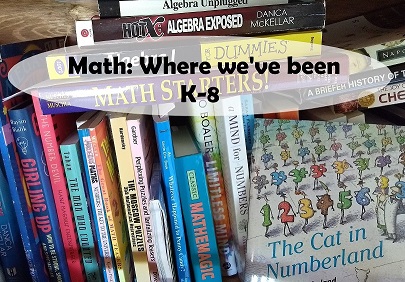
So I am one of those weird people that actually loved math in school. I graduated with a BS in Math from the University of Michigan, which sounds like torture itself. Why did I choose math? Because it “makes sense” and is just a series of puzzles that are longing to be solved. I’m not talking arithmetic or plugging in numbers to the quadratic equation, but proofs and long problems that require creative thought. THAT is mathematics.
Full disclosure: I couldn’t do “calculus” today to save my life, even with a degree in Math. I ended up in Information Technology, but what my degree did for me is teach me how to think logically. Math isn’t always about what you remember, but the process to get to the end result.
So when I decided to homeschool I realized that “math should be the easiest subject for me to teach”. HA! Was I wrong for so many reasons:
Reason 1: Math is exploration
I was taught traditional math through high school, and since I’m a “good test taker”, I would be taught a concept, would quickly understand the steps I needed to use, and could easily reproduce those steps in homework and on tests. But math is SO much more! In teaching (i.e., “re-learning”) elementary and middle school math, I realized there are so many ways to look at the same problem. There are different ways to solve, model, and play with simple problems, and I am pretty sure I never was encouraged to look at those alternate “visions”.
“Here is the step by step process, now do it that way every time”.
Most math teachers in the world
Reason 2: Textbooks are dry and don’t tell the entire story
For my daughter, who is very hands on and visual, learning a cookbook method for solving problems doesn’t work. The method that works for her is more often not the method that works for me. (I’m very left brained, and she is very right brained.) Early on we found out about the concept of “living math”, which encourages exploration with manipulatives and reading “real” math stories and texts. (A great resource for this has been the Living Math website and forums.).
While working through problem sets has always been a struggle (boring!), reading a good math reader book or story has been a very memorable part of our math lessons. In elementary school we read through many of the Sir Cumference picture books, but one of our favorites was The Cat in Numberland That book is more of a short chapter book that delves into the concept of infinity, which normally isn’t a topic explored until high school. Even in early elementary school, though, it intrigued Sunshinegirl, and we read it often. A perfect example how mathematics isn’t just formulas but can be creative thought experiments.
Reason 3: My daughter isn’t me
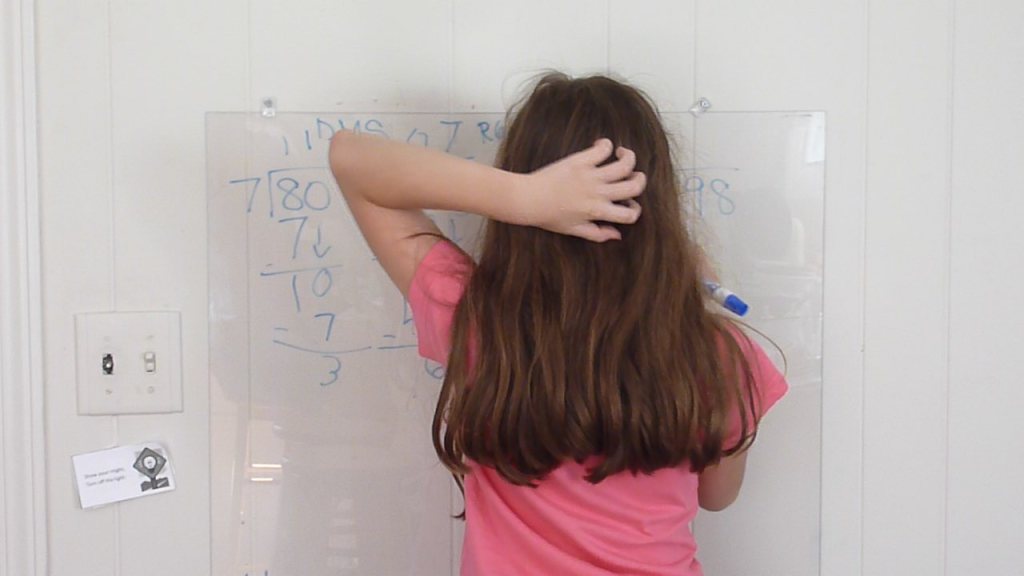
This is the biggest reason, and it has been the underlying source of tears and struggles throughout her math career. She KNOWS I have a degree in math, so early on she wasn’t sure if she could “live up” to my level of math knowledge. This stressed her out, long before I realized it. Yes, I’m a bad homeschool mom for not realizing this early on.
As I mentioned before, I am a very logical thinker, and I can see how things “work” fairly quickly in mathematics, so I’ve never struggled in math (well, other than Math 512 Abstract Algebra!). My daughter is a creative, free soul, which I absolutely love about her, but this makes logical, organized thinking much harder. If I knew then what I know now, we would have done elementary math SO much different: MUCH more hands on, more exploration.
Curriculum and resources used
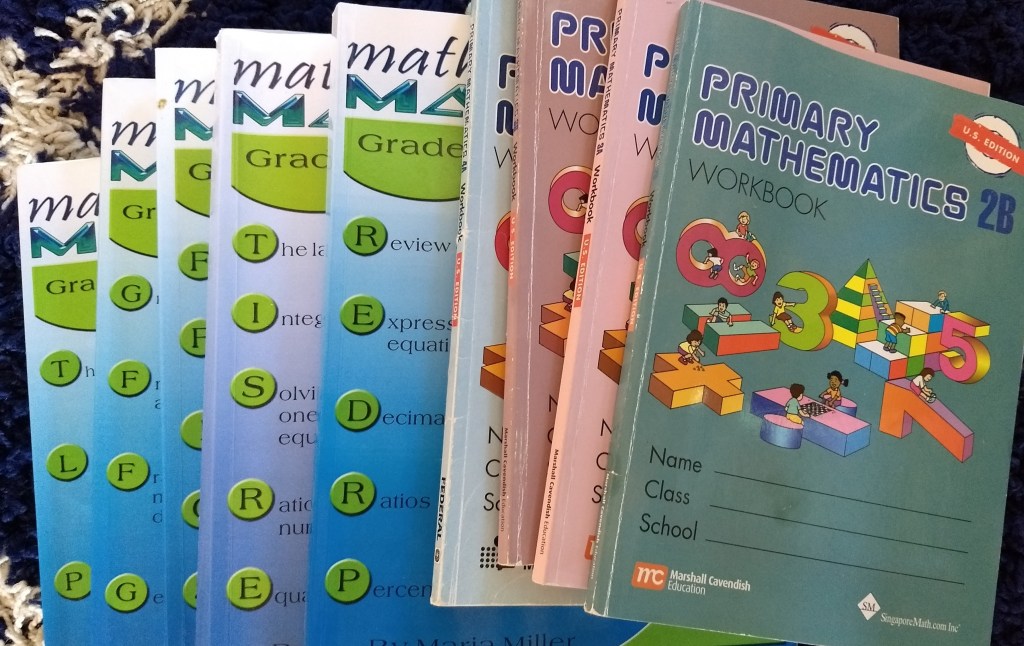
It probably helps to explain what we used over the years — and I suppose this doesn’t help anyone approaching the high school years, but it might show the progression we’ve taken and why we are going forward the way we are.
In elementary school we tried many different options, always including the living math books in the mix. We started with a “free” program called MEP (from the Centre for Innovation in Mathematics Teaching), and it worked for a year or two, but quickly moved too abstract for Sunshinegirl. We spent a few years with Singapore Math after reading so many things about how rigorous and complete it was; honestly, I felt it was lacking practice and some concepts, but I probably was missing something.
We turned to Math Mammoth in late elementary and middle school, and we only wished we had found it sooner! Math Mammoth is very complete in its coverage, provides lots of practice problems (with a purpose) and is relatively inexpensive. Each MM workbook covers half of a year and is consumable. All of the lessons and practice problems are in the one book, and the explanations were extremely thorough. It was using these books that I realized that when I went through school I was taught “this is the one way to do it, so rinse and repeat”. With MM, she (Maria Miller, the writer) explains the same concept in different ways, each lesson attacking the same idea in a different way. The long term goal (to me) was to have the student explore the different aspects and find the way that made the most sense. There was a lot of visual learning (bar diagrams to solve algebra problems, e.g.,) which is exactly what Sunshinegirl needed.
Math Mammoth only provides resources through Year 7 (equivalent to Pre-algebra), so we had to look further for high school. See my post on high school direction for where we went from there.
Our math experience
There were a lot of tears, I hate to admit. A lot of frustration over the years with various aspects of math. As mentioned, it wasn’t until middle of Middle School that Sunshinegirl vocalized what was wrong — she feels she can’t live up to the expectations of a math major. To take the further, it was hard for me to realize that everyone learns math differently, and the way I was taught in public school is NOT the way all kids learn. It is no wonder so many kids hate math by the time they graduate high school. I just feel like the worst homeschool mom because it took me eight years to figure this out!
What helped alleviate the tears? Early on I would walk through the text with her, explaining the day’s concept, and then I would say “ok, do these problems”. I’d then walk away, only to grade it when she was done. This did NOT work. Sometimes it was a focus problem that drew out the math session beyond an hour (a no-no in the Charlotte-Mason-short-lesson world). Often, though, she would struggle with a problem and not want to call me back to the table to help – to her that was admitting failure. She still is like that today. She didn’t believe me when I said that mistakes grow your brain.
Early in middle school I realized the best method FOR US: we went through the lesson together (having her do sample problems ON THE WHITEBOARD), and then we BOTH did the problems, separate, but at the same time. She had a math notebook, and I had a math notebook. I would snap pictures of the problem set for my reference, and she and I would separately work through them. With me right next to her, I could always sense the drifting of focus or the frustration of being stuck before things escalated. If I got to a problem that I knew would be tough, I could make a comment like “if you get stuck on #4, let me know — it took me a long time to see what they were asking”. We were in this together. When we were both done (yes, I would finish before her), we would walk through our solutions together. Sometimes I was wrong (I didn’t check my answers with the key), which was a lesson to her that no one is perfect.
I had the privilege of homeschooling one child, though, and I know moms with multiple students wouldn’t have the luxury of sitting and doing math problems with all of their students. Sometimes I would do them a day or two beforehand (if I had a meeting or appointment during “math” time), and that was good enough. Sometimes I would just sit at the table with her while she did math but I did other things — being nearby still gave me the chance to sense any issues before they blew up.
Hang in there
If you are blessed with students that love math and “get it”, then none of this may seem useful to you. But having been that kid that “got it”, I realize that I didn’t have the chance to explore and see math in different lights. Encourage the student that “gets it” to explore beyond the text. (For students that need more of a challenge, Beast Academy is a great curriculum — comic books, but challenging and deeper thinking.)
If you are a parent like me with a child that thinks differently than you do and seems to struggle with math, then take heart. Just remember that it isn’t all just about what math the student retains years from now, but it is the ability to logically think through problems and analyze that is the long term skill. Use a curriculum that works for your student, even if it isn’t the most rigorous. Supplement with puzzles and living math. Foster a love of math exploration. (And do a better job than I did!)
 Top of Her Class of One